
Bolt Grade Chart
Understanding Bolt Grade: Strength, Safety, and Selection
Bolt grading is a standardized system that indicates the strength and quality of bolts. Whether you’re a DIY enthusiast or a professional engineer, understanding bolt grades is crucial for ensuring the safety and reliability of your projects. Let’s delve into what these grades mean and how to use this knowledge effectively.
What is Bolt Grading?
Bolt grading is a classification system that defines a bolt’s mechanical properties, particularly its strength and hardness. The grade is typically marked on the bolt head and corresponds to specific material compositions and heat treatments.
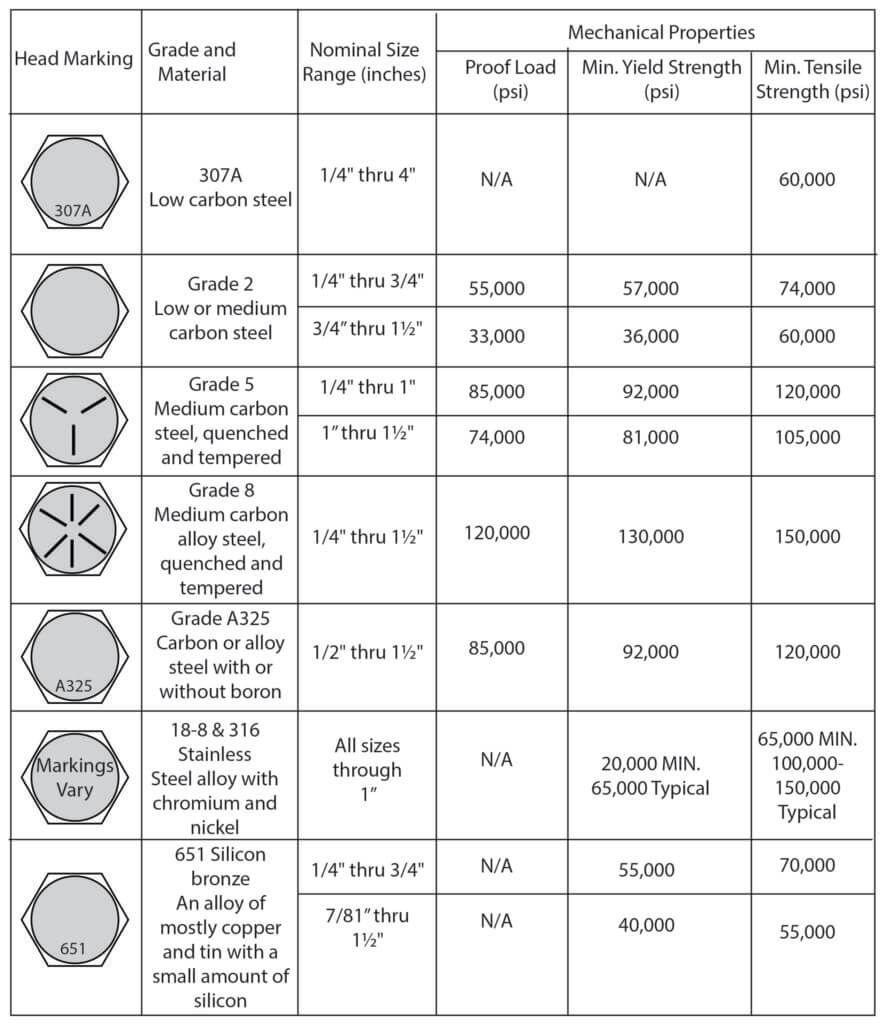
Most people think of a bolt’s strength in terms of when it breaks. But that’s the last step in the process. If you look at the bolt grades chart below, you’ll see that the first step in bolt stretch is its proof load. Then comes its yield and then its tensile strength.
Understanding bolt “strength” terms
You may think steel bolts are solid, stiff, or rigid. They’re not. It has a certain amount of elasticity. In other words, a bolt stretches when torqued. Think of a bolt as if it’s a spring or bungee cord that clamps pieces together. As it’s tightened to the proper torque, it stretches slightly and can handle a certain amount of additional stretch yet keeps the pieces clamped together.
The concept of bolt stretch is important to understand because bolts need to stretch once they’re torqued in order to accommodate normal expansion and contraction, especially in automotive use.
What is a bolt’s proof load?
Proof load is the maximum stretching force (torque) that can be applied to a bolt that will allow it to return to its original length when the force is removed.
Proof load is typically between 85-95% of the yield strength
What is Yield Strength?
Yield strength is the point at which a bolt is tightened or loaded beyond its proof load, causing it to exceed its maximum allowable stretch. Once a bolt it tightened to yield strength, it will no longer return to its original length if the torque or load is removed. At that point, the bolt is permanently damaged.
What is Tensile Strength?
Tensile strength is the maximum amount of stretch the bolt can withstand without actually breaking. In other words, the bolt has been tightened or loaded beyond the point where it will no longer return to its original and is continuing to stretch right before it actually breaks apart.
Common Grading Systems
SAE (Society of Automotive Engineers) Grades – Used in the United States
ISO Metric Grades – Used internationally
SAE grades are denoted by radial lines on the bolt head:
Grade 2: No marks (low strength)
Grade 5: Three radial lines (medium strength)
Grade 8: Six radial lines (high strength)
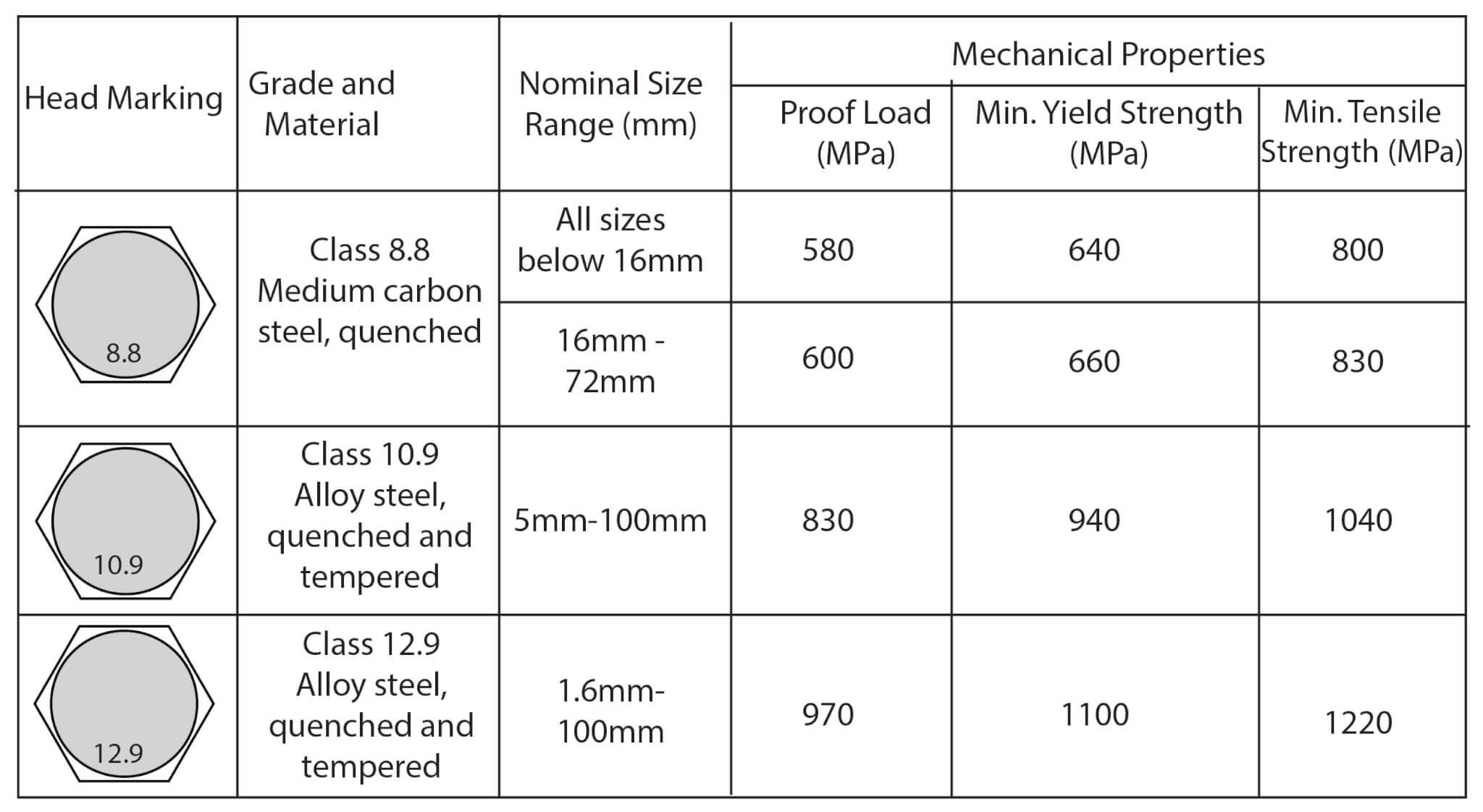
ISO grades are marked with a number and decimal:
Class 4.8: Low strength
Class 8.8: Medium strength
Class 10.9: High strength
Class 12.9: Very high strength
Common Misconceptions About Bolt Strength
• Bigger is Always Better: Higher grades aren’t always necessary and can sometimes be detrimental.
• Grades are Interchangeable: Different systems (SAE vs. ISO) are not directly equivalent.
• All Bolts are Graded: Some specialty bolts may not follow standard grading systems.
US Bolt Grade Marking and strength
Metric Bolt Grade Marking and strength
©, 2023 Rick Muscoplat