
How to replace a car battery yourself
Learn how to replace a car battery yourself: A step-by-step guide
Replacing a car battery is a straightforward process that many vehicle owners can handle with just a few basic tools. Whether your battery has reached the end of its lifespan or is failing to hold a charge, knowing how to replace it can save you time and money. This guide will walk you through the steps to safely and effectively replace your car battery.
Connect a backup power system before you replace a car battery in a late-model vehicle
Here’s why battery backup is so important
1) Disconnecting battery power causes the computer to lose its adaptive memory
Any time you disconnect battery cables from your car battery, the computers in your vehicle will lose their volatile adaptive memory. When you start the vehicle with the new battery, it may not start, or may start but not run well because it’s running off of factory programming. It can take up to 10 cold starts and drives to operating temperature for the computers to relearn how to run properly.
2) Disconnecting the battery causes the computer to lose its throttle body base idle memory
An electronic throttle body contains a small motor that opens and closes the
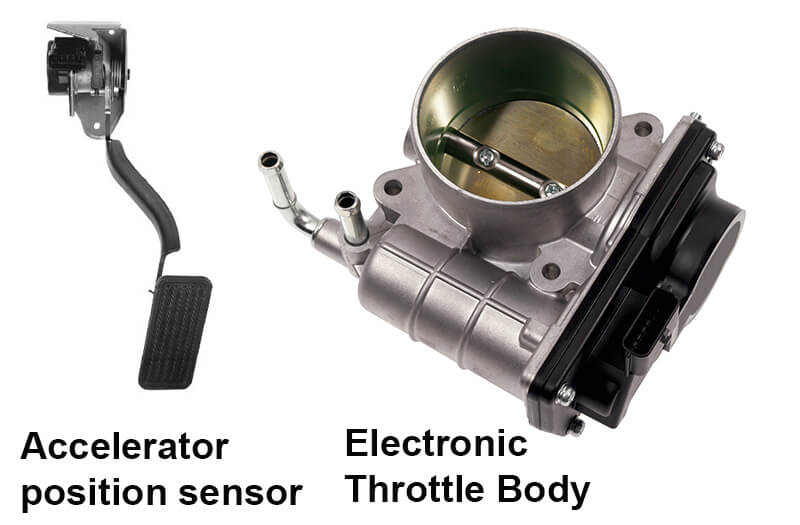
The gas pedal sends electronic signals to the PCM which then tells the throttle body how far to open
throttle plate to control how much air enters the engine. As carbon accumulates in the throttle body opening, the engine computer compensates for the buildup and establishes a new “home” position for the throttle plate.
If you disconnect the battery without providing backup power, the computer will lose this base idle setting. When you connect the new battery, the engine may not start! If it does start, it may run poorly. In some vehicles you have to perform a throttle body relearn procedure to get it to start and run properly.
3) Disconnecting the battery can cause a Stability Control Calibration problem
Stability control systems compare inputs from the steering angle sensor to the readings from the yaw sensor to figure out if the vehicle is in a skid situation. If you disconnect the battery without providing backup power first, whichever position the wheels are in when you disconnect the power will be the new “straight-ahead” when you connect the new battery. As soon as you drive the car, the computer will detect a steering angle sensor problem and set the check engine light. How do you reset the steering angle? Yup, an expensive scan tool.
4) Disconnecting the battery resets all its readiness monitors
If you have smog/emissions testing coming up soon, a “readiness monitors not ready” situation will be an automatic fail.
6) Disconnecting the battery can cause the Ford Failure Mode Effect Management (FMEM) to resets
The FMEM stores an adaptive “fail-safe” strategy that substitutes known-good values for sensor data that’s missing.
6) Some ABS modules reset to factory default— On some makes and models you need a high-end scan tool to reset
7) The Climate Control Systems on Some Vehicles Can Lose Door Actuator Calibration
Most climate control systems vary air temperature by opening and closing baffles and doors to regulate how much air passes over the heater core or evaporator coil. Electric motors operate those doors. When the HVAC controller loses power, it forgets the doors’ position. Most vehicles self-calibrate when you restart after a battery changeout. However, some late-model vehicles require a scan tool re-calibration to return the motors to their home position.
8) The power accessories may lose their memory
If you’ve programmed memory seat positions or auto up/down features on your windows, those may be gone if you disconnect power.
Avoid all those potential problems by using battery backup power when you replace a car battery.
You’ll need three things: a jumper pack, a special OBDII cable, and electrician’s tape.

Get this ES5000 1,500 amp peak power jumper pack for about $125
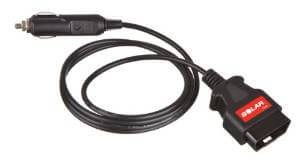
Solar ESA30 OBDII Memory Saver Cable
Here’s the procedure:
1) Connect the D-shaped end of the ESA30 memory saver cable to the OBDII port on your car.
2) With the engine off and keys out of the ignition cylinder, plug the opposite end into the jumper pack and turn it on.
3) Disconnect the negative battery terminal.
4) Disconnect the positive battery terminal and immediately wrap the entire terminal end with several layers of electrician’s tape. With backup power applied, the positive terminal is powered, and if it touches any metal component, it will blow out the fuse in the jumper pack and depower your car’s computer and modules. Shove a disposal plastic cup over the end of the positive terminal and tape it to the cable for extra safety.
5) Disconnect the battery hold-down rods and bracket or bottom retainer.
6) Remove the old battery and clean the tray and negative terminal. Neutralize any battery acid you find in the tray.
7) Clean the posts on the new battery.
8) Swap in the new battery and reinstall the insulating jacket (if equipped).
9) Reconnect the hold-down and tighten it until the battery doesn’t move with gentle force. Do NOT overtighten the hold-down device. Over-tightening can damage the battery case and cause early failure.
8) Remove the tape, clean the positive terminal, and install it on the positive post
9) Install the negative battery terminal.
A step-by-step guide to replace a car battery without backup power
1) Engine off, keys out of the ignition, and doors closed
2) Remove the negative battery cable first
3) Then disconnect the positive battery cable
4) Loosen the battery hold-down device and remove the hold-down.
5) If the battery has an insulating jacket, remove it and set it aside to reuse on the new battery
6) Remove the old battery.
7) Examine the battery tray for signs of battery acid leakage. If you find any, neutralize the acid with baking soda. Clean and dry the tray before putting it back in the vehicle.
8)Load in the new battery, ensuring the positive and negative posts are in the same location as the old battery.
9) Reinstall the battery insulating jacket
10) Reinstall the battery hold-down bracket/device. Do NOT overtighten. Tighten the hold-down bracket just enough to prevent battery movement. Over-tightening the bracket is the #1 cause of battery case damage and acid leaks.
11) Connect the positive cable first, followed by the negative cable.
If your vehicle has a start/stop feature, there’s might be an extra step
Some vehicles require a special ECM new battery re-programming procedure. It tells the ECM that a new battery has been installed so it can charge the battery with the proper voltage. However, if you don’t update the ECM, it will charge the new battery using the older higher voltage, causing the new battery to fail in as little as six months!
Some vehicles automatically conduct a self-relearn, while others, like Audi, BMW, and VW require a scan tool reprogramming. You must check this out beforehand to find out what your vehicle requires.
If your vehicle requires scan tool reprogramming, get it done by a shop ASAP after replacing the battery. If you skip this step, you can destroy the new battery.
©, 2016 Rick Muscoplat
Posted on by Rick Muscoplat