
What does a leveling kit do for your truck?
A leveling kit raises the front end of the truck so owners can install larger tires/wheels
Installing a leveling kit on your truck raises the front end about 2″’, allowing you to install larger tires/wheels (up to 33″ tires in some cases). A leveling kit also gives you slightly under-better body ground clearance, which is important if you use your truck for off-roading. In surveys, owners cite the look of larger tires and the more aggressive stance as their main reason for installing a leveling kit on their trucks. They cite increased ground clearance as the second reason.
A leveling kit eliminates the truck’s positive rake
All light trucks come from the factory with the front end lower to the ground than the truck bed. Truck engineers designed this “positive rake” so the truck would sit level when the bed was loaded with cargo. Many truck owners don’t like the look of a positive rake and prefer a level stance.

Notice the difference in tire-to-fender clearance in a stock truck with a positive rake. Here, you can also see the difference in bed height compared to hood height and the difference in ground clearance between the front of the truck and the rear of the truck

This image shows the added space you get at the front of the truck when you add a leveling kit
The Pros and Cons of
Installing a Leveling Kit On Your Light Truck
Pros:
• A leveling kit raises the front ride height by as much as two inches allowing you to install larger tires and wheels.
• It removes the positive rake and gives your truck a more aggressive stance.
• It gets you slightly more body ground clearance at the front of the truck. However, since the spacers only raise the body height, you still have to be concerned with ground clearance for the engine transmission suspension and rear differential
• It’s much cheaper than a suspension lift kit or body lift kit and is much less costly to install if you choose professional installation.
Cons
• Anytime you change the ride height, tire/wheel size, or rake angle of your vehicle, you must recalibrate all Advanced Driver Assistance System (ADAS). That means recalibrating accident avoidance cameras, radar, Lidar, parking assistance sensors, and blind spot monitoring sensors. Recalibration will add cost to the modification. Failure to recalibrate can cause these accident avoidance systems to fail when you need them most.
• Removing the positive factory rake will negatively affect ride height when you place cargo in the truck bed. Adding cargo to a leveled truck causes a reverse rake, where the bed sags and raises the nose of the truck. The raised nose reduces driver visibility and results in a looser front end due to weight shifting to the rear of the truck. It also interferes with the ADAS systems on your truck.
• Raising the body raises the center of gravity, creating instability in turns and increasing the chances of rollover in high-speed turns and curves.
• If you add bigger tires and larger wheels but use the factory struts, they most likely won’t do a good job of dampening springs oscillations. In other words, when you add more weight with bigger tires and wheels, you really should install new struts that are calibrated to handle the additional upward/downward force created by the heavier tires and wheels. If you don’t, the tires can hit the fender liners and scallop due to uncontrolled oscillations.
What’s in a leveling kit, and how does it raise the front of the truck?
Most kits include spacers and new hardware to install the spacer on top of the existing strut mount. The spacer raises the strut tower/body of the vehicle. You can buy more feature-inclusive leveling kits, including mechanically or pneumatically adjustable Coilover struts. Higher-end adjustable leveling struts allow you to adjust ride height and ride comfort so you can operate your truck in both street and off-road conditions.
In addition, you can buy rear leveling kits to raise the rear wheels by 2″. That allows you to add larger tires on all 4 wheels and gain ground clearance while maintaining the positive factory rake look.
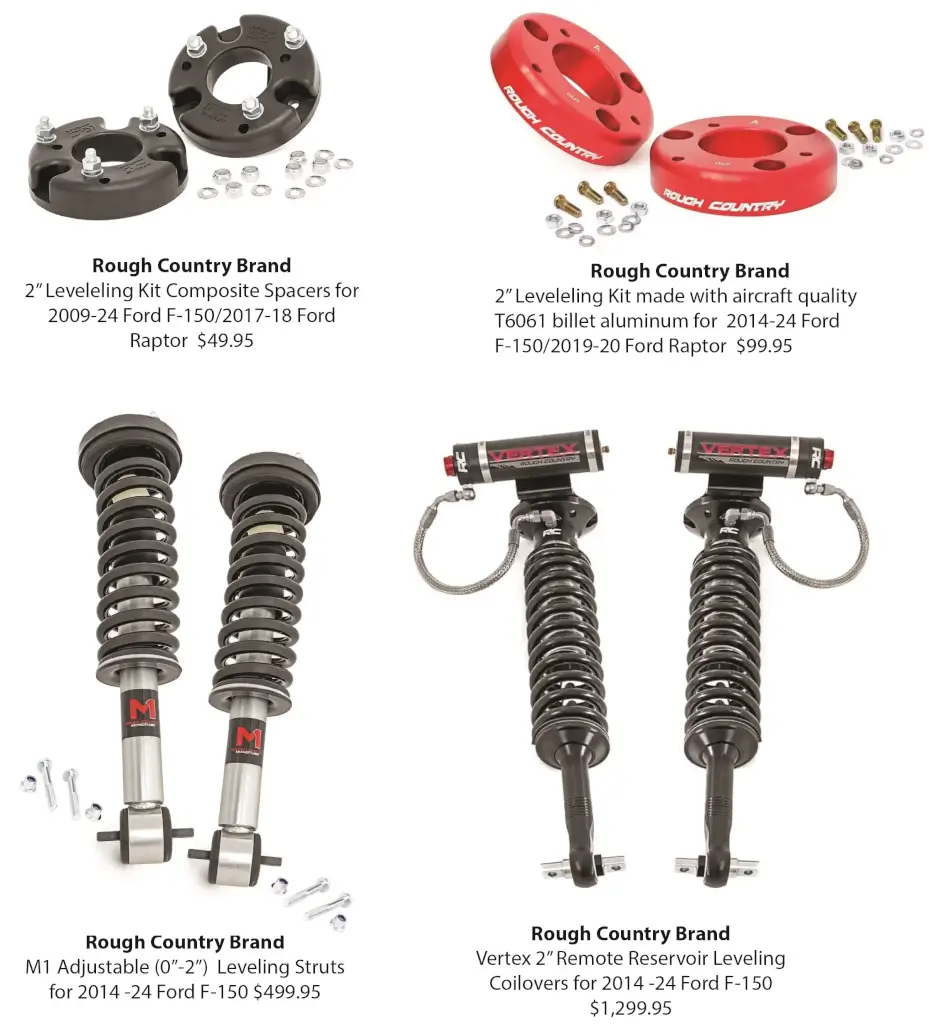
This is just a sampling of leveling kits for a Ford F-150 truck from supplier Rough Country (www.roughcountry.com). Starting at the upper left, see their inexpensive composite spacers. To the right, you’ll see their billet aluminum spacers. At the bottom, you’ll see some of Rough Country’s mechanically and pneumatically adjustable coilovers. The mechanically adjustable coilovers allow you to adjust ride height from 0″ to 2″. The pneumatically adjustable coilovers allow you to adjust ride height and comfort.
Is a leveling kit hard to install?
A leveling kit is much easier to install than a lift kit. You can install a leveling kit if you can replace a strut assembly. However, the installation is a bit more difficult on a 4WD truck, so you might want to consider paying a professional to install your lift kit.
The bottom line on leveling kits
If your main goal is to raise the front end of your truck so you can install larger tires/wheels, a leveling kit is the way to go. They’re inexpensive and the easiest to install. You’ll save a lot of money over a lift kit and not have to deal with any of the degraded performance issues associated with lift kits.
You’ll see a slight improvement in body ground clearance with a leveling kit. That’ll help when going over speed bumps and when entering/leaving steep driveways. However, since you’re not actually raising the suspension, you still have to be concerned about engine, transmission, differential, steering, and suspension component clearance.
©, 2024 Rick Muscoplat
Posted on by Rick Muscoplat