
How often do need to replace a brake caliper?
Common Issues That Require a Brake Caliper Replacement
Ensuring that your brake calipers are in good working order is essential for vehicle safety. However, unlike brake pads and rotors, which need regular replacement, calipers don’t have a set replacement interval. Yet many unscrupulous shops recommend caliper replacement on every brake job. That’s not only unnecessary for most car owners, but it’s actually a rip-off. So how do you know if your caliper needs replacement? This article explores when and why you might need to replace your brake calipers.
The 3 Reasons to Replace a Brake Caliper
There are only three reasons to replace a brake caliper. After reading, you’ll notice that I didn’t include seized caliper slide pins as a reason. That’s because seized pins can be fixed easilly with new pins and boots for a lot less than the cost of a rebuilt caliper.
• The caliper is leaking — If the square cut O-ring has failed and is leaking or the internal parking brake mechanism is leaking, the caliper must be rebuilt or replaced
• The dust boot has failed— The caliper piston dust boot protects the piston from corrosion. If the boot is torn or otherwise damaged, it must be replaced. If the technician spots any corrosion on the claiper piston after removing the dust boot, the piston must be replaced along with the dust boot or the caliper must be replaced or rebuilt.
• The caliper piston doesn’t roll back properly— A hardened O-ring is less pliable and may not roll the piston back to its home position quickly, causing the brake pads to drag, overheat, and wear out quickly. In that case, the caliper should be rebuilt or replaced
All the other caliper issues can be fixed for less than the cost of a replacement caliper
Brake caliper abutment areas and slide pins can rust  and bind, causing brake release issues. Binding also causes the brake pads to wear unevenly, make noise, and require more braking effort. However, rust and binding issues can be fixed without a full brake caliper replacement.
Technicians can easily clean the rust from the brake pad abutment areas and apply corrosion-resistant brake grease. Corroded slide pins and protective rubber boots can be replaced separately for about $22 per wheel.
Even if the corrosion in the caliper bracket bores is severe, the shop can replace just the caliper bracket for about $32 instead of the entire caliper.
In most cases, you do not need to replace the entire brake caliper to fix corrosion issues!
If the shop finds these conditions do NOT require new brake calipers
• Corroded or seized caliper slide pins. Corroded caliper slide pins can be replaced with new parts for about $11 per wheel.
• Corroded bores on caliper bracket. Severely corroded caliper brackets can be replaced with a rebuilt bracket for around $32 each.
• Degraded or torn caliper slide pin boots can be replaced for $11 per wheel.
• The brake pads show uneven wear. Uneven wear is most often caused by rust buildup or corroded caliper slide pins. Fix the problem with new slide pins and possibly a rebuilt bracket and clean off the rust buildup instead of buying new brake calipers.
Here’s the price difference between a full brake caliper replacement versus fixing just what’s wrong
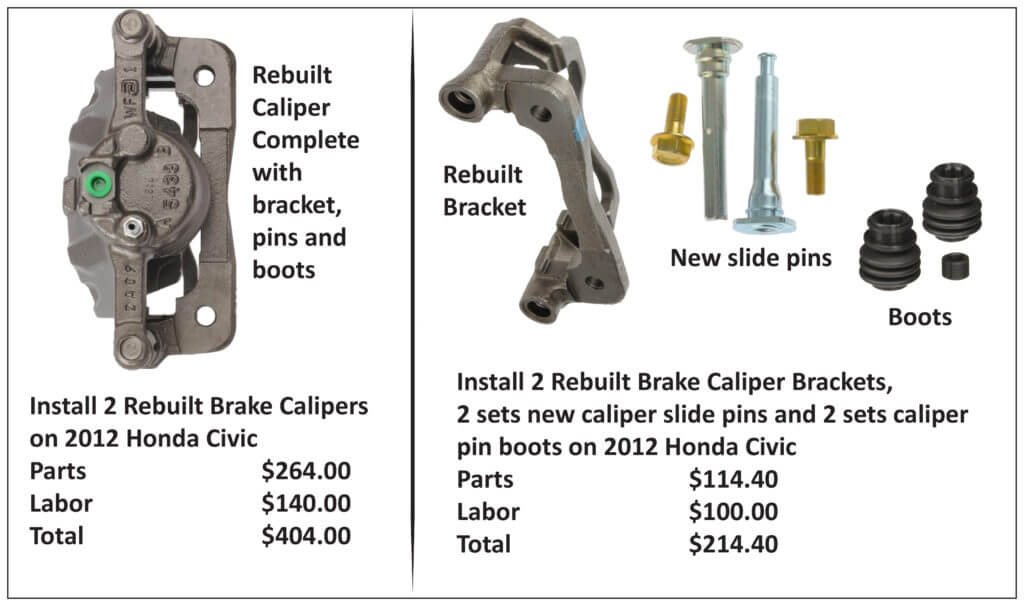
Most rust issues can be fixed with new slide pins and a boot kit for a total cost of around $75 per wheel. Even in a worst case scenario, it’s still cheaper to replace just these parts rather than a new caliper.
©, 2019 Rick Muscoplat
Posted on by Rick Muscoplat