
Car radiator: How it works and how it fails
Understanding your car radiator and how it keeps your engine cool
The car radiator is a crucial component of an internal combustion engine’s cooling system, designed to regulate the engine’s temperature and prevent overheating. Understanding how a radiator works and the common reasons for its failure can help in maintaining your vehicle’s performance and longevity.
How a Car Radiator Works
1) A car radiator’s basic function— The primary function of a car radiator is to dissipate the heat generated by the engine during combustion. It does this by circulating coolant through the engine and then transferring the heat from the coolant to the air. This process helps maintain the engine at an optimal operating temperature, preventing overheating and associated damage.
2) The key components of a car radiator— The core is the central part of the radiator and consists of a network of tubes and fins. The coolant flows through the tubes, and the fins increase the surface area for heat dissipation.
The Inlet and Outlet Tanks: These tanks, usually located on the sides or top and bottom of the radiator, direct the flow of coolant into and out of the core.
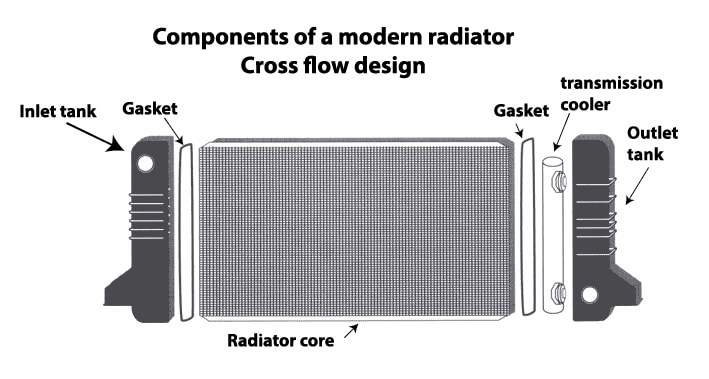
Thermostat: The thermostat regulates the flow of coolant to ensure the engine remains at the correct temperature. It opens to allow coolant to flow when the engine is hot and closes to restrict flow when the engine is cool.
3) The Cooling Process— Coolant Circulation: The engine generates heat during operation, which is absorbed by the coolant circulating through the engine block and cylinder head. The heated coolant flows into the radiator’s inlet tank and passes through the core’s network of tubes. As the coolant travels through the tubes, heat is transferred to the fins and then dissipated into the air flowing through the radiator.
When the vehicle is stationary or moving at low speeds, cooling fans help draw air through the radiator to enhance the heat dissipation process. The cooled coolant exits the radiator through the outlet tank and is recirculated back into the engine by the water pump, repeating the cycle.
Common Causes of Radiator Failure
Despite their importance, radiators can fail due to various reasons. Recognizing the symptoms and causes of radiator failure can help prevent severe engine damage.
1) Leaks— Cracks and Corrosion: Radiators can develop leaks in the core, tanks, or the tank-to-core seals. Tank cracks and tank-seal failures are caused by age and heat. Core leaks are caused by stone/rock impacts and internal corrosion from not replacing coolant on schedule.
2) Clogging— Radiator tube clogs develop due to dirt, debris, sediment, and stop-leak products. In addition, corrosion caused by galvanic corrosion can cause clogging. Lastly, coolant gelling can occur if you mix different types of coolant.
3) Overheating— Overheating degrades the rubber and plastic components, causing radiator failure.
Radiator construction over the decades
Copper brass radiators were once the norm
Most older radiators had a copper core and brass tanks. Copper transfers heat better than modern aluminum radiators, but they’re cost prohibitive. The copper tubes were soldered to a header and footer stamped piece and soldered together. Then, the brass tanks were soldered onto the core. The weak link in a traditional copper-brass radiator construction was the soldered tube-to-header joint.
Plastic/copper radiator saved on cost
To save money, manufacturers switched to a plastic copper design. This radiator has the same copper core, header, and footer but is attached to plastic tanks and sealed with a gasket.
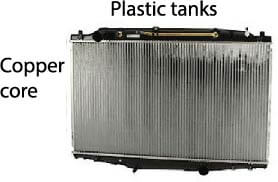
Plastic Aluminum radiator is now the norm
To save even more money and some weight, car makers switched to an aluminum core with plastic tanks. The base
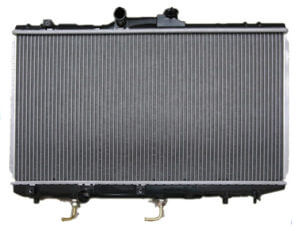
Typical down flow or vertical flow radiator
The heat transfer rate of aluminum is lower than copper, but the tubes are wider and stronger, so they actually cool faster than a copper core radiator.
Here’s an example of the cooling capacity of a copper core radiator versus an aluminum core unit
A copper/brass radiator uses two rows of 1/2 tubes for a total core thickness of 1.25″, whereas a plastic aluminum radiator with the same cooling capability would have 1 row of tubes for a total core thickness of 1″. In heavy-duty applications, where a copper/brass radiator would have three rows of 1/2 in tubes for a total core thickness of 1-7/8″, a plastic aluminum radiator with the same cooling capability would have 1 row of 1-1/4″ tubes for a total core thickness of 1-1/4″.
Aluminum aluminum radiators are for racing applications
Radiators with aluminum tanks and cores offer 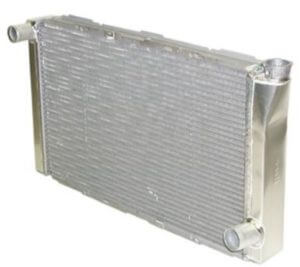 faster heat dissipation than a plastic aluminum version. They’re most often used in racing and off-road applications where proper cooling is critical.
Which radiator construction is better?
You’ll see various opinions on this topic. People who prefer copper brass believe it cools better because copper has a better heat transfer rate. But copper tubes are smaller, so copper brass radiators require more rows to achieve the same cooling capacity as a comparable aluminum radiator. More rows mean more resistance to airflow, which can negate the heat transfer properties of copper.
Copper isn’t as strong as aluminum, and the tubes, headers, footers, and tank are soldered together. Aluminum tubes are stronger than copper, and the tubes, headers, and footers are brazed using aluminum welding techniques. Finally, copper is more prone to corrosion than aluminum, making regular coolant changes a critical factor for radiator life. In addition to regular coolant changes, copper radiators are more susceptible to degradation due to improper coolant/water mix ratios.
For all those reasons, I prefer an aluminum core radiator.
The water pump moves coolant through the engine
The coolant circulating throughout the engine absorbs heat from around the cylinders and cylinder heat. The engine’s water pump then forces the hot coolant to the radiator, where the heat is removed. If the flow rate is too fast, the coolant won’t pick up enough heat or lose enough heat while traveling through the radiator. If the coolant flow is too slow, the coolant will pick up too much heat while in the engine, possibly causing it to boil.
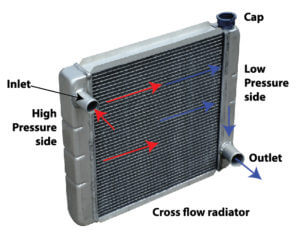
Hot high pressure coolant enters the inlet tank and flows across the tubes to the outlet tank. Airflow across the tubes cools the coolant and lowers both the temperature and pressure. Since the radiator cap is on the outlet tank, high RPMs won’t cause a pressure release
The flow rate is determined by the engine RPM driving the water pump, the water pump design, the size and condition of the thermostat, the size of the radiator, and the size and condition of the radiator fans. A failure in any of those components will affect engine cooling.
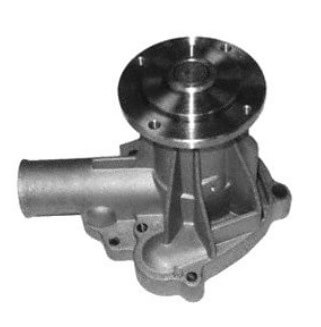
Typical belt driven water pump
How coolant flows through the engine
Coolant is sucked into the engine from the bottom of a down-flow radiator or the side opposite from the upper radiator hose on a cross-flow style radiator. The cooled coolant if forced around the cylinders and cylinder head(s) to pick up heat from those areas. Some hot coolant is diverted to the heater core to warm the passenger compartment. The hot coolant exits from the top of the engine and thermostat area and moves through the upper radiation hose to the top tank of a down-flow radiator or the intake side of a cross-flow radiator. Flow rate is determined by the thermostat.
Coolant heat is removed with fans and ram-air
As the hot coolant flows through the radiator fins, outside air is forced through the fins based on vehicle speed or pulled through the radiator fins with radiator fans. The rate of cooling is directly related to vehicle speed and radiator fan speed.
On a down-flow radiator, maximum cooling is achieved near the bottom of the radiator. On a cross-flow radiator, maximum cooling is achieved on the side opposite the upper radiator hose intake.
Electric radiator fans can be single, double or variable speed, depending on 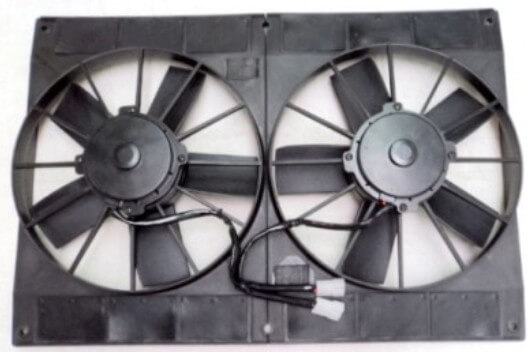 the year, make and model. Mechanical fans are driven by an accessory drive belt connected to the crankshaft. Most mechanical fans employ a temperature or electrically-controlled viscous clutch. At high vehicle speeds where ram-air velocity is greater than mechanical fan RPM, the viscous clutch disengages the fan from the drive belt, allowing it to free-wheel. If the mechanical fan was not allowed to free-wheel at high vehicle speeds, the ram air would slow the mechanical fan, causing engine drag and lower MPG.
On late-model vehicles with multiple electric radiator fans, one fan is often used to supplement the engine cooling fan when the AC system is operating.
Automatic transmission coolers
Vehicles equipped with an automatic transmission often incorporate an automatic transmission cooler inside the radiator. Since automatic transmission fluid temperatures are higher than engine coolant temperatures, the radiator does double duty by cooling both engine coolant and transmission fluid.
The transmission cooler is located at the bottom of a down-flow radiator and the suction side of a cross-flow radiator.
Radiator replacement cost
Depending on the year, make, and model, radiators typically cost around $400 for the part and require approximately one hour to install. Radiator replacement also requires a cooling system flush and refill with fresh coolant.
See other parts of the cooling system
Thermostat
©, 2017 Rick Muscoplat
Posted on by Rick Muscoplat