
Car Wont’ Start? Step-by-step guide on what to check
How to Fix the Most Common No-Start Problems
Quick Summary:
This article walks you through a logic-based way to figure out why your car won’t start.
No-start issues fall into one of three categories:
• Battery/charging faults
• Starter circuit failures
• Fuel/ignition problems.
In this guide, I’ll walk you through what I personally check in order whenever a car won’t start, so you can get moving again without wasting time or money.
Article
I’ve been diagnosing no-start situations for decades, and I can tell you this: when a car won’t start, the worst thing you can do is try random fixes. Instead, you want to think like a pro — follow a logical troubleshooting “tree” and listen closely to what the vehicle is telling you.
So the very first question I ask is simple:
Does the engine crank? — You turn the key — do you hear the engine rotating? Or do you hear nothing? That single observation completely changes the diagnostic direction.
When All You Hear is Clicking or Slow Cranking When You Turn the key
If your car won’t start and cranks like it’s struggling to stay alive — that’s a battery or power connection issue. A rapid series of clicks indicates insufficient power reaching the starter.
Here are some common sounds and what they mean
• Normal cranking with a fully charged battery— Click on the play button below to hear a normal cranking sound
This sound proves the battery is good, but the no-start problem is fuel- or ignition-related.
• Cranks and starts after a while but won’t keep running— Click on the play button to hear the sounds of an ignition or fuel delivery problem.
This problem is usually air or fuel-related, but can sometimes be caused by severely worn spark plugs. If you’re stranded, try checking for a clogged air filter. If it’s clogged, start by checking the filter. That works; drive it to the nearest auto parts store for replacement. If the filter looks okay and you can keep it running, immediately get to a shop. They’ll check for the proper fuel pressure, delivery, and sensor readings.
• Slow halting cranking caused by a seriously discharged or failing battery— Click on the play button below to hear the sound of a discharged battery.
If you hear this, get a jump start and immediately get the battery and charging system tested.
• Rapid clicking when turning the key— This can be caused by a discharged battery or poor battery terminal connections. Click on the play button below to hear the rapid clicking sound associated with a weak battery or bad battery terminal connections.
If you hear rapid clicking, try cleaning the battery terminals. If you don’t have the right tools, try tapping each battery terminal with the heel of your shoe. That can sometimes establish a sufficient connection to get you started. Then get it to a shop for a more thorough diagnosis.
• A click with no cranking— This can be a sign of a dead battery or a dead starter. Click the play button to hear what a single click sounds like (the driver in this audio repeatedly turns the key to start and gets a single click each time).
Check the battery and battery terminal connections. If you get a jump and still hear the same sound, the starter has likely failed.
• You hear a high-pitched whine when turning the key— A bad starter drive mechanism causes this. Click on the play button to hear the bad starter drive.
In the past, shops replaced the starter drive. However, with the high cost of labor nowadays, most shops replace the entire starter.
• You hear a grinding sound when turning the key— Worn teeth usually cause this on the flywheel or starter motor. Click on the play button to hear a grinding starter motor.
There’s not much you can do in this situation besides calling for a tow truck. The repair usually involves replacing the ring gear on the flywheel, which is fairly costly.
Try this trick if you’re stranded:
• Wiggle each battery cable — corrosion can block current
• Tap the battery terminals with your shoe heel to restore contact temporarily
• If you have jumper cables, jump it and head straight to a shop for a charging system test
• A single solid click — That usually means the starter has failed internally.
When the Car Cranks but Won’t Fire: The Battery Is Fine, But…
If the engine spins normally yet your car won’t start, the electrical system is working well enough to crank. Now I begin checking the basics: spark, fuel, air, and security system operation.
1) Wiggle the shift lever and try again. If the park/neutral switch is worn,  it may make better contact and allow cranking. If that doesn’t work, move the shift lever to neutral and try starting. If it still won’t crank, try these steps in order
2) Check the battery: Battery voltage must be above 12.2 volts. Use your meter to check the battery voltage. Set the
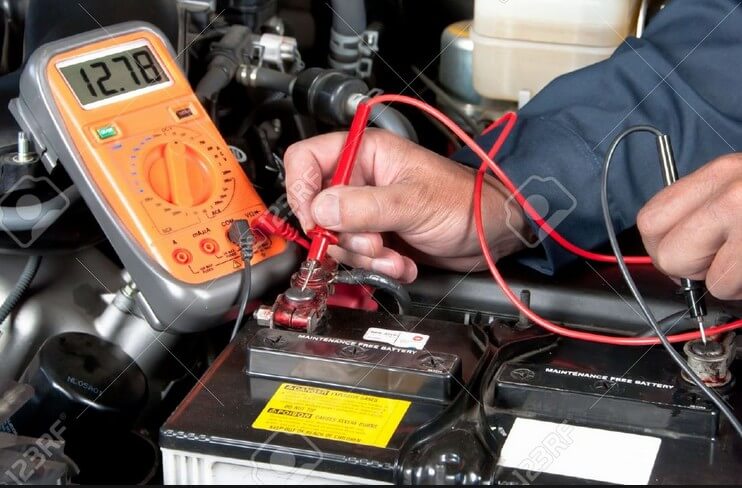
Check battery voltage with a multimeter.
Meter to DC volts and attach the positive (red) lead to the positive battery terminal and the negative (black) lead to the negative battery terminal. If the meter reading is below 12.2, have the battery tested at an auto parts store.
Next, clean the battery posts, terminals, and ground connections with a wire brush.
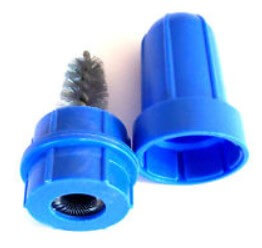
Clean battery posts and terminals with a special wire brush
Remove the battery terminals, clean the posts on the top terminal battery, and clean the side attachment points on the side terminal battery. Then, clean the battery cable terminals. Check the condition of the bolt on the side terminal of the battery. The threads must be sharp and free of corrosion. If they’re in bad shape, replace the bolt. You must have solid contact with the side terminal.
Then, clean the ground connections. Clean the ground cable connection where it attaches to the engine, the ground cable connection where it attaches to the fender or radiator support, and the ground cable connection at the firewall and where it attaches to the back of the engine.
Check for power at the starter and starter motor relay
The voltage at the battery cable on the starter and the starter “S” terminal can tell you a lot. If power isn’t getting to those terminals, there’s no way the starter will run. Here are the checks to perform:
Check for battery voltage on the heavy cable bolted to the starter.

View of terminals on the starter motor
Connect the positive lead to the large battery cable and the negative lead to ground. You must see the battery voltage. If there is no battery voltage, repair or replace the cable/terminal.
Check the voltage at the starter’s “S” terminal when the key is turned to the START position. Connect the positive lead to the “S” terminal and the negative lead to ground. If you don’t see battery voltage while trying to start, get a wiring diagram and trace the power routing to the “S” terminal.
On older cars without computer control or anti-theft, battery power to the starter motor usually flows through a fuse to the ignition switch. From there, it flows to the park/neutral switch before going to the “S” terminal. Check for battery power entering and exiting the IGN switch. That confirms the fuse and the IGN switch are good. Next, measure the battery voltage at the park/neutral switch input and output while attempting to start the engine. If power comes out of the park/neutral switch but isn’t present at the “S” terminal, check for power at any connectors or splices in between or look for an open in the “S” wire.
Starter solenoids can fail in many ways. The wire windings can short or form an open. The copper disc on the plunger can develop pits or corrosion, preventing good electrical contact between the battery cable and the starter motor.
In some starter models, you can replace only the solenoid. In other designs, you can remove the cover and replace the plunger, copper disc, battery, and motor contacts. And, in some designs, you must replace the entire starter.
The other possibility is that the starter solenoid is working properly and delivering power to the starter motor. Still, the starter motor windings have shorted, preventing the starter motor from turning. That would sound like a loud single click. The easiest way to check for that condition (assuming you’ve already checked the battery and it’s in good shape) is to turn on the dome light and try starting the engine. If you hear a single click and the dome light dims way down, that’s a good indication the starter motor is bad due to a short in the windings. If you turn the key several more times and smell burning, that’s insulation melting off the starter motor windings. At that point, you have no choice but to call a tow truck.
Ignition Issues — Worn spark plugs and weak ignition coils are extremely common causes of a crank-no-start—especially after a cold night. No spark = no combustion.
Fuel Delivery Problems — Either the fuel isn’t getting to the engine, or there’s too much of it. The top culprits:
• Failed fuel pump
• Clogged injectors
• Leaking injectors are flooding the cylinders
A quick driveway test I often suggest: listen for the fuel pump. Turn the key to RUN and listen near the gas tank for a 2-second hum. Silence usually means the pump isn’t doing its job.
Security System / Immobilizer — Modern anti-theft systems can crank but prevent starting. Look for a flashing SECURITY or key-shaped light on the dash — that’s the vehicle telling you it thinks the thief is you
©, 2015 Rick Muscoplat
Posted on by Rick Muscoplat