
Common Causes of Turbo Failure and How to Prevent Them
Understanding the Causes of Turbo Failure
A turbocharger increased the air volume in the cylinder, allowing the ECM to add more fuel and get more power out of every compression stroke. That allows carmakers to get more power out of smaller engine blocks, which lowers vehicle weight and increases fuel economy. However, despite their advantages, turbochargers are susceptible to failure. Understanding the causes of turbo failure is crucial for maintaining engine health and performance.
Clean oil and lots of it are the most important factor in turbo life
Some turbochargers can spin at speeds up to 300,000 RPM. The only way to prevent the shaft, bearings, and seals from disintegrating due to friction is to keep a constant flow of cooled oil circulating through the unit. Failure to check your oil level and top it off when needed, or going too long between oil changes is the single most common cause of turbo failure.
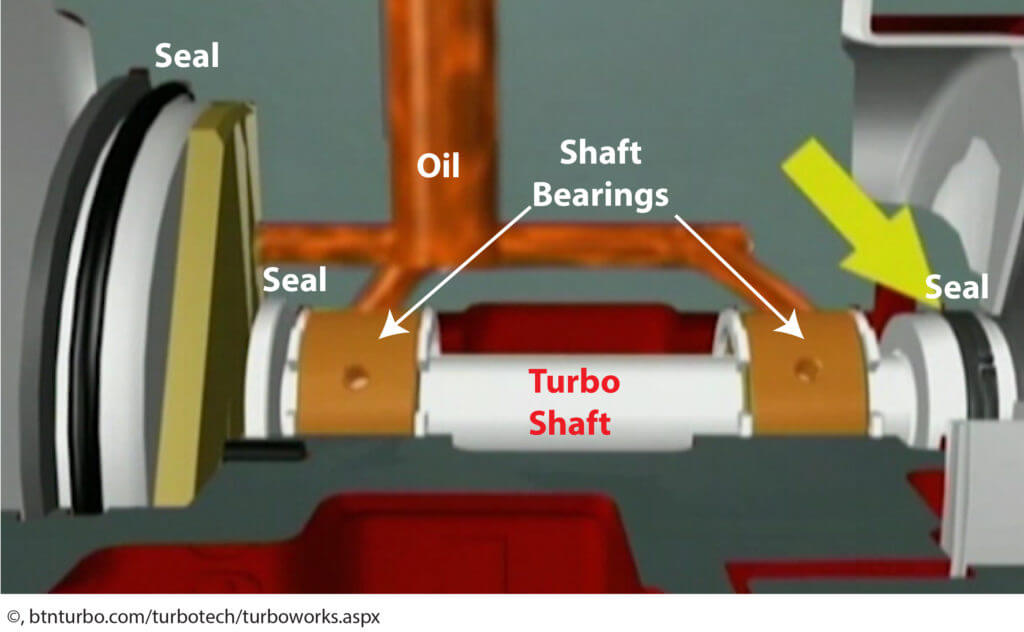
Turbo failure is most often caused by oil contamination or oil starvation
In fact, according to btnturbo.com, a major rebuilder of replacement turbochargers, 95% of all turbocharger failures are due to oil or foreign object damage, not manufacturing defects.
What causes turbo oil starvation?
• Using the wrong viscosity oil— Carmakers specify a specific oil viscosity so that the oil flows at the proper rate through tight bearing clearances. Using a higher viscosity oil results in a lower flow rate and less heat transfer out of high friction areas.
• Operating your engine when it’s low on oil— All engines use some oil. With synthetic oil and longer oil change intervals, it’s not uncommon to run low between changes. If you don’t check the dipstick and add oil. you can starve the turbo of cooled oil, causing turbo failure.
• Using a poor-quality oil filter— Turbo engines generate a lot of heat and that degrades oil,
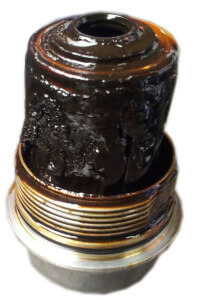
This is what oil sludge looks like on an oil filter
even synthetic oil. If you go too long between oil changes or use an economy filter that’s not rated for extended oil change intervals, the oil filter media can become loaded and go into bypass mode. When an oil filter is in bypass mode, the oil BYPASSES the filtering media. In other words, you’re circulating dirty oil through the engine and turbo.
• Malfunctioning oil bypass valve— The oil bypass valve can be located in the oil filter or in the oil pump. If it sticks in bypass mode, the oil won’t be filtered.
• Clogged oil lines— Oil deposits and sludge can restrict the flow
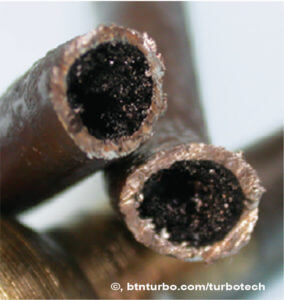
Clogged turbo oil lines
of oil through the oil cooling lines to and from the turbo. In fact, most rebuilt turbo manufacturers require the installation of new oil lines to the turbo to keep the warranty in force.
• Worn oil pump— An oil pump must deliver oil at a certain pressure and quantity. However, pressure and quantity also depend on oil clearances at the bearings. If you’ve neglected oil changes and have worn bearings, the oil will pour out of the bearing clearances, preventing the pump from maintaining proper pressure.
What causes oil contamination?
Engine oil can carry various contaminants into the turbo bearing system, leading to damage. The most common contaminants are fine particles, often carbon and soot from the combustion process. When the concentration of these particles becomes too high, they act as an abrasive, gradually wearing down and polishing the bearing and shaft surfaces. This wear increases clearances and clogs oil feed holes, eventually preventing the oil from properly controlling the shaft. As a result, there is typically a noticeable increase in noise, oil leaking past the turbine end seal, and oil burning. In vehicles without a particulate filter, this can also lead to visible exhaust smoke.
• Short trips in cold weather— Cold weather requires a richer air/fuel mixture and some of that unburned fuel winds up in the crankcase oil. Cold starts also produce moisture as a byproduct of combustion, and that too lands in the oil due to blow-by. During a stort trip, the oil never gets hot enough to evaporate the fuel and moisture, so it mixes with the oil, thins it, and reduces its lubricating abilities.
• Overextending oil change intervals— Carmakers post Normal and Severe service recommendations. Most drivers fall into the Severe service category but maintain their vehicles according to the Normal recommendations. Going beyond recommended oil change intervals depletes the viscosity index improver additives in oil, causing it to thin as you rack up the miles. So, you lose lubricating quality and all anti-wear and anti-corrosion protection.
Poor oil cooling is the second most common cause of turbo failure
Turbo equipped engines use an oil cooler to remove heat from the oil. 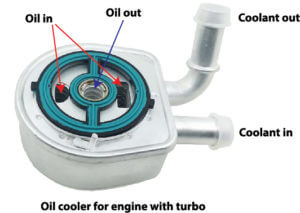 Oil coolers can remove heat using an air exchange radiator or a coolant radiator. An air-cooled oil cooler usually sits near the radiator in front of the vehicle. Clogged fins can prevent proper airflow and impact damage can restrict oil flow. A coolant exchange oil cooler circulates engine coolant through a copper tube that’s immersed in the turbo oil flow. Since engine coolant is at a lower temperature than oil coming from the turbo, it cools the oil.
Foreign object impact damage is the third most common cause of turbo failure
Foreign objects entering the turbocharger can cause severe damage. These objects can include dirt, debris, or even parts of the engine that have broken loose. The high-speed rotation of the turbocharger’s turbine and compressor can turn these foreign objects into projectiles, damaging the blades and housing.
Common Sources of Foreign Objects:
• Failed air filter box seals or cracks in the filter box— Gaps or leaks in the air filter box can allow dirt and debris to enter the turbocharger.
• Poor air filtration or filter degradation— A damaged or low-quality air filter can fail to block contaminants, allowing them to enter the turbocharger. In a worst-case scenario, the filter media self-destructs, causing bits of it to suck into the turbocharger. Since the turbine spins at extremely high speeds, ANY debris can destroy the turbine blades.
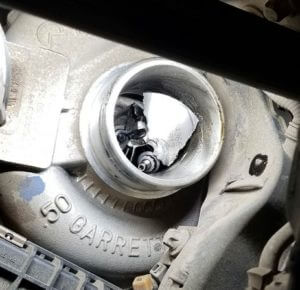
Damaged air compressor turbine. Notice the air filter media on the turbine.
You can introduce foreign objects into the intake airflow stream any time you check the air filter or disconnect the air duct. A rag, loose screws or nuts can instantly destroy a turbo.
Overheating and Heat Soak is the fourth most common cause of turbo failure
Turbochargers operate under extreme temperatures. The exhaust gases that drive the turbine can reach temperatures exceeding 1,000 degrees Celsius (1,832 degrees Fahrenheit). While turbochargers are designed to handle high temperatures, prolonged exposure can lead to overheating and heat soak.
Causes of Overheating:
• Extended high-speed driving— Prolonged periods of high-speed driving or heavy towing can increase exhaust gas temperatures, putting extra strain on the turbocharger.
• Inadequate cooling— Insufficient cooling, whether from inadequate oil or coolant flow, can cause the turbocharger to overheat.
• Improper shutdown procedures— Shutting off a hot engine immediately after heavy use can lead to heat soak, where the residual heat in the turbocharger has no chance to dissipate. This can damage the bearings and other components.
Turbos can fail due to over-revving
Turbos are designed to handle a range of speeds. But if you exceed those speeds, the turbine blades can come apart, or the bearing may not be able to handle the load.
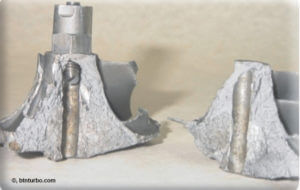
Turbine damage from overspeed
Turbo failure can also be caused by material fatigue and manufacturing defects
Turbochargers are subjected to extreme stresses, and over time, the materials can fatigue and fail. Additionally, manufacturing defects can lead to early failure.
Factors Contributing to Material Fatigue:
• Repeated thermal cycling— The constant heating and cooling cycles can cause thermal fatigue, leading to cracks and other failures.
• Vibration and shock loads— Engine vibrations and sudden shocks can stress the turbocharger components, particularly if the vehicle is driven aggressively.
Less than 1% of turbos fail because of manufacturing defects. Most failures are caused by the three ‘turbo killers’ of oil starvation, oil contamination and foreign object damage.
©, 2018 Rick Muscoplat
Posted on by Rick Muscoplat