
Common Subaru Problems Every Owner & Buyer Should Know
Guide to Subaru’s Most Common Problems: An Insider’s Perspective
As a seasoned automotive technician who has worked on Subarus, I’m going to break down the most common Subaru problems that can turn your beloved boxer-engined beauty into a expensive planter. Let me be crystal clear: Subarus are fantastic vehicles with incredible all-wheel drive capability and overall excellent reliability, however they have some notorious issues that every potential owner needs to understand.
Common Subaru Head Gasket Failures
When discussing common Subaru engine problems, head gasket failures are the elephant in the room. I’ve seen this issue many times. Specifically, the 2.5-liter naturally aspirated EJ series engines from the late 90s to early 2010s are the poster child for head gasket problems.
The head gasket problems affect the naturally aspirated EJ25D, EJ251, and the EJ253 engines. The head gasket problem affected mostly the single overhead cam engines. Don’t blame all Subaru engines of this era though, because the 1.6L, 1.8K, 2.0L and the 2.2L engines didn’t have a head gasket problem, nor did the EG and EZ 3.0L, 3.3L, or the 3.6L versions.
The head gasket problem in the EJ series was limited to the normally aspirated engines, not the 2.0L or 2.5L turbocharged engines.
The root cause?
It’s not the Boxer engine design, as most
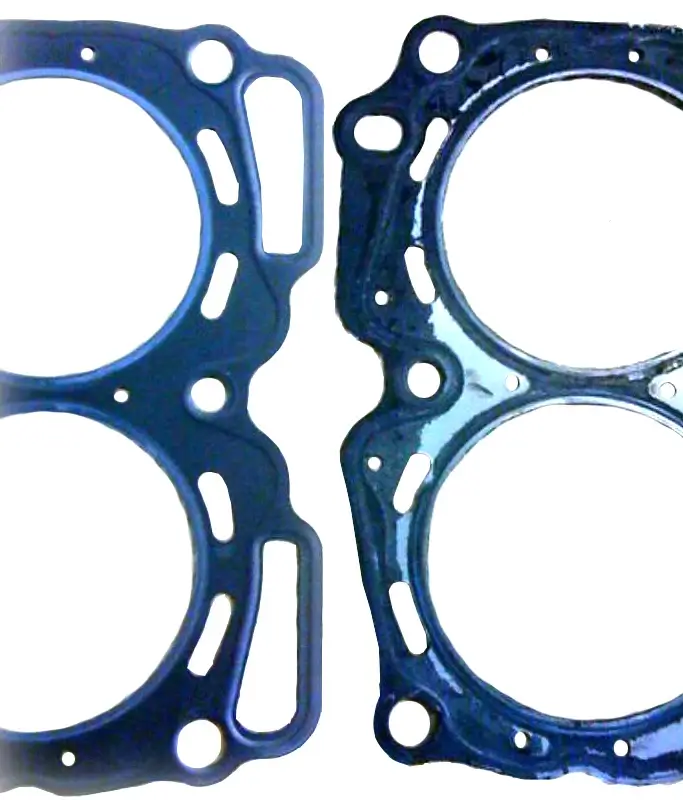
This image shows a new Subaru head gasket (left) versus a degraded Subaru head gasket. Notice the missing graphite sections on the gasket on the right.
people think. If it were, it would affect all Boxer engines, and as I said above, it doesn’t; it only affects the EJ series. The root cause is a poor head gasket design. Starting in 1997 and used through 1999, Subaru began to use a multi-layer steel shim head gasket with a graphite-type outer film. And this is where the problem started. The graphite coating deteriorates, allowing coolant to enter the combustion chamber and exhaust gases to enter the cooling system.
In mid-1998, Subaru redesigned the 2.2L and 2.5L engine cylinder heads and camshaft configurations. This design also had problems with external oil and coolant leaks. In both designs, the gaskets would typically start failing between 120,000 and 150,000 miles.
Subaru originally thought the problem was related to coolant and developed an additive for use during coolant changes. Unfortunately, that didn’t stop the gasket deterioration.
The problem was the deterioration of the composite gasket due to expansion/contraction cycles that scrubbed off the graphite coating. This caused the gasket to leak oil and coolant externally. However, as the gasket deterioration progressed, exhaust gases entered the coolant, along with engine overheating.
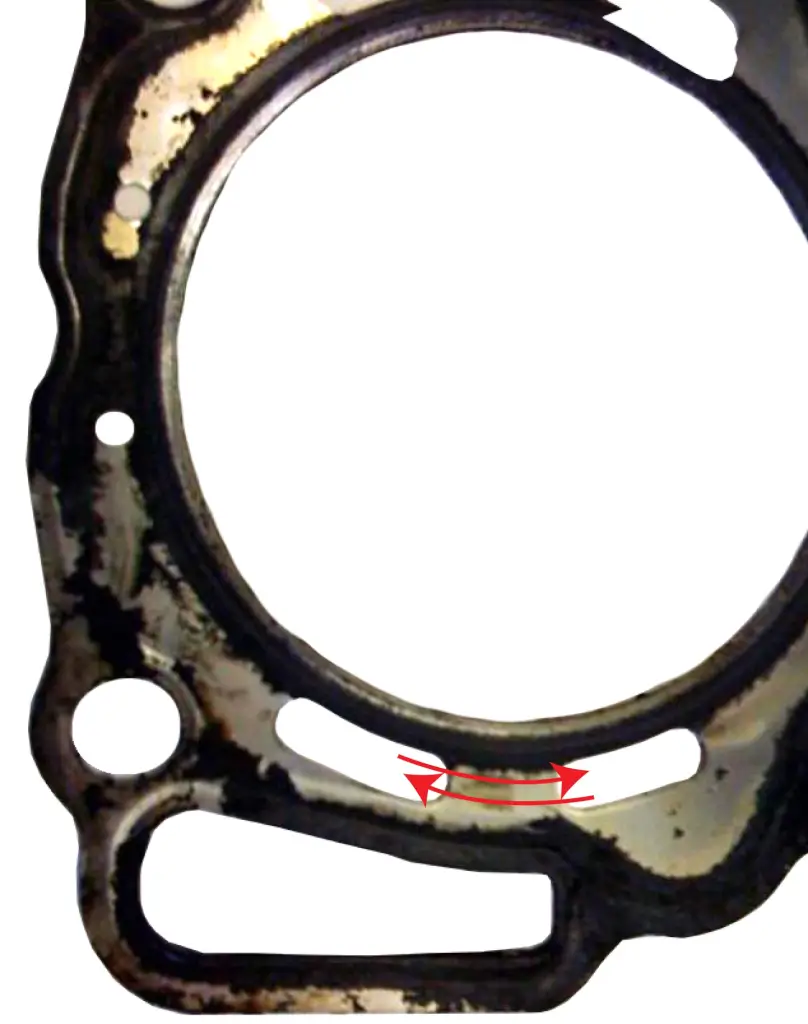
Subaru EJ Engine Head Gasket Repair Costs
While you can replace the head gaskets with the engine in the car, most shops remove the engine to clean the engine deck better and get the best possible seal on the new gaskets. Luckily, the 4-cylinder boxer engine is relatively easy to remove.
Once you replace the head gaskets with the newer multi-layer steel design, the engine will be good for a long time, so it’s usually worth the expense.
• If you repair the Subaru gasket problem yourself, expect to spend a minimum of $1,000. That includes sending the cylinder heads out to a machine shop, the cost of the new head gaskets and head bolts, new engine mounts, timing belt, not idlers and timing belt tensioner, new water pump and thermostat, coolant and oil.
• If a shop does the job, expect to pay around $2,900 to $3,500
Things You Do That Make The Subaru Head Gasket Issue Even Worse
Performance Tunes
Many WRX and STI owners think they’re race car drivers and pay to have their ECM remapped for more performance. Those owners are begging for head gasket problems later on. The EJ engines aren’t designed to handle tuning.
Poor Maintenance
Due to the design of the boxer engine, all particulate matter in the engine falls to the bottom, where it sits in contact with the head gasket. As the coolant circulates, the particles can scrub against the head gasket, causing faster deterioration. Subaru recommends a coolant change at around 100K miles and they mean it. If you don’t adhere to the coolant change schedule, you can accelerate head gasket damage.
Is it worth it to replace your Subaru head gaskets?
That all depends on the condition of the rest of the vehicle. If the body is in good shape and you’re willing to invest in normal upcoming suspension maintenance like replacement struts, wheel bearings, brakes, and steering wear items, it’s worth spending the money.
Let’s talk about the CVT (Continuously Variable Transmission), one of the most common Subaru transmission problems. Introduced around 2010, these transmissions have been a source of major headaches for Subaru owners.
Common Subaru Transmission Problems
Subaru CVT transmissions—specifically the Lineartronic CVTs used from 2010 onward—are a mixed bag. They offer smooth acceleration and good fuel economy, but they’ve also developed a reputation for several significant issues. As someone who’s seen the ins and outs of these units in the shop, I can tell you the most common Subaru CVT transmission problems typically fall into the following categories:
1. Torque Converter Shudder and Failure— This is especially common in early TR690 CVTs (used in Outback and Legacy from 2010 to 2014). The torque converter develops a shudder at low speeds or while accelerating lightly. Sometimes, it fails to transfer power smoothly, leading to jerky movement or slipping.
• Symptoms: Shuddering, slipping, hesitation under light acceleration
• Repair Cost: $1,000–$2,500 depending on whether you replace just the torque converter or the entire transmission
2. Valve Body and Solenoid Failures— The CVT’s valve body controls hydraulic pressure and solenoid actuation. These solenoids fail over time, leading to rough shifting, hesitation, or the dreaded “limp mode.” Subaru doesn’t sell solenoids separately—you must buy the entire valve body unless you go aftermarket.
• Symptoms: Delayed engagement, hard shifting, and warning lights (P0700, P2764, etc.)
• Repair Cost: $1,000–$2,000 depending on labor and part source
3. Chain Slip and Pulley Wear— Unlike many CVTs that use a steel belt, Subaru’s CVTs use a steel chain between two variable-diameter pulleys. Over time, the chain can wear the pulleys, causing chain slip under load or during acceleration. This is one of the more catastrophic CVT failures.
• Symptoms: Whining noise, jerky acceleration, sudden loss of power
• Repair Cost: $4,000–$8,000 or more for complete transmission replacement
4. Overheating and Fluid Degradation— Subaru CVTs are sensitive to heat and require specific CVT fluid (Subaru CVTF) to maintain proper operation. Overheating from towing, mountain driving, or fluid neglect can lead to premature failure. Many models lacked a transmission cooler, which worsened the issue.
• Symptoms: Overheating warning light, reduced performance after long drives
• Prevention: Install an aftermarket cooler if towing, and change fluid every 30,000–60,000 miles
5. Transmission Control Module (TCM) Issues— The TCM can develop software or internal faults that mimic mechanical problems. Subaru has issued several TSBs (Technical Service Bulletins) and software updates to reprogram faulty TCM behavior.
• Symptoms: Unexpected gear ratio errors, limp mode, stored trouble codes
• Fix: Sometimes a software update; worst case, TCM replacement ($500–$1,200)
6. Delayed Engagement into Drive or Reverse— Many drivers notice a delay when shifting from Park to Drive or Reverse. This can worsen with age and often points to internal wear or fluid breakdown.
• Symptoms: Lag or delay of 2–5 seconds before the car moves after shifting
• Repair Cost: May need a full rebuild or replacement depending on severity
7. High Repair and Replacement Costs— Unlike traditional automatic transmissions, CVTs are difficult and expensive to rebuild. Many shops don’t even attempt it. When a CVT fails, most people end up replacing the entire unit.
Used Transmission: $1,500–$3,000
Remanufactured: $5,000–$8,500 (or more at the dealership)
Labor Costs: $1,000–$2,000 depending on location and vehicle model
Subaru Models Most Affected By The CVT Transmission Issues:
2010–2014 Outback and Legacy (TR690 CVT)
2014–2018 Forester (TR580 CVT)
2012–2017 Impreza
2013–2017 Crosstrek
SUBARU EXTENDS THE WARRANTY
To retain their reputation, Subaru extended warranties on certain models and years due to known CVT issues—up to 10 years/100,000 miles in some cases—so it’s always worth checking with a dealership before shelling out for repairs.
Subarus are incredible machines when properly maintained. They’ve even won the 2024 Most Reliable Vehicle Award. But these most common Subaru problems can turn your dream car into a financial nightmare.
My advice? Always:
Get a pre-purchase inspection
Maintain your vehicle meticulously
Budget for potential repairs
Consider the vehicle’s value before investing in major repairs
Remember, these issues don’t mean you shouldn’t buy a Subaru. They mean you should be an informed, prepared owner.
©, 2025 Rick Muscoplat