
Does your water heater need an expansion tank? What the code says
Water Heater Expansion Tank Requirements and Sizing Guide
Quick Summary
In many homes, a water heater expansion tank is required by the plumbing code whenever the plumbing system is considered a “closed system.” That usually happens when the home has:
- A backflow preventer or check valve installed ahead of your water meter to prevent household water from backing up into the city water supply.
- A pressure reducing valve (PRV) — Used in areas where the water pressure entering the home is too high and must be reduced.
A water heater expansion tank is required in those situations because water expands as it heats. Since a closed system prevents the expanding water from pushing back against the city or well water, the added pressure of the expanding hot water could damage the home’s plumbing pipes, faucets, and all connected appliances. A water heater expansion tank incorporates an inflatable bladder to absorb the increased pressure, preventing damage to the pipes, faucets, and appliances.
Without one, thermal expansion can cause:
Dripping from the water heater’s temperature and pressure (T&P) valves
* Shortened life span of the water heater due to tank flexing and lining cracks from the pressure fluctuations
* Leaking faucets due to excessive pressure
* Pipe stress due to repeated high pressure expansion and contraction
* Damaged appliances caused by high pressure failure within the electrically controlled inlet valve of washing machines, ice makers, and dishwashers.
Even where code doesn’t require one, I often recommend installing an expansion tank because it reduces pressure spikes and protects the entire plumbing system.
What Is a Water Heater Expansion Tank?
A water heater expansion tank is a small pressure tank installed 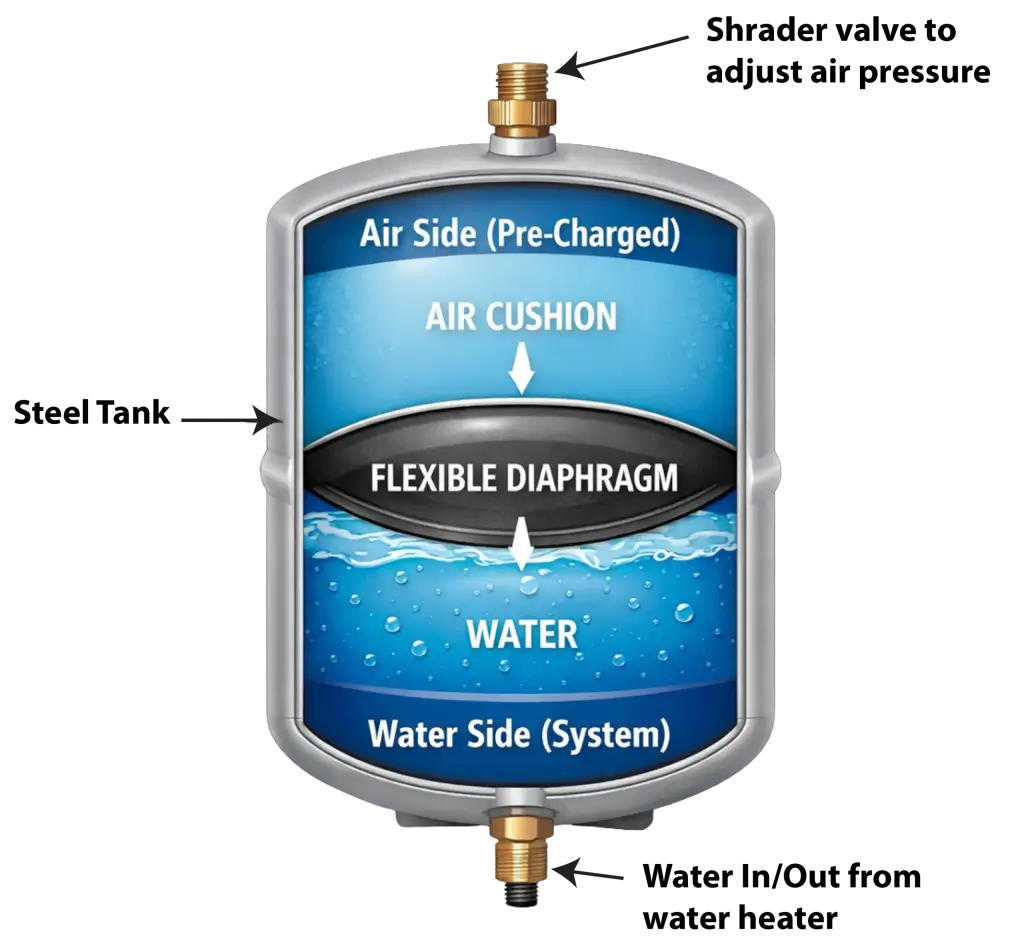 on the cold water supply line near the water heater. Inside the tank is a rubber diaphragm or bladder that separates compressed air from incoming water.
When water heats inside a water heater, it expands. Since water is nearly incompressible, that expansion creates pressure. In an open plumbing system, some of that expanded water can flow backward into the municipal water main. But in a closed system, the expanded water has nowhere to go.
That’s where the expansion tank comes in.
The air chamber inside the expansion tank compresses as heated water expands, absorbing the excess pressure before it damages plumbing components.
Benefits of an Expansion Tank Even When Not Required
Even if code doesn’t require one, installing a water heater expansion tank provides several important benefits.
It Reduces Pressure Spikes
Thermal expansion can increase pressure dramatically during a heating cycle. I’ve measured systems that climb from 60 PSI to over 100 PSI without an expansion tank.
Those repeated spikes stress:
* pipe joints,
* faucet cartridges,
* washing machine hoses,
* dishwasher valves,
* and ice maker solenoids.
It Extends Water Heater Life
Repeated pressure cycling places stress on the tank and internal components. A properly sized expansion tank helps stabilize system pressure and may extend water heater life.
It Helps Prevent T&P Valve Dripping
One of the most common symptoms of thermal expansion is intermittent dripping from the temperature and pressure relief valve.
Many people replace the valve without solving the real issue.
It Reduces Plumbing Noise and Water Hammer Effects
An expansion tank can help soften sudden pressure fluctuations in the plumbing system.
⸻
Where Is an Expansion Tank Installed?
A water heater expansion tank is installed on the cold water supply pipe feeding the water heater.
In most residential installations, it is mounted:
* above the water heater,
* on the cold inlet line,
* after any shutoff valve,
* and after any pressure reducing valve or backflow device.
The tank can be mounted vertically or horizontally, although vertical mounting usually places less stress on the piping.
I strongly recommend properly supporting horizontally mounted tanks because a waterlogged tank becomes surprisingly heavy.
⸻
Sizing an Expansion Tank
Properly sizing an expansion tank is critical.
A tank that’s too small won’t absorb enough expansion volume. A tank that’s oversized usually won’t hurt anything, but it costs more and takes up additional space.
When sizing an expansion tank, plumbers consider:
* water heater capacity,
* incoming water pressure,
* and expected temperature rise.
Typical residential sizing examples:
* 40-gallon heater: often uses a 2-gallon expansion tank
* 50-gallon heater: commonly uses a 2-gallon tank
* Higher pressure systems may require a larger tank
Most manufacturers provide sizing charts based on:
* heater size,
* supply pressure,
* and temperature settings.
⸻
Correct Expansion Tank Pressure
The correct expansion tank pressure is one of the most misunderstood parts of installation.
The air pressure inside the tank should match the home’s static water pressure before installation.
For example:
* if house pressure is 60 PSI,
* the expansion tank should be precharged to 60 PSI.
To determine the correct expansion tank pressure, I use:
1. A water pressure gauge connected to a hose bib or faucet.
2. Air pressure measured at the Schrader valve on the empty expansion tank.
The tank must be isolated from water pressure when checking air charge.
If the air pressure is too low:
* the tank accepts too much water,
* reducing expansion capacity.
If the pressure is too high:
* water may not enter the tank properly.
Improper precharge is one of the biggest reasons expansion tanks fail prematurely.
⸻
Final Thoughts on Water Heater Expansion Tanks
A properly installed water heater expansion tank is one of the best ways to protect a residential plumbing system from thermal expansion damage.
If your home has:
* a pressure reducing valve,
* check valve,
* or backflow preventer,
you likely need one by code.
Even when not required, the benefits are substantial:
* lower pressure spikes,
* reduced plumbing wear,
* fewer leaks,
* and longer water heater life.
Just remember that proper installation matters. Correct location, proper support, accurate sizing, and setting the correct expansion tank pressure are what make the system work effectively.
Posted on by Rick Muscoplat