
How to buy a car battery: A Comprehensive Guide
Buy the Right Car Battery: Learn The Key Factors to Consider
Quick Summary
Buying a car battery is easy if you understand the different types of batteries, where each is used, along with group sizing and terms like cold cranking amps, reserve capacity, and venting.
Group size—Group size refers to the physical dimensions and terminal locations of the battery terminals. To get a direct replacement without worrying about fitting in the battery box, always buy the group size listed for your vehicle.
Cold cranking amps — Cold Cranking Amps (CCA) is a battery rating that measures how much electrical power a car battery can deliver for 30 seconds at 0°F (-18°C) while maintaining at least 7.2 volts. In simple terms, the higher the CCA, the better the battery is at starting your engine in cold weather.
Reserve Capacity (RC) — The amount of time (in minutes) a fully charged battery can supply 25 amps before its voltage drops below 10.5 volts — essentially a measure of how long it can power your vehicle’s electronics if the charging system fails.
Battery venting — All batteries can vent explosive hydrogen gas. When a carmaker places the car battery under a seat or in the trunk, they use a vented battery that connects to a vent tube. If your car battery is located under a seat or in the trunk, you must replace it with a vented battery.
Battery types — There are at least three different types of car batteries, and you must replace your car battery with the same type used by the carmaker
Flooded Lead-Acid (SLI) Batteries: These are the traditional, most common car batteries — also called Starting, Lighting, and Ignition (SLI) batteries.
AGM (Absorbed Glass Mat) Batteries: A more advanced lead-acid design where the electrolyte is absorbed into fiberglass mats.
• Required for start/stop systems
• Better vibration resistance and longer life
• Better cold-weather starting and power for modern electronics
• More expensive — usually 2–3× the cost of flooded batteries
EFB (Enhanced Flooded Battery): A reinforced version of a flooded battery designed explicitly for lower-duty start/stop vehicles.
• Cheaper than AGM but more durable than standard flooded
• Handles frequent engine restarts
• Not as long-lasting as AGM in heavy start/stop applications
Helpful Rule of Thumb 🔧
If your car originally came with AGM → replace with AGM
If it came with EFB → use EFB or upgrade to AGM
If it came with Flooded → stick with Flooded (unless upgrading electronics)
Article
Over the years, I’ve helped hundreds of drivers figure out how to buy a car battery that actually matches their vehicle’s needs — not just what’s sitting on a store shelf. A battery is not a one-size-fits-all purchase. If you want the best car battery, you must start by identifying the type of battery you need based on your vehicle’s equipment.
Start by Knowing the Type of Battery Your Car Requires
Most vehicles built before 2020 came with a traditional SLI (starting, lighting, ignition) flooded lead-acid battery. These are the most affordable and perfectly adequate for standard ignition systems.
But then things got more complicated. Many newer vehicles — especially those equipped with start/stop — require AGM (Absorbed Glass Mat) or EFB (Enhanced Flooded Battery). If your car came with AGM or EFB from the factory, you must replace it with the same type. I can’t stress that enough.
Many drivers try to save money by swapping in an SLI instead — and then they’re shocked when the new battery dies six months later.
If Your Battery Is in the Trunk or Under a Seat — Pay Attention!
Batteries vent hydrogen gas when charging. If your car stores the battery inside the passenger area, it must use a vented design with a tube that routes gases outside. Replacing a vented battery with a non-vented one is dangerous — the risk of explosion isn’t worth saving a few bucks. This is one of the most critical factors in choosing what type of car battery to buy.
Group Size: The Battery Must Physically Fit
The best car battery in the world is useless if it doesn’t fit in the tray or the terminals don’t line up correctly. Group size is listed in your owner’s manual under BCI, JIS, or DIN sizing systems. Get it wrong, and the hood might slam into the terminals — creating fireworks and a dead car.
Correct group size = proper fitment + correct terminal orientation
Don’t Skip the Electrical Specs (This Is Where Performance Lives)
Now we get into the numbers that separate a “just OK” battery from the best car battery:
• Cold Cranking Amps (CCA): Power to start your engine in cold weather
• Reserve Capacity (RC): How long it can power electronics if the alternator fails
I always recommend choosing a battery that meets or exceeds the factory CCA and RC ratings. That’s an easy way to buy more reliability without paying a premium brand price.
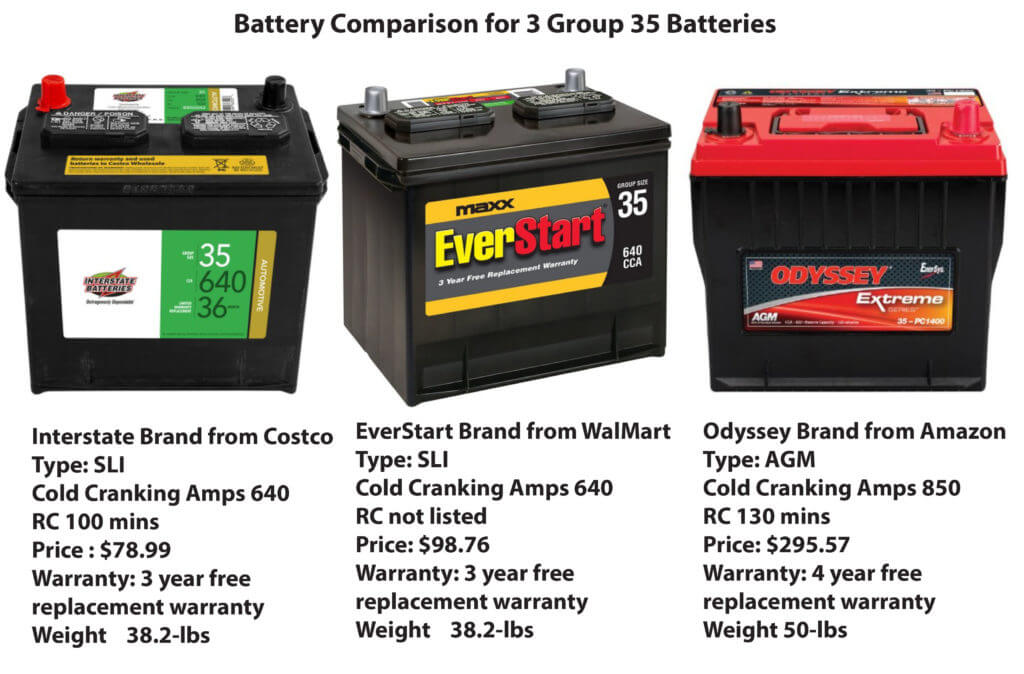
Three Group 35 batteries. Two are SLI and have 640 CCA. The third is an AGM type with 850 CCA. See the difference in price and weight? NOTE: The prices shown are pre-pandemic. Lead prices have skyrocketed, and these same batteries now cost a lot more
Battery Age Matters — Fresher Is Better
A battery sitting on a shelf slowly self-discharges. When learning how to buy a car battery, always check the date code. A battery built within the last 3 months is ideal. A “new” but old-stock battery is already halfway to retirement.
Ignore Brand Marketing — Only 3 Companies Make U.S. Batteries
Here’s one of the biggest myths in choosing the best car battery: Almost every brand — Duralast, DieHard, EverStart, SuperStart, NAPA — comes from one of three manufacturers:
East Penn
Clarios (formerly Johnson Controls)
EnerSys
So instead of brand names, focus on:
✔ CCA rating
✔ RC rating
✔ Warranty type and length
Warranties: The Hidden Trap Most Shoppers Miss
A battery may carry a full-replacement warranty (best option) or a pro-rated one (worse than it looks).
Example: You buy a 4-year pro-rated battery for $149
It fails at 36 months
Replacement cost is based on full retail — not what you paid
You end up paying around $119 for the replacement
If you’d chosen a full replacement warranty, that same failure = free battery.
If you want to know how to buy a car battery with zero financial surprises:
Full-replacement warranty or nothing.
Battery Registration: The Step Nobody Warns You About
Many late-model cars (especially BMW, Audi, VW, Ford, GM, Hyundai, Kia) require a battery registration procedure using a scan tool after installation. If you skip it:
• Charging system may overcharge or undercharge
• New battery life will be shortened dramatically
Even DIY installers may still need a shop visit to finish the job.
©, 2020 Alex Steil, Rick Muscoplat
Posted on by Rick Muscoplat