
How to Measure Tread Depth With a Tread Depth Gauge
Learn why measuring tire tread depth with a gauge is better than the penny test
While many drivers are familiar with the “penny test” or “coin test” for checking tread depth, relying on this method can give you a false sense of security. The penny test only tells you if your tire tread depth is above the legal minimum. It can’t tell you if it’s approaching or below the critical 4/32″ depth at which a tire starts losing a significant amount of stopping power, nor can it tell you if you have uneven tire wear. Using a gauge to measure tread depth gives you much more actionable information. It tells you the exact tread depth, as well as an indication of how your tires are wearing, including whether your tires are under or over-inflated or whether your car’s alignment is off. A tire tread depth gauge costs less than $10 at any auto parts store or even less online and is the best tool you can use to stay on top of tire issues.
The Problem with 2/32-Inch Tread Depth And the Penny Test
The 2/32-inch benchmark comes from U.S. federal regulations, which require tires to have at least this much tread depth. However, 2/32 of an inch is widely regarded as the absolute minimum tread depth, and many experts argue that waiting until your tread is worn down is far too risky.
At 2/32-inch tread depth, tires are significantly less effective at gripping the road, especially in wet conditions. Water has a harder time being channeled away from the tire, leading to increased chances of hydroplaning. Stopping distances are also greatly extended on wet roads, increasing the risk of accidents. In fact, studies have shown that at 2/32-inch tread depth, stopping distance on wet roads can be almost twice as long compared to new tires. Look at the tread depth chart below. Notice how you need almost 22% more stopping distance on wet pavement when you drive on tires with less than 4/32″ of tread.

Tire tread depth chart showing the relationship between tread depth and wet stopping distance
What is tread depth?
Tread depth is the height of the tread blocks from the area that contacts the road to the base of the tread block, where it meets the tire cap. New tires typically have a tread depth of 10/32” to 12/32”.
If the tires are rotated according to the carmaker or tire manufacturer’s schedule and the vehicle alignment is maintained, the tread blocks will wear evenly across the tire until they’re worn to the legal minimum of 2/32,” at which point they must be replaced.
However, the legal minimum is different than the safe minimum. Actual track testing proves that tires lose a substantial amount of traction once the tread blocks wear down to 4/32″.
How to measure tire tread depth with a tread depth gauge
Purchase a tread depth gauge at any auto parts store
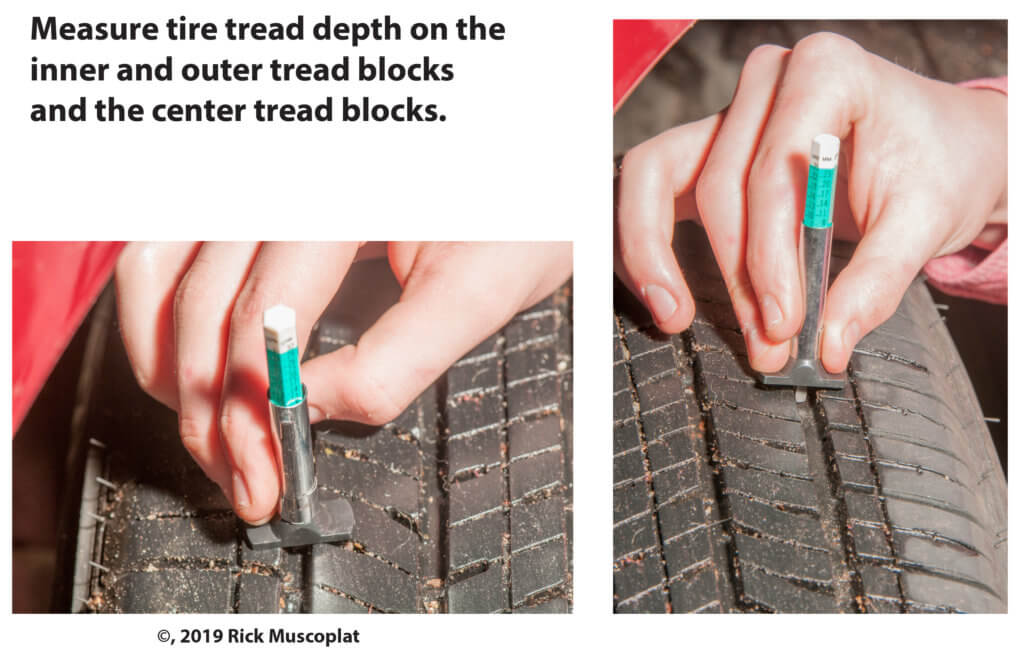
1) Wipe the dirt off the tire before starting your measurements
2) Start by checking the tread depth on the outermost tread blocks. Record the measurement.
3) Then, check the tire tread depth in the center tread blocks, followed by the innermost tire tread blocks.
What the readings mean
The readings should be within 1/32″ of each other. If they vary more than that, you have a tire pressure or alignment issue.
If the tread is worn more on the inner and outer tread blocks the tires are under-inflated
The weight of the vehicle 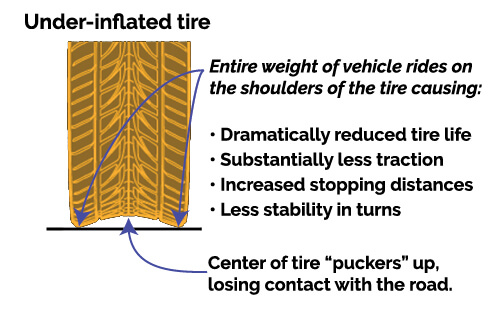 is riding on the shoulders of the tires and the center is puckered up. So you’re wearing off the tread blocks on the shoulders of the tires.
If the tread is worn more in the center tread blocks than the inner or outer tread blocks, your tire is over-inflated
The weight of the vehicle is riding on the center 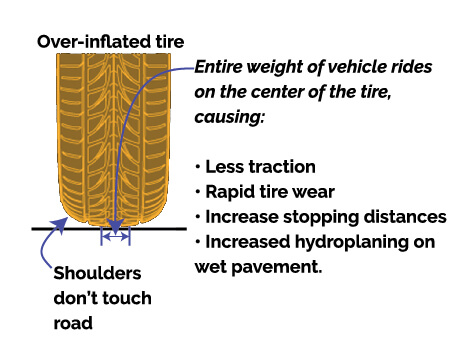 of the tires and wearing out only the center tread blocks.
If the tread is worn more on the inner tread blocks, you have an alignment problem
The tire is tilted in towards the engine and more weight is being transferred to the innermost edge of the tire. This is usually fixed by adjusting CAMBER
If the tread is worn more on the outer tread blocks, this is also an alignment issue
The vehicle is out of alignment. This can be caused by either camber or toe or a combination of both.
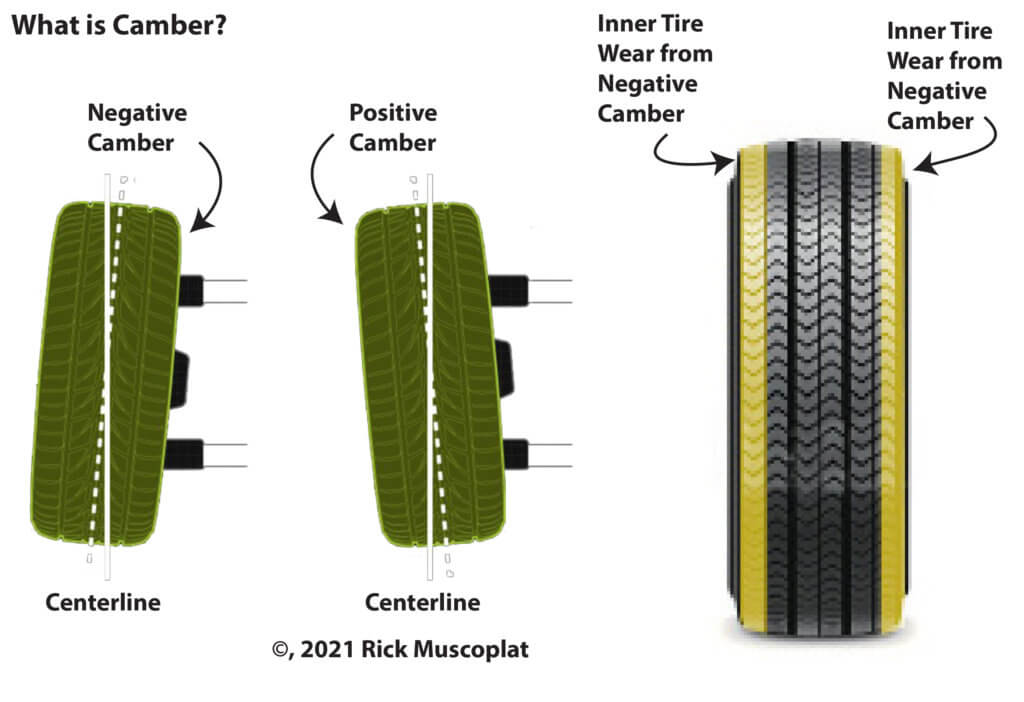
The Camber alignment angle refers to the inward or outward angle of the tire when viewed from the front of the vehicle. Too much inward (negative) camber will cause accelerated wear on the inside shoulder area of the tire. Too much outward (positive) camber will cause accelerated wear on the outside shoulder of the tire. Improper camber is often caused by worn wheel bearings, worn ball joints, worn strut mounts, bent control arm or worn control bushings.
What affects tread wear?
Lack of maintenance is the #1 factor in abnormal tread wear. Running the tire at less than the recommended pressure causes rapid wear on the outer tread while sparing the center tread. Overinflation, on the other hand, causes rapid wear on the center tread while sparing the tread on the inner and outer edges.
Misalignment (tow or camber) can cause accelerated tread wear on the inner or outer edge of the tire.
Worn shocks or struts cause “cupping” (divots) in the tread as the tire bounces too much after hitting an obstacle or pothole and then hits the pavement, causing a gouge in the rubber.
Out of balance causes uneven tread wear.
Tread and traction
The greater the tread depth, the more traction the tire can create with the road. In wet weather, deep tread, sipes and the voids between the tread blocks act to squeeze water off the road and move it to the sides of the tires. In snow conditions, the voids and sipes capture, compress and eject snow from the road surface, proving traction.
Studies have shown that once tread wears down to 4/32”, traction decreases dramatically from that point to 2/32”. In effect, the useful life of a tire is really only 6/32” to 8/32” of the original tread.
Tire Inflation
The recommended inflation pressure for a vehicle is listed on a decal in the driver’s door area. The recommended tire pressure is based on a number of factors like the weight of the vehicle, the maximum payload rating, and passenger comfort. The recommended pressure for most passenger vehicles is 30 to 36-psi.
The MAXIMUM pressure listed on the tire is NOT the recommended pressure. It is exactly as it says it is; the MAXIMUM pressure that the tire can be inflated to, regardless of the load.
The tread is referred to as TREAD, not thread. Thread is used for sewing, not tires.
©, 2021 Rick Muscoplat
Posted on by Rick Muscoplat