
Complete Guide to Car Battery Testing and Diagnosis
Understanding Car Battery Voltage Readings
Quick Summary
A proper car battery health check includes:
• Measuring battery voltage
• Performing a cranking test
• Checking for voltage drop at the terminals, and, ideally,
• Conducting a car battery CCA test with a digital battery analyzer.
A battery can show 12.6 volts and still fail to start your vehicle if it can’t deliver enough current. Learning how to perform a car battery voltage test and check a car battery with a multimeter can help you avoid unexpected breakdowns and determine when it’s time to replace it.
How to Test a Car Battery and Know When It’s Time for Replacement
Over the years, I’ve tested thousands of batteries, and I’ve learned one important lesson: a battery can look healthy on the surface while hiding serious problems inside.
Many DIYers pull out a voltmeter, see 12.6 volts, and assume the battery is fine. Unfortunately, that’s not always true. Voltage only tells you the battery’s state of charge. It doesn’t tell you whether the battery can deliver the amperage needed to crank an engine on a cold morning.
If you want an accurate answer, you need to perform several tests. Here’s exactly how I recommend testing a car battery.
Step 1: Perform a Car Battery Voltage Test — The simplest way to begin is with a car battery voltage test.
How to Test a Car Battery With a Multimeter
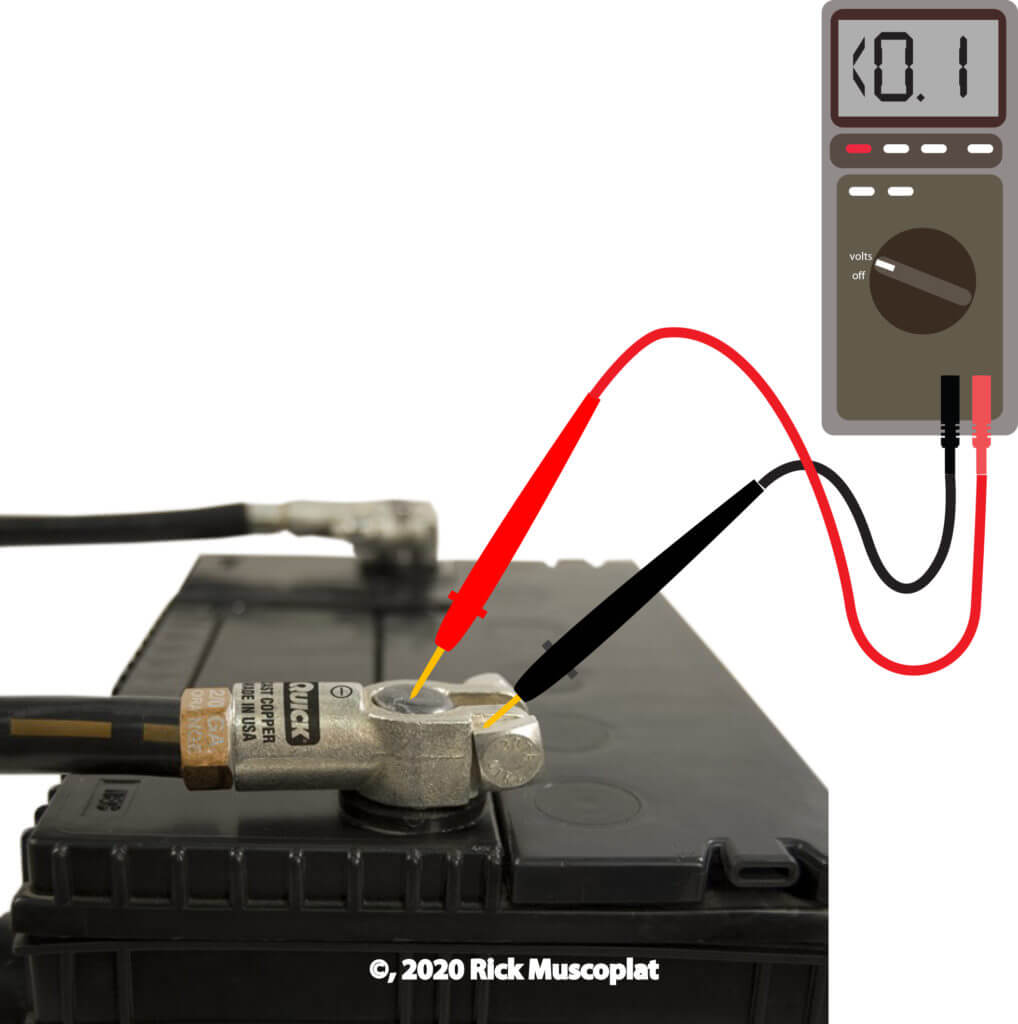
Battery voltage drop test
• Turn off the engine and all accessories.
• Set the multimeter to DC volts.
• Connect the red lead to the positive battery post.
• Connect the black lead to the negative battery post.
• Read the voltage.
• Compare the voltage reading to the voltage/temperature chart below to find the battery’s state of charge
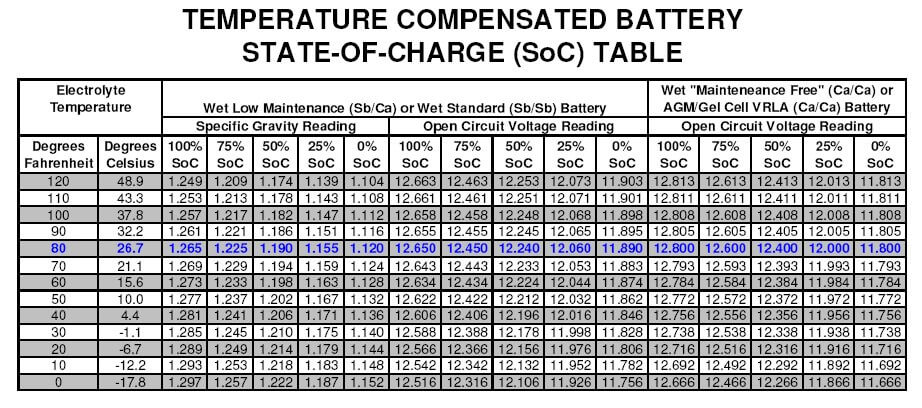
Keep in mind that a voltage test only tells you the battery’s charge level. It does not tell you whether the battery is healthy.
Step 2: Perform a Cranking Voltage Test — This step helps determine whether the battery can produce enough current. Leave the multimeter connected and have a helper crank the engine. Watch the voltage reading during startup.
A healthy battery should generally stay above:
• 10 volts during cranking
• If the voltage drops below 10 volts, the battery’s internal condition is deteriorating.
• If the voltage falls below 9.6 volts, replacement is usually recommended.
This test is often the quickest way to determine whether a car battery is dead or nearing failure.
Step 3: Check for Voltage Drop at the Battery Terminals — I’ve seen many batteries condemned when the real problem was corrosion between the terminals and battery posts. To test for excessive resistance:
• Set your meter to the lowest DC voltage setting.
• Place one lead on the battery post.
• Place the other lead on the battery terminal.
• Crank the engine.
Repeat on both positive and negative sides.
• A reading greater than 0.1 volt indicates excessive resistance.
• Cleaning the battery posts and terminals may restore normal starting performance.
Step 4: Perform a Car Battery CCA Test — A CCA test provides far more information than a simple voltage reading. CCA stands for Cold Cranking Amps. This rating indicates how much current the battery can provide for 30 seconds at 0°F while maintaining usable voltage. Many professional shops rely on these tests because they accurately predict battery failure before it happens.
Modern digital battery testers measure:
• Cold Cranking Amps
• Internal resistance
• Conductance
• Battery health
• State of charge
What Is a Car Battery Load Test?
A car battery load test measures the battery’s ability to deliver current under load. Traditional load testing applies a load to the battery using a carbon pile equal to half the battery’s rated CCA for 15 seconds.
For example: The tester is connected to a battery rated at 600 CCA and tested at 300 amps for 15 seconds while monitoring the voltage. The voltage must not drop below 9.6 volts. If the voltage falls below that threshold, the battery fails the load test.
Why Your Car Battery’s Internal Resistance Matters
One of the most important indicators of battery condition is internal resistance. A car battery is built with lead plates that connect to a bus bar. Over time, the plate-to-bus-bar connections develop higher internal resistance. In addition, plate sulphation reduces the power each plate can deliver.
An internal resistance test indicates the condition of your car battery by measuring its internal resistance. It is a highly accurate indicator of whether your battery should be replaced
That’s why a battery can still show 12.6 volts but fail to start an engine. Modern digital testers measure resistance and conductance to provide a more accurate picture of battery health.
Why batteries fail the test
• Lead plates sulfate
• Active material sheds
• Internal connections deteriorate
• Resistance increases
When Should You Replace a Car Battery?
I generally recommend replacement when:
Replace Immediately If:
• The battery fails a load test
• The battery fails a CCA test
• Cranking voltage drops below 9.6 volts
• The case is swollen or cracked
• The Battery leaks acid
Consider Replacement If:
• The battery is more than 4 years old
• The starting performance is declining
• Internal resistance is high
• The battery repeatedly requires charging
Modern batteries last 3 to 4 years, less in hot climates
Weak Car Battery Symptoms
Before reaching for a meter, look for common weak car battery symptoms:
• Slow engine cranking
• Clicking noise when turning the key
• Dim headlights
• Interior lights are fading during startup
• Electronic accessories behaving erratically
• Battery warning light illuminated
• Vehicle requiring frequent jump starts
• Corroded battery terminals
• The battery is older than four years
If you’re experiencing any of these symptoms, it’s time for a complete battery inspection.
Choosing a Battery Tester
For DIY battery testing, I recommend a digital conductance tester rather than an old-style load tester. A good digital tester can perform:
• Voltage testing
• Battery health analysis
• Conductance testing
• Internal resistance testing
• CCA verification
These tools provide far more accurate results and can often predict battery failure months before it occurs.
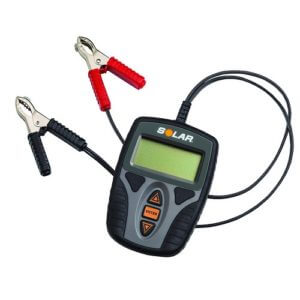
Solar BA9 Battery Tester
A solid-state battery tester like the Solar BA9 is a great way to assess your battery’s overall condition. This tester checks several types of batteries, from the traditional flooded lead-acid (SLA) found in most cars to Absorbed Glass Mat (AGM) flat plate, AGM spiral-wound, and even gel-cell batteries used on electric-start lawn mowers.
The tester conducts a simulated load test, as well as conductance and resistance tests. When a car battery tests good using this type of charger, it’s an indication that you can count on the battery to perform in the future. Repeat the battery test each season for peace of mind
Midtronics is considered top-of-the-line in the auto trade. But their products are pricey. Expect to pay at least $200 for a Midtronics battery tester. A less expensive and equally accurate option is the Solar BA9 battery tester (around $55 on Amazon).
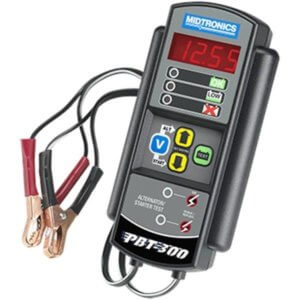
Battery testers to avoid
Several companies make a combination of volt and load testers. In the industry, these are referred to as battery toasters because the load test uses heating coils similar to those used in a toaster. They’re cheap, but they’re not very reliable because the resistance of the coils changes based on
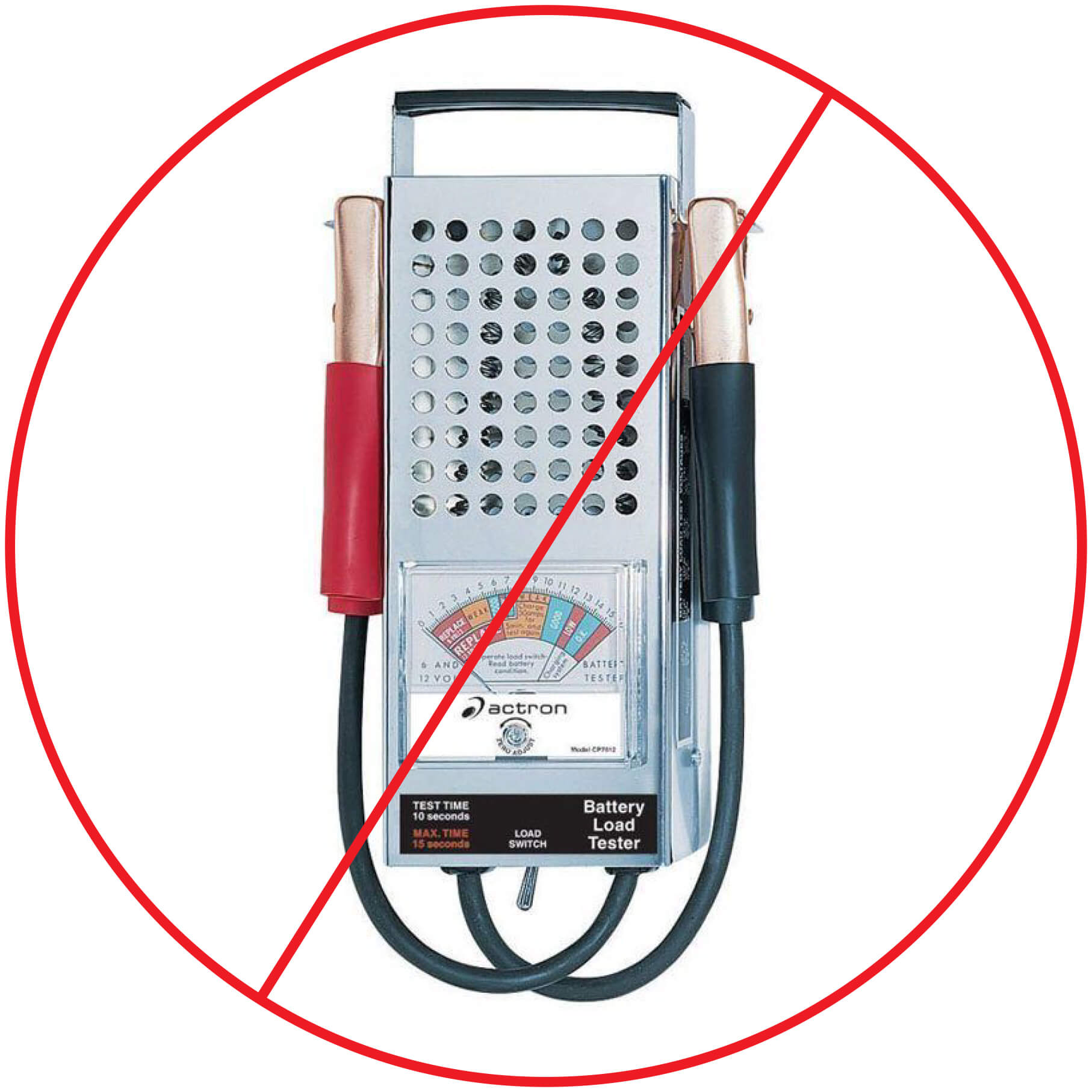
An old-fashioned battery tester
on their temperature. Perform the test, and you’ll get one reading. Perform it 15 seconds from now, and you’ll get a different reading.
Final Thoughts
If you truly want to know how to test a car battery, don’t stop at checking voltage. A complete battery evaluation includes a car battery voltage test, a cranking test, a voltage-drop test, and, ideally, a car battery CCA test using a digital battery analyzer.
A battery that shows proper voltage may still be nearing failure if it can’t deliver sufficient current. By performing these tests regularly, you’ll avoid surprise breakdowns, extend battery life, and know exactly when replacement is necessary.
©, 2018 Rick Muscoplat
Posted on by Rick Muscoplat