
Ignition Coil Operation: The Real Science Behind Spark
What Happens Inside an Ignition Coil
Quick Summary
An ignition coil uses basic electromagnetic principles to store energy and then release it in a controlled, violent burst. Understanding ignition coil operation makes it easier to diagnose misfires, weak spark issues, and no-start conditions. Once you grasp how the primary and secondary windings interact, ignition problems stop being mysterious and start being measurable.
Article
The Science Behind Ignition Coils: How an Ignition Coil Turns 12 Volts Into 40,000
I’ve lost count of how many times I’ve heard someone say an ignition coil “boosts voltage.” That’s technically true, but it skips over what’s really happening. An ignition coil isn’t a voltage booster in the moment—it’s an energy storage device that releases voltage only when the magnetic field collapses. Once you understand that, the operation of an ignition coil makes perfect sense.
Every gasoline engine depends on an ignition coil to create enough electrical pressure to jump the spark plug gap and ignite the air-fuel mixture. Without that spark, compression is meaningless.
Ignition Coil Operation Is Based on Magnetic Induction
At its core, an ignition coil is a transformer. Inside the housing are two windings of wire—the primary and the secondary—wrapped around an iron core. The entire purpose of this design is to create, store, and then rapidly collapse a magnetic field.
The ignition coil does not continuously generate high voltage. High voltage only appears at the exact moment the magnetic field collapses. That timing is what makes spark ignition possible.
How the Primary Circuit Turns an Ignition Coil Into an Electromagnet
The primary winding inside the ignition coil is made from relatively thick wire and contains only a few hundred turns. When the ignition system applies battery voltage to this winding, current begins to flow. As soon as current flows, the iron core becomes magnetized.
This is a critical point in ignition coil operation: the coil is not doing anything dramatic yet. It is simply storing energy in the form of a magnetic field. The longer the primary circuit stays energized—within limits—the stronger that magnetic field becomes.
Modern engine computers control this precisely using dwell time, ensuring the ignition coil reaches full saturation without overheating
How the Secondary Circuit Creates High Voltage
Wrapped around the primary winding is the secondary winding, made from extremely fine wire. Instead of hundreds of turns, it contains thousands—often 20,000 or more.
This huge difference in turn ratio is what allows an ignition coil to generate such extreme voltage. But voltage doesn’t appear until the magnetic field collapses.
When the ignition system abruptly shuts off current to the primary winding, the magnetic field collapses almost instantly. That collapsing field cuts across the secondary winding, inducing a massive voltage spike. This is classic electromagnetic induction, and it’s the heart of ignition coil operation.
How an Ignition Coil Can Produce 40,000 Volts From 12 Volts
This is where many explanations go wrong. The ignition coil doesn’t “step up” 12 volts in real time. Instead, it converts stored magnetic energy into electrical pressure.
The faster the magnetic field collapses, the higher the induced voltage in the secondary winding. That’s why ignition modules and engine computers are designed to shut off the primary circuit sharply rather than gradually.
The resulting voltage surge travels through the ignition coil output, down the plug wire or boot, and across the spark plug gap—where resistance finally forces the voltage to discharge as a spark.
Inside the Ignition Coil: Primary Windings and Iron Core
Inside a typical ignition coil, the primary winding contains roughly 200 turns of heavy-gauge wire wrapped around a laminated iron core. 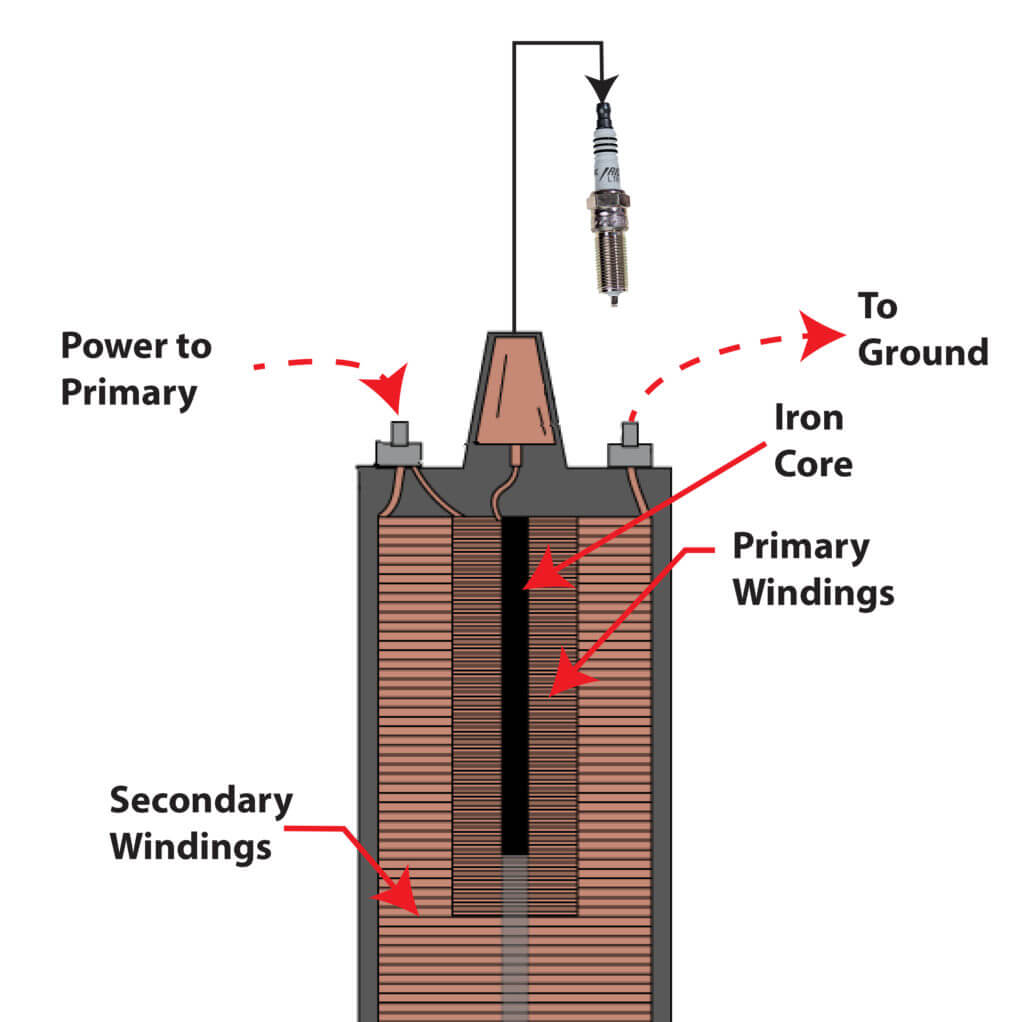 The iron core intensifies the magnetic field, allowing more energy to be stored in a compact space.
When 12 volts are applied, the ignition coil becomes a powerful electromagnet. Nothing sparks yet—but the system is fully charged and waiting for the collapse.
Secondary Windings: Where Voltage Is Born
The secondary winding is wrapped either around the primary winding or around the core itself, depending on coil design. With roughly 20,000 turns of fine wire, even a brief magnetic collapse generates enormous voltage.
This design is why ignition coils are sealed in epoxy or oil. A single internal insulation failure can allow voltage to leak internally instead of reaching the spark plug.
See this post for information on bad ignition coil symptoms
See this post for information on how to test an ignition coil
How Often Does an Ignition Coil Fire?
The frequency with which an ignition coil produces a spark depends on the ignition system design.
In a traditional single-coil distributor system, the coil fires once for every cylinder firing event. The formula looks like this:
At 3,000 RPM on a four-cylinder engine, the ignition coil fires about 6,000 times per minute. That’s 100 sparks every second—nonstop.
In modern coil-on-plug systems, each ignition coil fires only for its assigned cylinder. That reduces workload, improves spark energy, and dramatically increases reliability.
Why Understanding Ignition Coil Operation Matters
Once you understand ignition coil operation, diagnosing misfires becomes much easier. A weak spark isn’t always caused by the spark plug—it’s often caused by reduced magnetic saturation, internal insulation breakdown, or improper dwell control.
Knowing how an ignition coil works allows you to test it intelligently instead of guessing or throwing parts at the problem.
©, 2020 Rick Muscoplat
Posted on by Rick Muscoplat