
Knock Sensor Code Explained: Causes, Diagnosis, and Repair
Common Causes of a Knock Sensor Code
Quick Summary
A knock sensor is your engine’s early-warning system against destructive combustion events like pre-ignition and detonation. When it works properly, it protects pistons, valves, and bearings by telling the computer exactly when knock occurs, so timing and fuel can be adjusted instantly. When a knock sensor code sets, the sensor itself is rarely the culprit—wiring issues, poor connections, or engine conditions that actually cause knock are far more common.
Article
How it Protects Your Engine (And Why It Matters)
Carmakers didn’t add a knock sensor just to meet emissions rules—they added it because modern engines run closer to the edge than ever before. Higher compression ratios, aggressive ignition timing, turbocharging, and leaner air-fuel mixtures all make engines more efficient, but they also make them more vulnerable to abnormal combustion.
It exists to catch those problems before they turn into melted pistons or broken ring lands. And once you understand how it works, diagnosing a knock sensor code becomes far less intimidating.
Why Detecting Knock Is So Important
Pre-ignition and detonation aren’t just annoying noises—they’re engine killers.
Pre-ignition happens when the air-fuel mixture ignites before the spark fires.
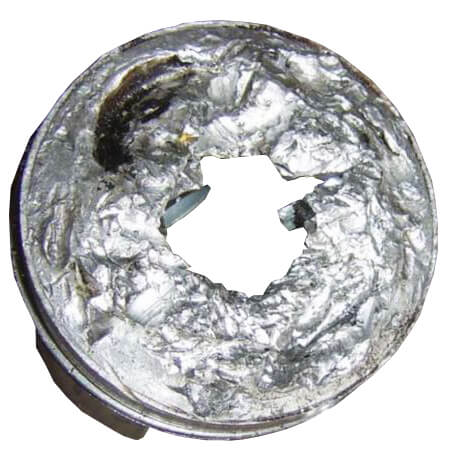
Piston damage caused by the high heat of pre-ignition
Carbon buildup inside the combustion chamber can glow red-hot and act like a second ignition source. When that happens, the piston is still coming up toward top dead center, and pressure spikes violently. Prolonged pre-ignition can burn a hole straight through the piston crown.
Detonation is different but just as dangerous. Detonation occurs after the spark plug fires. As the flame front expands,

Examples of detonation damage
pressure rises so quickly that remaining pockets of unburned fuel spontaneously ignite. Multiple flame fronts collide, creating the sharp metallic knock people often describe as “ping.”
The knock sensor allows the engine control module to distinguish between normal and destructive combustion. Based on when the knock signal occurs relative to spark timing, the ECM can retard ignition timing, enrich the air-fuel mixture, or do both to protect the engine.
That’s why a working knock sensor is critical to engine longevity.
How the ECM Uses Sensor Data
Here’s where things get more sophisticated than most people realize. The sensor can’t tell the difference between detonation and other vibrations—like hitting a pothole or driving over a rumble strip. So the ECM cross-checks the signal against crankshaft speed data.
During real detonation, the affected cylinder produces less torque, causing a slight drop in crankshaft rotational speed. If the ECM sees a knock signal and a corresponding drop in crank speed, it knows the knock is real. If there’s vibration without a change in crankshaft speed, the ECM ignores it.
This is also why a knock sensor code isn’t set just because the sensor “hears” something—it’s set because the signal doesn’t behave the way the ECM expects.
How a Knock Sensor Code Is Set
When the engine starts, the ECM sends a bias voltage to the knock sensor. Because it knows the sensor’s resistance and the wiring circuit, it expects a specific return voltage.
If the return voltage is too high, too low, or missing altogether, the ECM assumes there’s an electrical fault and sets a knock sensor code. This could be due to an open circuit, a short to ground, a short to voltage, or excessive resistance in the wiring or connector.
What’s important to understand is that a knock sensor code usually means the ECM can’t trust the signal—not that the engine is actively knocking.
How Often Knock Sensors Actually Fail
In real-world repair work, knock sensors fail far less often than people think. They’re solid-state devices with no moving parts. Once installed, they usually last the life of the engine.
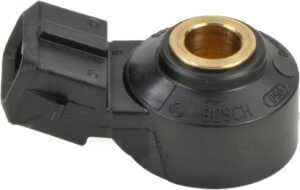
A typical knock sensor.
Most knock sensor code complaints trace back to wiring issues, corroded connectors, oil intrusion in the harness, or poor sensor mounting. Even dropping a new sensor before installation can damage the crystal and cause a false code.
Interestingly, when people replace a knock sensor, and the code disappears, it’s often because unplugging and reconnecting the electrical connector restored a clean, low-resistance connection—not because the sensor itself was bad.
How to Diagnose a Knock Sensor Code the Right Way
When I’m diagnosing a knock sensor code, I start with the basics. I inspect the wiring harness and connector for corrosion, oil saturation, pin tension problems, or damaged insulation. A visual inspection alone fixes more of these codes than most people expect.
Next, I verify the sensor’s torque. A knock sensor must be tightened to the manufacturer’s specification. Too loose and it can’t “hear” properly. Too tight and the crystal can be damaged or produce erratic signals.
From there, I use scan data to confirm whether the ECM is seeing any knock activity and whether that activity makes sense under load. If the engine is actually knocking due to carbon buildup, incorrect fuel octane, overheating, or lean operation, fixing the underlying engine condition is the real repair, not replacing the sensor.
Only after electrical checks and engine condition checks do I consider replacing the knock sensor itself.
Fixing the Root Cause Matters More Than Clearing the Code
Clearing a knock sensor code without fixing the cause is risky. If the ECM can’t detect knock, it can’t protect the engine. That may not show up as a drivability issue right away, but over time, it increases the risk of piston damage, bearing wear, and catastrophic engine failure.
Understanding how a knock sensor works—and how a knock sensor code is set—lets you fix the problem correctly instead of guessing.
When people replace the knock sensor and the trouble code goes away, it’s usually because they’ve removed and reinstalled the electrical connector, and the sensor now has good contact.
For more information on how to test a knock sensor, see this post.
©, 2022 Rick Muscoplat
Posted on by Rick Muscoplat