
Common Causes of Spark Plug Failure: A Comprehensive Guide
Learn the most common causes of spark plug failure and the failure symptoms
Spark plugs play a critical role in the efficient operation of an internal combustion engine. They ignite the air-fuel mixture in the combustion chamber, driving the engine’s pistons and generating power. However, over time, spark plugs can fail for various reasons, affecting engine performance, fuel efficiency, and emissions. Understanding the common causes of spark plug failure is essential for maintaining optimal engine health.
Improper torque is the #1 cause of spark plug failure
NGK reports that over 90% of all early spark plug failures can be traced to improper spark plug torque during installation. I bet you’ve never used a torque wrench to install spark plugs. Even in the days before aluminum cylinder heads, DIYers and professional technicians never used a torque wrench to tighten spark plugs. But just because they installed and fired up doesn’t mean it wasn’t the cause of their eventual failure. Here’s why.
Excessive torque damages the spark plug seal
Spark plugs consist of a hollow threaded shell and a porcelain insert. When you tighten a spark plug too much, you distort the shell and break
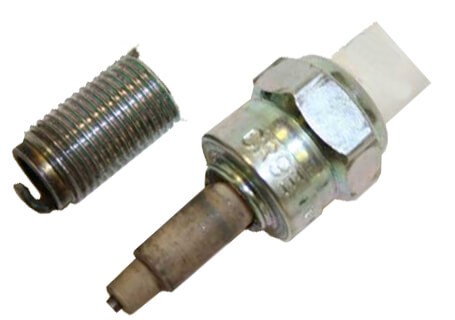
Broken spark plug due to excessive torque
the shell-to-porcelain gas seal or cause a hairline fracture that results in misfires. Spark plug manufacturer NGK says that improper torque is responsible for 90% of spark plug warranty claims. Bad plug? Yeah, you probably caused it yourself.
If you don’t clean around the spark plug wells before removing the old spark plugs, the dirt, and grit can fall into the combustion chamber or lodge on the seat or threads. That dirt can cause improper tightening even if you use a torque wrench.
Don’t use anti-seize on new spark plugs
Yes, I realize you’ve been taught to use it. But that advice is OBSOLETE. Read this post about the change in spark plug installation techniques. Most new spark plug threads are
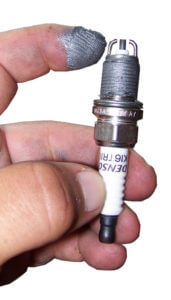
Most spark plugs don’t require anti-seize
treated with a metallic zinc or nickel anti-seize coating AT THE FACTORY. The coating prevents thread galling during installation and prevents seizing in the cylinder head. Adding anti-seize only throws off your torque calculations, causing you to over-torque.
Tightening a spark plug by hand without a torque wrench is just plain crazy
If you under-tighten a spark plug, it won’t seat properly, causing combustion gasses to leak out. It also won’t make full contact with the cylinder head, which means it can’t properly dissipate heat. That results in pre-ignition and detonation and possible engine damage. Under tightening can also cause the spark plug to eventually blow right out of the cylinder head, taking the cylinder head threads with it. In addition to breaking the shell-to-porcelain seal, overtightening can distort the cylinder head threads or even rip them out.
What’s the proper torque specification?
The proper torque depends on the type of spark plug seat, whether tapered or washer, the cylinder head material, and the spark plug thread diameter. Refer to the shop manual or spark plug manufacturer’s website for the proper torque.
Improper electrode material metal is the 2nd most common cause of early spark plug failure
Carmakers know their engines and when they recommend platinum, double platinum, yttrium or iridium spark plug, they mean it. You should never downgrade spark plugs to save money. The spark plug will fail early.
The wrong spark plug gap is the 3rd most common cause of spark plug failure
Many plugs come pre-gapped. But that doesn’t mean you shouldn’t check the gap with your gauge. If the gap is too large for your engine, close the gap to spec. Excessive gap stresses the ignition coils and causes fire-through damage to boots and plug wires.
The wrong heat range is the 4th most common cause of early spark plug failure
Again, the carmaker knows their engines better than you. Use the recommended heat range for the longest spark plug life, best engine performance, and best gas mileage.
Spark plug failure symptoms
• Engine Misfires, Rough idle, Surging, or Hesitation—When a spark plug fails, it may not produce a strong enough spark to ignite the air-fuel mixture in the combustion chamber. This can lead to incomplete combustion, causing the engine to misfire. You may notice this as a hesitation or jerk while accelerating, or the engine may feel rough and unstable at idle. Continuous misfires can also damage the catalytic converter and other engine components.
• No-start or Hard Starting—A failing spark plug can make it difficult to start your vehicle, especially in cold weather. An enlarged gap due to wear can cause a spark plug to not produce a strong enough spark to ignite the air-fuel mixture, particularly when the engine is cold and requires a richer mixture to start. If you experience extended cranking times or the engine fails to start, it’s possible that one or more spark plugs are failing.
• Poor Fuel Economy— When the spark plugs do not ignite the fuel properly, the engine may consume more fuel to compensate for the lack of power. This inefficiency can result in a noticeable drop in fuel economy.
• Increased Exhaust Emissions— Faulty spark plugs can lead to incomplete combustion, which can increase exhaust emissions. Worn spark plugs can cause you to fail an emissions test.
A failing spark plug can trigger the Check Engine Light (CEL) on your dashboard. Modern vehicles are equipped with onboard diagnostics systems that detect issues with the engine’s performance. If the system detects a misfire or other issue related to the ignition system, it will illuminate the CEL. If your
©, 2017 Rick Muscoplat