
The Importance of Changing Spark Plugs for Engine Performance
When and How to Replace Your Spark Plugs
Like any other automotive wear part, spark plugs have a finite lifespan and will eventually need replacement to ensure optimal engine performance and fuel efficiency. Knowing when to change spark plugs is essential for maintaining your vehicle. Here are key indicators and general guidelines to help you determine the right time for a replacement.
Here are the facts about spark plug change intervals
• Of the vehicles built since the 2000 model year, 38% have a spark plug change interval of less than 100K
• Of those, 2/3 have a spark plug change interval of less than 60K miles
• While precious metal spark plugs are designed to provide longer service life, the demands of today’s modern engine continue to shorten the life of even precious metal plugs.
• Lean burn engines and engines with direct injection run hotter and shorten spark plug life
• Turbochargers increase combustion pressures and combustion temperatures, which shorten spark plug life
How late model engines result in shorter spark plug life
• Lean-burn engines— Smaller 4-cylinder engines achieve emissions compliance using a leaner mixture that burns hotter than older engine. A hotter burn means a shorter spark plug life. Even though the newer iridium spark plugs have higher melting point, they still have a shorter life when used in a lean-burn engine or one equipped with a turbocharger.
• Direct injection increases cylinder pressure. DI fuel injectors can inject fuel at up to 2,000 psi. thereby increasing compression pressures, and that can lower spark plug life.
• Turbo chargers also boost cylinder pressure— Higher cylinder pressures wear out spark plugs faster
• Coil-on-Plug ignition coils— COPs output higher firing voltages that can wear plugs faster.
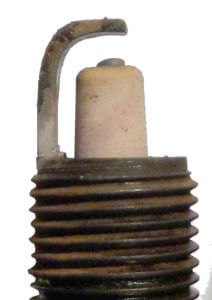
Worn spark plug with rounded center electrode and excessive gap
Spark plug life depends on MANY factors, including your particular engine design, ignition system design, the type of plug recommended by the factory, and whether the engine is equipped with a turbo. Since there’s no universal engine, there’s no such thing as universal spark plug life.
Spark plug life is listed in your maintenance guide
Never depend on word-of-mouth advice from your buddies. Here’s an example of how much the spark plug change intervals vary:
2010 Ford Fusion: Spark plug change spark plugs at 90,000 miles
2013 Chevy Equinox: Spark Plug change spark plugs at 97,500 miles
2013 Subaru Forrester: spark plug change spark plugs at 60,000 miles
2016 Subaru Forester: Spark plug change at 60,000 miles
2013 Toyota Camry: Spark Plug change spark plugs at 120,000 miles
Can you go beyond the spark plug change interval?
Yes, but not without cost. When you reach 80% of the spark plug’s projected life, the spark plug electrodes are 80% worn. It’s at that point when spark plugs start to misfire. And those misfires cost you in terms of performance, efficiency, and gas mileage. Worse yet, misfires cause carbon deposits in the cylinder head and can damage the expensive catalytic converter. So it’s NEVER a good idea to go longer than car maker recommendations.
Which plugs should you use?
ALWAYS use the same type of plug recommended by the carmaker. If the car came equipped with fine-wire iridium, you MUST use that same style to get the same life and performance. My preference is to stick with the same brand that was installed at the factory.
Can you change spark plugs yourself?
Replacing spark plugs isn’t a hard job. But one thing has changed from the early days of DIY spark plug change: you now need a torque wrench. Over and under torqueing spark plugs is the number 1 cause of spark plug failure, which results in a misfire and can even cause the spark plug to blow out of the cylinder head (taking the threads with it).
Spark plug torque is dramatically reduced in engines with an aluminum cylinder head. Where you could have gotten away with hand tightening on a cast iron head, doing the same thing on an aluminum head can cause serious and expensive damage. Trust me, your hands can’t tell the difference between 15 ft/lbs and 25 ft/lbs., so ALWAYS use a torque wrench.
For more tips on spark plug installation, see this post
©, 2018 Rick Muscoplat
Posted on by Rick Muscoplat