
The Importance of the PCV Positive Crankcase Ventilation System
Understanding the PCV Positive Crankcase Ventilation System
The PCV Positive Crankcase Ventilation plays a vital role in reducing emissions, improving engine efficiency, and prolonging engine life. Despite its significance, the PCV system is often overlooked during routine maintenance, which can lead to a host of engine problems. This article will delve into the function, importance, and maintenance of the PCV Positive Crankcase Ventilation System, what it does, why it’s needed, and what goes wrong with the PCV.
The Function of the PCV System
The primary function of the PCV Positive Crankcase Ventilation system is to remove harmful blow-by gases from the engine’s crankcase and recirculate them into the intake manifold, where they can be burned in the combustion process. These gases, are a mixture of unburned fuel, air, soot, and combustion byproducts that escape past the piston rings during the combustion process.
Prior to the implementation of the PCV system and emissions laws, carmakers would simply vent the blow-by gasses to the atmosphere, causing air pollution. The gasses must either be vented or removed, because without a PCV system, these gases would accumulate in the crankcase, increasing pressure and potentially causing oil leaks or even damaging engine seals. Additionally, the gases contain harmful substances like hydrocarbons, carbon monoxide, and nitrogen oxides, which contribute to air pollution. The PCV system addresses these issues by routing the gases back into the engine’s intake, reducing emissions, and preventing the buildup of harmful substances in the crankcase.
How combustion gasses escape past the gap
No matter how new the engine, the high
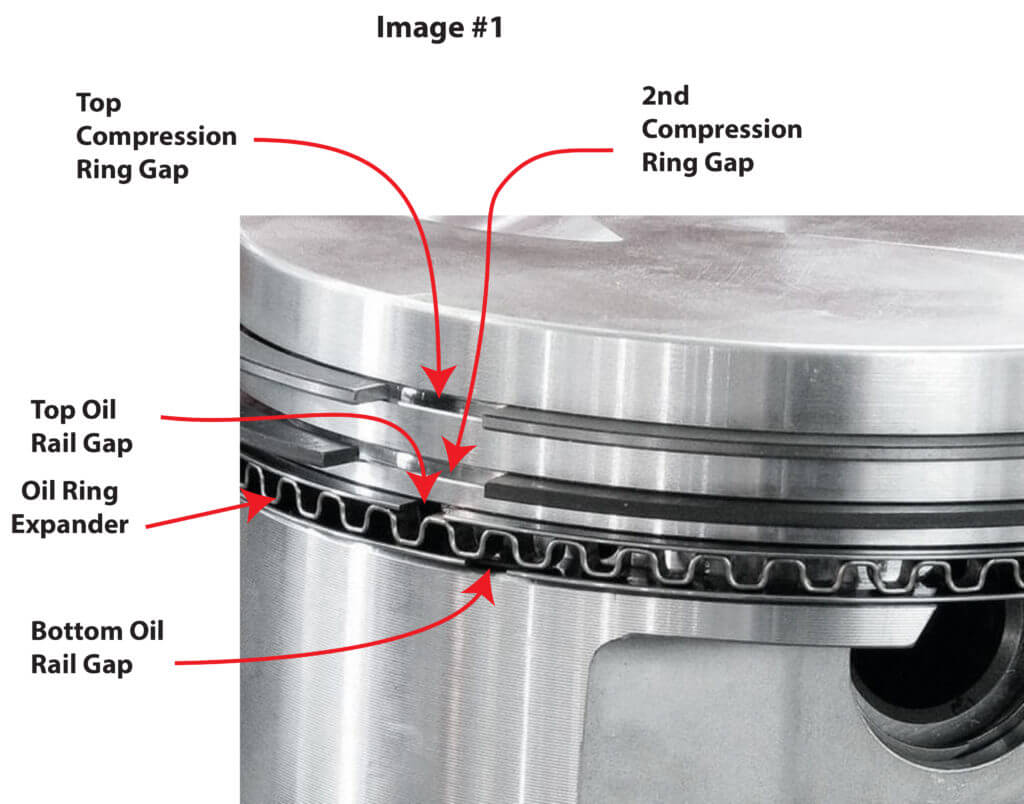
Piston rings installed on piston but not staggered. This image just shows how large the piston ring gap is before compression.
the pressure created during the combustion process forces air/fuel and exhaust gasses through the piston ring gaps and down into the crankcase. In the early days of engine design, way before pollution controls were mandated, these “blowby” gasses were simply vented to the atmosphere through a tube on the back of the engine. Blowby gasses are a major contributor to air pollution, causing smog and respiratory diseases. To eliminate this pollution, carmakers were forced to develop a positive crankcase ventilation system. Here’s how it works.
How a PCV Positive Crankcase Ventilation System works
A tube connects from the intake manifold to
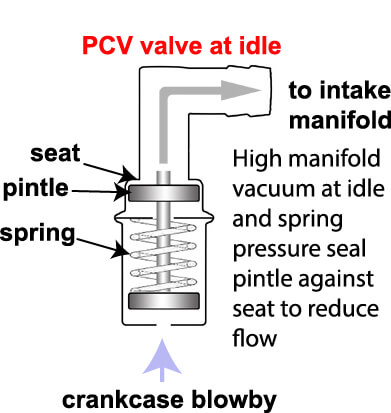
At idle, the PCV valve restricts airflow
the engine’s valve cover. The intake manifold is always in a vacuum state while the engine is running, so it sucks blowby gasses from the crankcase. Filtered replacement air is provided by another tube from the air filter box. Thus, the PCV system acts as a positive crankcase ventilation system.
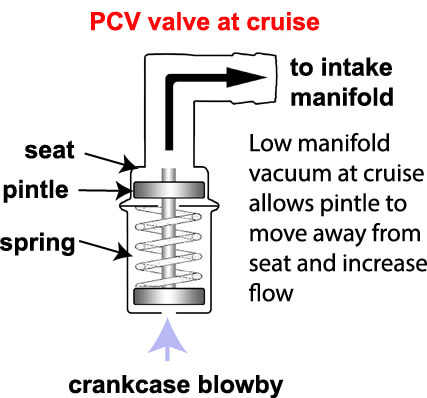
PCV operation at cruising speeds
The PCV Positive Crankcase Ventilation System prevents engine damage from backfire
Since the PCV tubing creates a direct link between the intake and the engine, and since blowby gasses are flammable, carmakers install a one-way check valve between the intake and engine to prevent engine damage in the event of a backfire. If the engine experiences a misfire by way of an intake valve, where fire blows backward through the intake, the pressure forces the PCV valve to close to prevent the fire from entering the crankcase.
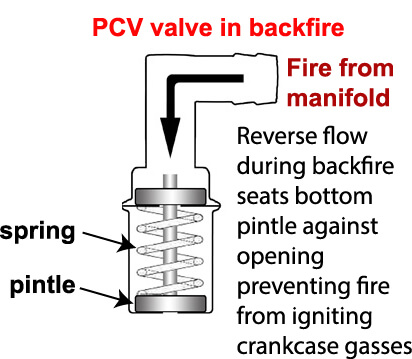
The PCV valve closes to prevent a backfire from igniting crankcase vapors and damaging your engine
The PCV valve is also a metering device
Since the intake is always under vacuum, the PCV valve incorporates an orifice size to the specific engine. The orifice acts as a metering device, so the crankcase is under a specified amount of suction. If the orifice is too large, the crankcase would be under too much suction and would actually pull more blowby out of each cylinder. That would reduce engine performance. If the orifice is too small, the blowby gasses would build up too much pressure in the crankcase which can cause valve cover and oil pan gaskets to leak.
Common Issues with the PCV System
While the PCV Positive Crankcase Ventilation System is relatively low-maintenance, it can develop problems over time. Some common issues include:
• Clogged PCV Valve: Over time, the PCV valve can become clogged with oil sludge and carbon deposits, preventing it from opening and closing properly. This can lead to increased crankcase pressure, oil leaks, and reduced engine performance.
• Vacuum Leaks: A damaged or disconnected PCV hose to the intake manifold can cause a vacuum leak, leading to rough idling, poor acceleration, and increased emissions.
• Oil Contamination: If the PCV system fails, blow-by gases can accumulate in the crankcase and mix with the engine oil, leading to oil contamination. This can cause sludge buildup, increased wear on engine components, and reduced oil life.
• Increased Emissions: A malfunctioning PCV system can result in higher emissions of harmful pollutants, potentially causing the vehicle to fail emissions tests.
Maintaining the PCV System
Regular maintenance of the PCV Positive Crankcase Ventilation System is essential to ensure its proper function and to prevent engine problems. Here are some key steps to maintain the PCV system:
• Inspect the PCV Valve: The PCV valve should be inspected regularly for signs of clogging or damage. If the valve is clogged, replace it.
• Check the PCV hose to the intake manifold for cracks: Inspect the PCV hose for cracks, leaks, or disconnections. A damaged hose should be replaced to prevent vacuum leaks and ensure proper system operation.
• Monitor Oil Condition: Regular oil changes are essential for maintaining the PCV system, as clean oil helps prevent the buildup of contaminants in the system. Additionally, if the oil appears dirty or contaminated, it could be a sign of a PCV system issue.
©, 2020 Rick Muscoplat
Posted on by Rick Muscoplat