
The Ultimate Guide to DIY Oil Changes: 4 Oil Change Tips
Alex’s Tips for Oil Changes: Five oil change tips to make the job easier and faster
Performing a DIY oil change is one of the most essential and straightforward tasks you can do to maintain your vehicle. Not only does it save money, but it also ensures that your car is running smoothly by keeping the engine lubricated and preventing wear. If you’re new to the process or looking to refine your technique, here are some essential oil change tips to make your DIY oil change efficient and successful.
Oil Change Tip #1 Use the right oil filter removal tool
You’ll need an oil filter wrench, and the type you need depends on the type of oil filter for your vehicle. I’ve posted in a separate article on advice to buy an oil filter wrench. Find that post here.
Buy the most current oil and the recommended viscosity oil for your vehicle
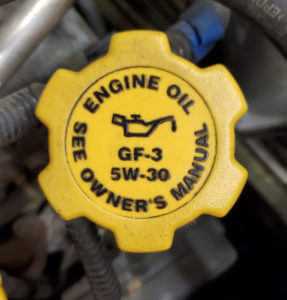
Next, buy the right oil. The American Petroleum Institute (API) classifies motor oil by a service rating. Over the years, oil refiners have made major improvements to motor oil and using the most up-to-date oil is critical to the safe operation of your vehicle. All API ratings for motor oil for gasoline engines start with the letter “S”. The very first classification was SA and that oil was designed for engines made in the 1920’s. The latest API classifications are SP, and it’s backward compatible with earlier engine oil recommendations.
Motor oil is also classified by the International Lubricants Standardization and Approval Committee (ILSAC). ILSAC is a collaboration between the American Automobile Manufacturers Association (AAMA), Chrysler, Ford, GM, and the Japanese Automotive Standards Organization. ILSAC GF-6 engine oil specifications target fuel economy, emission system protection, and enhanced engine oil robustness.
Oil Change Tip #3: Purchase a high-quality oil filter
When it comes to oil filters, it’s best to stick with a name brand like Wix, Fram, Bosch, Pureolator, ACDelco, Denso, Beck-Arnley, and Mahle/Clevite; if you’re using synthetic oil, make sure you buy a premium grade filter to get maximum protection.
Oil Change Tip #4 Lay large pieces of cardboard under the drain pan
I learned this oil change tip the hard way. No matter how careful you are, the oil is going to splash as it hits your drain pan. It’s a lot easier to fold up a scrap piece of cardboard than it is to mop up oil spills on your driveway.
#5: Use a box end wrench to remove the drain plug, not a socket and ratchet
You’ll get better leverage with a box end wrench and greatly reduce your chances of stripping the hex bolt instead of a socket and ratchet. See the image below to understand why you want to exert loosening pressure in the same plane as the drain bolt.
Locate the oil pan drain plug and use a box-end wrench to loosen it. A box-end wrench is much safer than a socket and ratchet because the angle of attack is in the same plane. That drastically reduces the chance of rounding off the shoulders of the drain bolt.
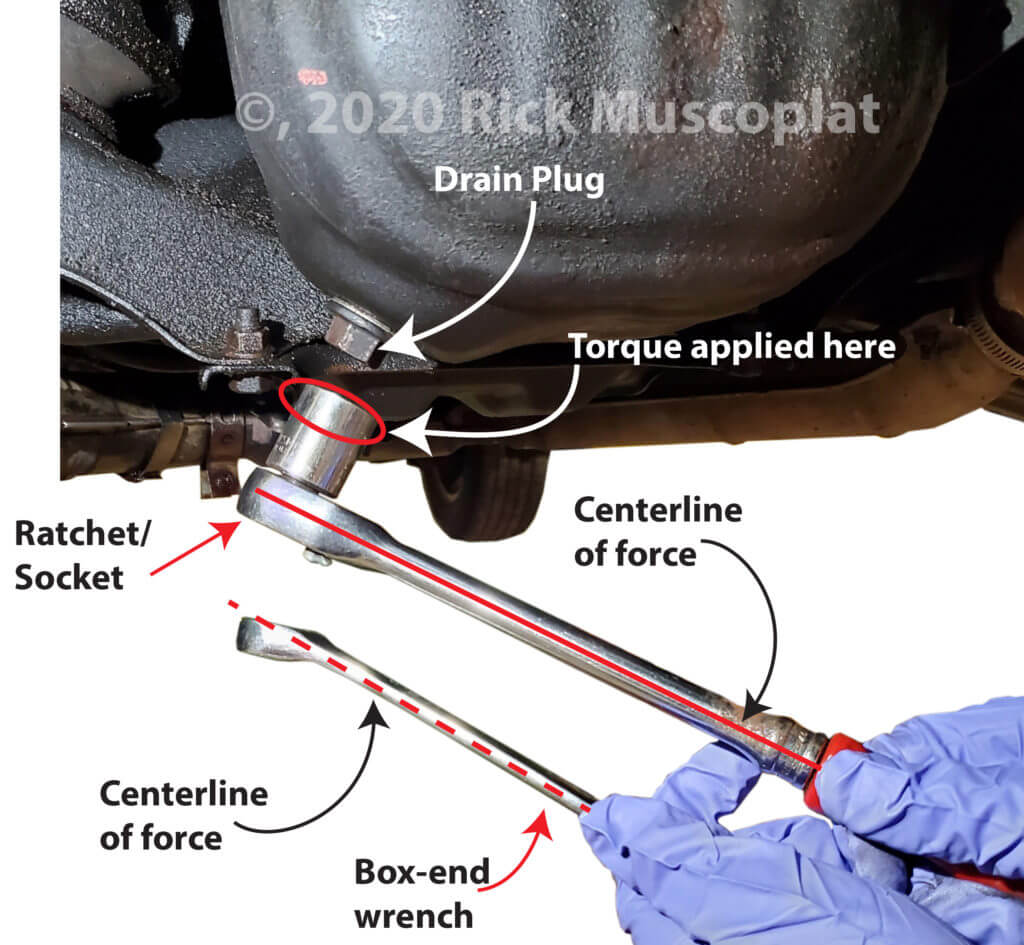
A box-end wrench is far less likely to strip the shoulders on the drain plug
Slide the box-end wrench over the drain bolt and loosen it with a few light blows from the rubber mallet. That’ll save the palms of your hands. Finish loosening the drain bolt with your fingers until you feel the last threads disengage. Oil will start dripping. Then, remove the bolt in one quick motion to avoid taking a bath in oil.
I like to use the Lisle #63600 Import Car Filter Wrench for my Subaru. Open the jaws and slide the wrench over the bottom of the filter. Then attach a 3/8″ drive extension and ratchet. Loosen the filter.
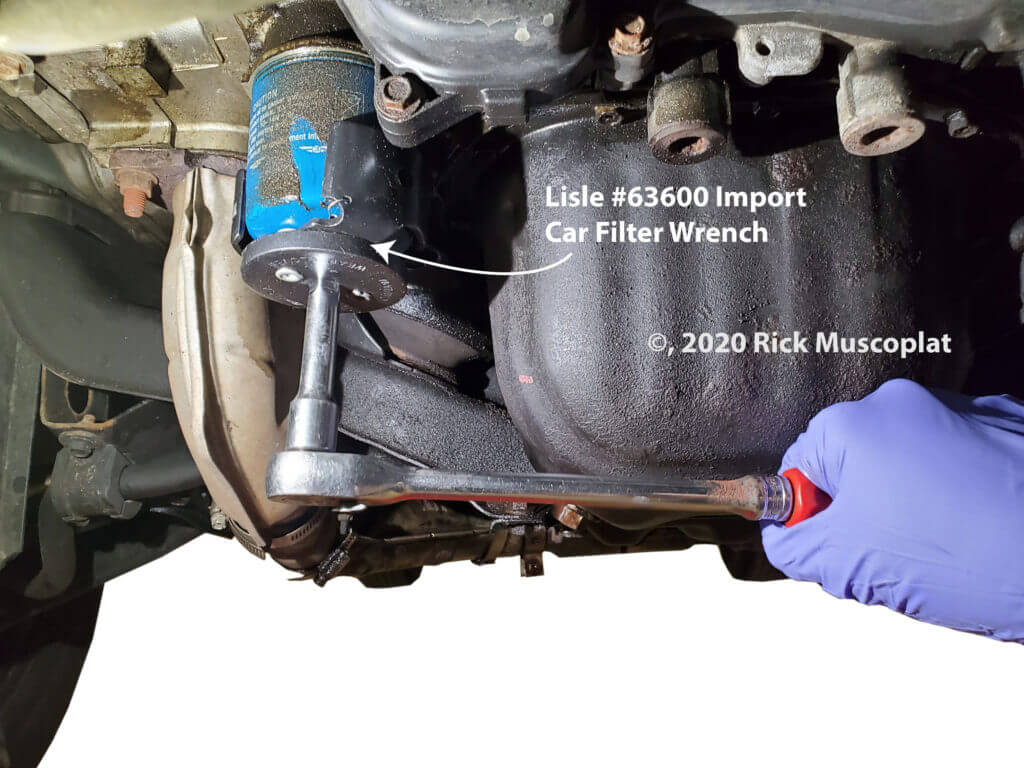
Then spin it off with your fingers and let the oil drain out. Make sure to check the oil filter mounting
surface to make sure the old O-ring isn’t stuck to it.
Place a thin film of new oil on the new gasket and install the new oil filter. Follow the oil filter box’s tightening directions. Never use a wrench to tighten the oil filter.
©, 2020 Rick Muscoplat Alex Steil
Posted on by Rick Muscoplat