
Understanding wheel speed sensors: How they work
Everything You Need to Know About Wheel Speed Sensors
Wheel speed sensors are integral to various safety and performance systems, including Anti-lock Braking Systems (ABS), Electronic Stability Control (ESC), and Traction Control Systems (TCS). Understanding what wheel speed sensors are, the types available, and how they function provides insight into how modern vehicles maintain control and prevent accidents in various driving conditions.
What wheel speed sensors do
Wheel speed sensors track the rotation speed of each wheel (in most vehicles *) and report the speed in either analog or digital form to the Anti-lock Brake Module (ABS Module). The ABS module compares the speed reading from each wheel. If the ABS module senses that one wheel is slowing down faster than the other wheels, it concludes that the slowing wheel is losing traction with the road (due to water, ice or snow). In other words, if all the brakes are applied and one wheel is slowing, the only logical conclusion is that the wheel has lost traction. If left alone, the wheel will lock up, causing it to skid across the road. Skidding tires don’t slow the vehicle, as well as tires that are braking but still have traction with the road.
To prevent skidding and to regain traction, the ABS module releases brake pressure to the slowing wheel so it can rotate at the same speed as the other wheels. Then it applies pressure again to that wheel until it senses it’s about to lock up. Then it releases pressure and repeats the apply/release cycle multiple times until the wheel comes under control. The apply/release operation can happen as often as 7 cycles per second.
How wheel speed sensors work
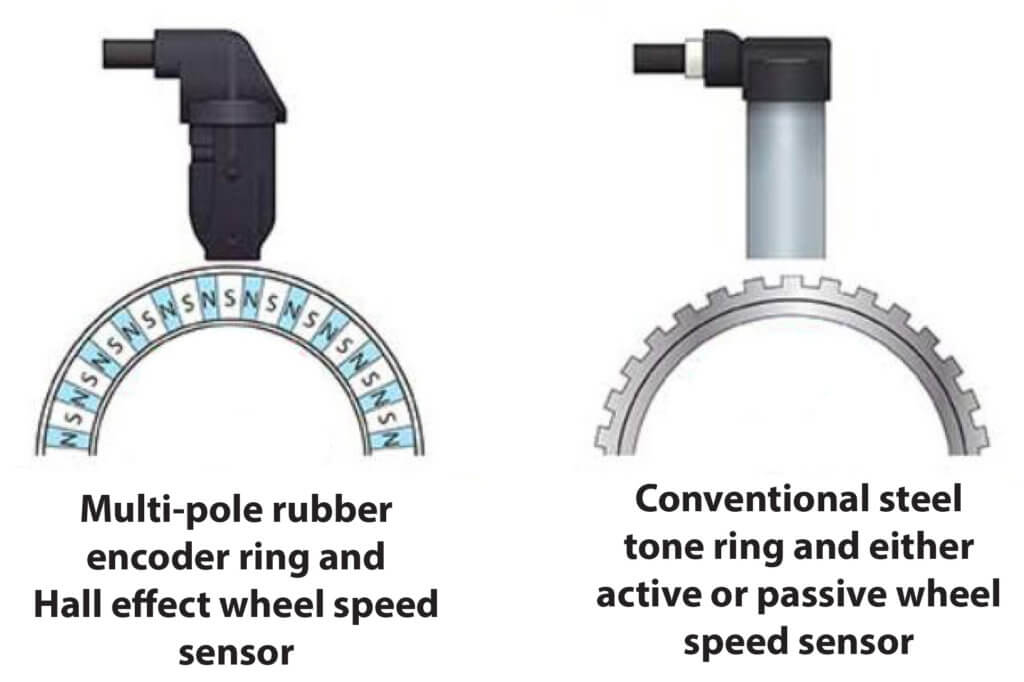
There are two types of wheel speed sensors: passive and active. Both types monitor either a toothed wheel, called a tone ring, or a rubber disc embedded with North/South magnetic material.
How does an passive wheel speed sensor work?
Passive wheel speed sensors are considered first-generation sensors. They’re built with a permanent magnetic at its core. The core is then surrounded by a coil of wire. One wire is connected to the magnet, and the other to the ABS wiring harness.
The sensor is placed close enough to the tone ring to induce magnetic flux onto the tone ring. The “air gap” between the sensor and the tone ring is critical as the magnetic flux is not very strong. As the toothed ring rotates, the distance between the top of the tooth and the valley varies, and so does the magnetic flux. The high/low flux creates an alternating (AC) voltage in the sensor’s coil (shown below). The frequency and amplitude of the high/low voltage indicate wheel speed, and the analog signal is sent to the ABS module. The ABS control unit converts the AC signal to a digital signal for interpretation.
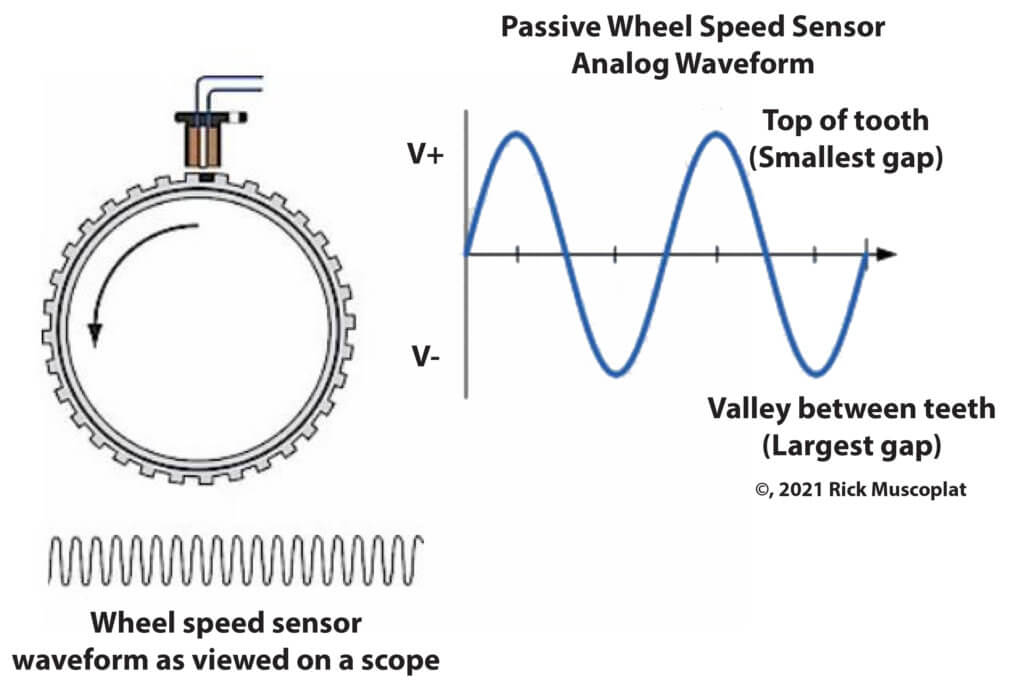
Passive sensors only start to operate when the wheel reaches a certain speed, so they have limited functionality and lower accuracy at very low speeds. They don’t operate if the vehicle is in reverse, so they can’t help determine the direction of travel. Due to the deficiencies inherent in passive wheel speed sensors, most carmakers have switched to active sensors on late-model vehicles.s
How does an active sensor work?
There are two types of active sensors; Hall Effect and Magneto-resistive. Both types require power in order to operate.
A Hall Effect sensor contains a semiconductor and a permanent magnet. As the steel tone wheel rotates, it changes the magnetic flux of the magnet inside the sensor. The semiconductor senses the changes in flux in terms of frequency and amplitude and converts the data into a digital square wave signal for the ABS module.
A Magneto-resistive wheel speed sensor, on the other hand, does not have an internal magnet, nor does it use a steel tone ring. Instead it monitors a multi-pole rubber ring mounted on the axle or wheel bearing.
The Magneto-Resistive wheel speed sensor contains two Magento-Resistive Elements situated close to the multi-pole “phonic wheel,” along with evaluation software and circuitry. The sensors detect a change in magnetic resistance as the phonic wheel rotates and it can sense both forward and reverse rotation. The sensors interpret the changes using evaluation software and circuitry and output a digital signal to the ABS module.
Active wheel speed sensors are far more accurate than passive wheel speed sensors, are able to sense speeds of less them 0.06 mph, as well as direction of travel. The ability to sensor direction and low speed is critical to the operation of both traction control and stability control systems.
* Some carmakers install a wheel speed sensor at each front wheel, but only one-speed sensor for the rear wheels, usually located in the differential on RWD vehicles. You’ll find this setup on older trucks.
Which vehicle systems monitor the wheel speed sensors?
Wheel speed sensors are a critical component of several vehicle safety and performance systems:
Anti-lock Braking System (ABS): Prevents wheel lock-up during hard braking by modulating brake pressure based on wheel speed data.
Electronic Stability Control (ESC): Enhances vehicle stability by detecting and reducing loss of traction.
Traction Control System (TCS): Prevents wheel spin during acceleration by adjusting engine power and applying brake force.
Adaptive Cruise Control (ACC): Maintains a safe following distance by adjusting vehicle speed based on the speed of the vehicle in front.
Tire Pressure Monitoring System (TPMS): Some TPMS systems use wheel speed data to detect differences in wheel rotation that may indicate low tire pressure.
©, 2021 Rick Muscoplat
Posted on by Rick Muscoplat