
What an EGR valve does and bad EGR symptoms
What does an EGR valve do and bad EGR symptoms
An Exhaust Gas Recirculation valve is designed to reduce combustion chamber temperatures to reduce oxides of Nitrogen emissions and help the engine burn a leaner air/fuel mixture without causes accelerated engine wear.
Emissions history and the development of the EGR valve
When the EPA first addressed air pollution, it directed its attention to the amount of unburned hydrocarbons (HC), carbon monoxide (CO), carbon dioxide (CO2), and oxides of nitrogen (NOx). By adjusting and monitoring air/fuel mixtures, a modern computer, and oxygen sensors can keep HC, CO, and CO2 under control. But reducing NOx is a bit harder. Nitrogen dioxide is just one of a group of reactive gasses referred to as “oxides of nitrogen,” or “nitrogen oxides (NOx).” These gases contribute to the formation of smog, ground-level ozone, and small-particle pollution. Plus, NO2 directly contributes to respiratory problems in the population.
An EGR valve reduces oxides of nitrogen emissions by recirculating some exhaust gasses back into the cylinder to cool the combustion event and prevent the formation of oxides of nitrogen (NOx). NOx forms when Nitrogen in the air combines with oxygen at high combustion temperatures, so the only way to reduce NOx is to reduce combustion temperatures.
The recirculated exhaust gas doesn’t burn, so it’s basically adding a non-burnable ballast to the mixture. In most cases, the EGR valve only adds up to 15% to the total air/fuel charge. But that 15% of non-burnable exhaust lowers combustion temperatures enough to significantly reduce NOx. The goal is to reduce NOx, but to do that, car makers need to reduce combustion temperatures. Exhaust gas recirculation has no other purpose but to reduce combustion temperatures.
When an EGR system fails, many people think they can just perform an EGR delete without having any effect on their engine. “It’s just an air pollution device,” they say. But when you perform an EGR delete on an engine designed to use EGR, you can cause serious damage to the engine. So it’s not simply an air pollution issue.
How does an EGR valve reduce emissions?
NOx forms when combustion temperatures are high. That normally occurs at the peak of compression/combustion. The nitrogen in the air combines with oxygen in the air/fuel mixture to form NOx.
So, automakers reintroduce exhaust gas under certain conditions to cool the combustion process. Cool is kind of a misnomer. The exhaust gas doesn’t actually cool. It acts as ballast to reduce the amount of air/fuel needed to maintain power, and less fuel means less heat.
The engine would choke and die if exhaust gas is introduced when the car is at idle or low RPMs. So, the computer commands the EGR valve to close at idle. But at higher RPMS when the vehicle is cruising, each intake stroke pulls in a set amount of cc’s of air/fuel whether it needs it or not. During those conditions, the computer commands varying amounts of EGR to save gas, reduce combustion temperatures, and stay within emissions standards.
What happens when you do an EGR delete?
When car owners perform an EGR delete, they usually just add a metal plate between the EGR valve and the manifold. That stops the flow of exhaust gas recirculation. But it also eliminates the cooling effect of exhaust gas recirculation. NOx goes up, and so does combustion temperature. On engines designed to run with EGR flow, the increased combustion temperatures create pre-ignition (ping/knock) that can eventually damage the piston. Also, higher-than-expected temperatures burn exhaust valves and can even burn holes in the piston heads. So you’re burning up your engine when you do an EGR delete.
Bad EGR symptoms
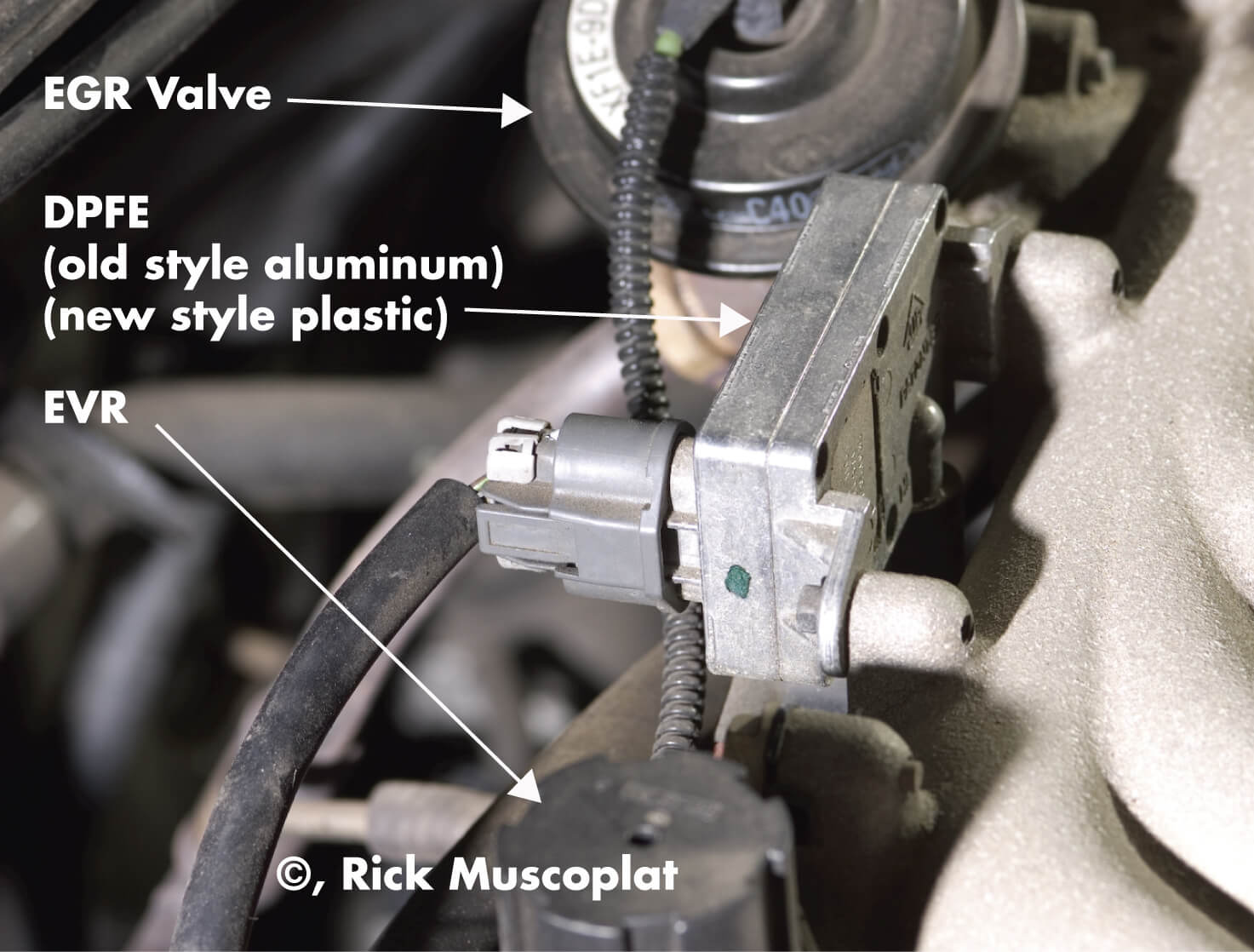
Ford DPFE sensor
Like any mechanical component, the EGR valve can malfunction over time due to wear, carbon buildup, or electronic faults. Recognizing the symptoms of a failing EGR valve is essential for maintaining engine efficiency and preventing potential damage. Here’s what to look out for:
1. Rough Idle and Stalling: A rough idle is one of the earliest signs of an EGR valve problem. When the valve fails to open or close properly, it disrupts the air-fuel ratio, leading to unstable engine idling. In severe cases, this instability can cause the engine to stall when idling or decelerating.
2. Poor Fuel Efficiency: A malfunctioning EGR valve can affect the engine’s fuel efficiency. If the valve is stuck open, it allows too much exhaust gas into the intake manifold, altering the air-fuel mixture. This imbalance often results in increased fuel consumption as the engine compensates for the incorrect mixture.
3. Check Engine Light (CEL) Activates: Modern vehicles are equipped with onboard diagnostics that monitor various engine parameters, including EGR valve operation. If the EGR valve malfunctions, it can trigger the check engine light on the dashboard. This warning indicates that the engine control module (ECM) has detected an issue with the EGR system and has logged a corresponding diagnostic trouble code (DTC).
4. Engine Knocking or Pinging: When the EGR valve fails to close properly, excess exhaust gases can remain in the combustion chamber during ignition. This can cause abnormal combustion patterns, leading to engine knocking or pinging noises. Ignoring these sounds can lead to more severe engine damage over time.
5. Increased Emissions: Since the EGR valve’s primary function is to reduce NOx emissions, a malfunctioning valve can result in higher emission levels during vehicle inspections. This symptom is particularly noticeable in regions with strict emissions regulations, where a failing EGR valve can cause a vehicle to fail emissions tests.
6. Decreased Engine Performance: A malfunctioning EGR valve can also cause a noticeable decrease in engine performance. Drivers may experience reduced acceleration, sluggish response to throttle input, or overall loss of power, especially during acceleration or climbing hills.
7. Visible Signs of Carbon Buildup: Over time, carbon deposits can accumulate on and around the EGR valve mechanism. These deposits can cause the valve to stick open or closed, impairing its function. Visual inspection of the valve and surrounding components can reveal excessive carbon buildup, indicating a potential EGR valve issue.
Typical EGR trouble codes
P0400: EGR flow malfunction
P0401: EGR insufficient flow detected
P0402: EGR excessive flow detected
P0403: EGR circuit malfunction
P0404: EGR circuit range/performance
P0405: EGR sensor A circuit low
P0406: EGR sensor A circuit high
P0407: EGR sensor B circuit low
P0408: EGR sensor B circuit high
P1403: EGR solenoid low
P1404: EGR system – closed valve pintle error
P1405: EGR solenoid high
P1406: EGR system pintle position error

Plugged EGR tube resulting in P0400 Exhaust Gas Recirculation Flow Malfunction trouble code
EGR valve replacement cost
EGR valves are fairly inexpensive, ranging from as little as $40 for an aftermarket unit, to around $180 for factory units. But total EGR valve replacement cost with labor can run around $200 to as high as $400 if the valve is located in a difficult location. That’s why car owners are tempted to perform and EGR delete. What they don’t consider is how much damage the EGR delete will do to their engine.
EGR cleaning
Since we’re dealing with dirty exhaust gas, it’s not uncommon for the valve to accumulate carbon buildup on the port and pintle. Sometimes you can perform an EGR cleaning operation by removing the valve and scrubbing it with a steel brush and throttle body cleaner. EGR cleaning only works about 50% of the time. That’s because the buildup is very hard to remove.
EGR passage blocked
Exhaust gas passages run from the exhaust manifold to the EGR valve, and from there to the throttle body or intake manifold. Over time, those passages can clog with carbon. In those cases, the shop may have to remove the throttle body or intake manifold and clean out the passages. It’s done with drills and flexible scrubbing cables (kind of like using a pipe cleaner to clean small passages. In the worst cases, the intake manifold must be replaced.
In summary
EGR valves perform an important function in keeping our air clean by reducing combustion temperatures. If you do an EGR delete, you eliminate the cooling effect of EGR. The higher combustion temperatures will cause detonation, piston damage, and burn your exhaust valves. In other words, an EGR delete will also damage your engine.
©, 2015 Rick Muscoplat
Posted on by Rick Muscoplat