
What does reserve capacity mean on a car battery?
Understanding Reserve Capacity On A Car Battery: What You Need to Know
Automotive batteries are rated in three categories: cold cranking amps, cranking amps and reserve capacity. I’ll cover cold cranking amps, cranking amp in this post and concentrate on just reserve capacity here.
The definition of car battery reserve capacity
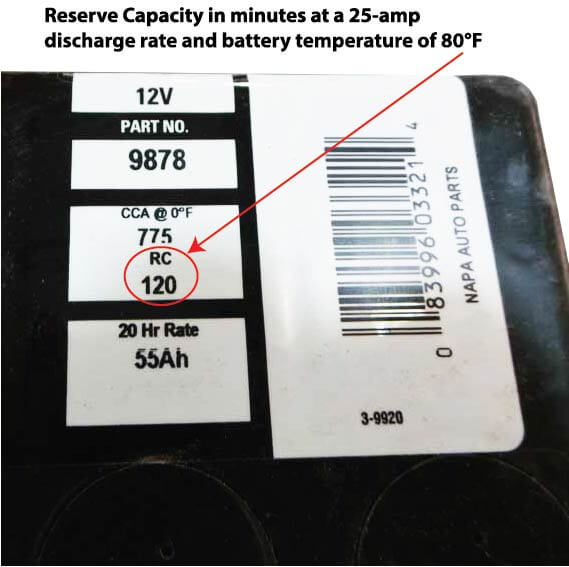
The reserve capacity is usually listed on the battery label
Automotive battery reserve capacity is a rating to give you an idea of how long the battery can be discharged at a rate of 25 amps while still maintaining at least 1.75 volts per cell or 10.5 total volts.
A 12-volt battery can output 2 volts for each of the six cells. The capacity is measured at 80°F. So, a battery with a 100 RC rating can provide 25 amps for 100 minutes. Since a lead-acid battery works through a chemical reaction, and chemical reactions slow in colder temperatures, you’ll get less capacity time than the stated reserve capacity in cold weather.
Why do you care about reserve capacity?
It used to be important only for deep-cycle marine applications, like a battery used for an electric trolling motor. But it’s much more important in automotive applications now because of all the electrical 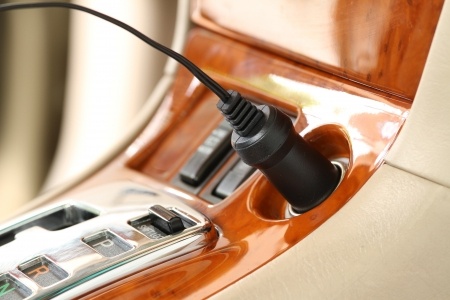 accessories owners plug into the power ports.
You should care about your car battery’s RC if you often sit in your car with the engine off and the radio and cell phone charger running. Or, if your kids are running phone chargers, video players or game consoles while the engine is off, they’re draining the RC of the battery.
Car battery reserve capacity is temperature and discharge-dependent
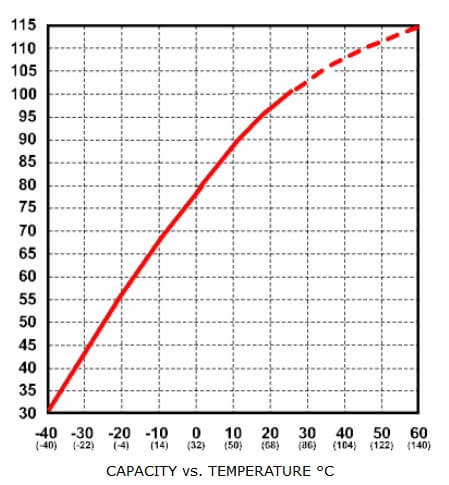
As you can see in this chart, reserve capacity falls as the temperature goes down. However, reserve capacity is also affected by the rate of discharge. As I mentioned above, a RC is based on discharging at a rate of 25 amps. However, Peukert’s law states that a battery’s reserve capacity falls faster as the rate of discharge increases. So, it’s not a linear rate. Draw more amps, and you’ll run the battery down faster.
To use the example above, if you use the same battery at the same 80°F, but draw 50-amps instead of 25-amps, you won’t get 50 minutes of power. The battery will drain at a faster rate due to the higher current draw.
©, 2017 Rick Muscoplat
Posted on by Rick Muscoplat