
AC Charged but Not Cold: Troubleshooting Guide
AC Charged but Not Cold — How I Diagnose a Car AC Not Blowing Cold
If you’re wondering why your car’s AC cold, even though it’s fully charged, you’re not alone. I get this question all the time from frustrated drivers dealing with a car AC not blowing cold on the hottest days after they’ve added refrigerant to the system. The truth is, when your AC is charged but not delivering cold air, it’s almost always a sign of deeper issues in the system. Let me walk you through exactly how I diagnose a car AC not blowing cold.
Understanding What Happens When An AC System is Low On Refrigerant
First, let’s talk about leaks. Almost every AC system leaks a small amount of refrigerant over time, especially during winter. That’s when seals contract. When summer rolls around, those seals expand again, but finding the leak can be nearly impossible. This is where most DIYers make a huge mistake. They assume topping off the refrigerant will fix a car AC not blowing cold symptom. Trust me, it won’t. And it may actually make things worse.
Whenever refrigerant leaks out, outside air leaks in. Air is a major problem. It occupies space in the condenser but doesn’t condense like refrigerant does. That means your condenser becomes far less efficient. If you’ve ever asked, “why isn’t my car AC cold?”, trapped air is often one reason. You can confirm it by comparing your gauge readings against proper static pressures for the ambient temperature.
If your high-side gauge is reading unusually high, or the needle flutters, that’s a clear signal there’s air in the system. But it gets worse. If that air contains moisture—and it often does—you’re looking at even more serious problems and possibly damage. Moisture in an AC system isn’t just harmless humidity; it reacts chemically with the refrigerant and oil to form acids and sludge. Acids and sludge will absolutely destroy components inside your AC system.
I’ve opened plenty of failed systems and found black sludge. This sludge clogs the orifice tube and expansion valve, which are crucial for refrigerant flow. That’s often the hidden answer to why isn’t my car AC cold after a recharge.
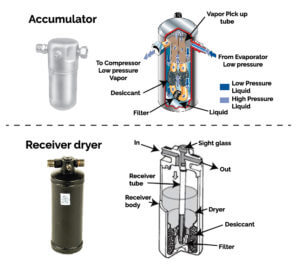
Most AC systems have a receiver/drier or accumulator filled with desiccant to absorb moisture. But that desiccant has a limited capacity. Once it’s overwhelmed—or worse, breaks apart—it spreads throughout the system, clogging everything in its path. If your car AC is not blowing cold, and you’ve repeatedly topped it off with a DIY kit, chances are you’ve unknowingly caused this damage yourself.
At that point, the only fix for a car AC not blowing cold is a full system overhaul. That means opening the system, flushing all the lines, replacing the orifice tube or expansion valve, the receiver/drier or accumulator, and probably the condenser too. Then, you must pull a deep vacuum—at least 45 minutes—to boil off all the moisture before recharging. See this post for static pressures at ambient temperatures.
Symptoms of Moisture in the AC System
So how do you recognize moisture contamination? A typical symptom is an AC that cools briefly and then suddenly blows warm. The is caused by moisture freezing in the expansion valve or orifice tube, where it blocks refrigerant flow. Another big clue is persistently high pressure readings on the condenser side, which screams air contamination.
•Blows cold, then nothing but warm air– Ice in the expansion valve or orifice tube
• Blows cold, then hot and very high pressure on the high side– Air in the system
Air in the system causes pressures on the high side to be higher than normal and causes the gauge needle to flutter.
Moisture Damage and Black Death
Moisture in the system in concentrations greater than 20 ppm can cause serious damage. A single drop of water is enough to push the entire system over the 20-ppm threshold. Water in an AC system reacts with the refrigerant to form hydrochloric acid (HCI). HCI corrodes steel, iron, copper, and aluminum. As the metals oxidize, they release particles that combine with the refrigerant oil to form sludge. It’s that sludge that clogs the intake screens to the orifice tubes and expansion valves, preventing them from metering refrigerant into or out of the evaporator.
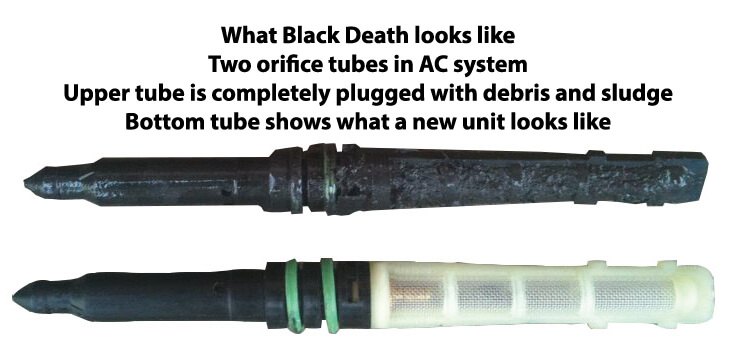
New and clogged AC orifice tube. Clogged tube shows evidence of “Black Death.”
If you frequently add refrigerant from a DIY recharge kit and have finally reached the point where the system is fully charged but not cold, chances are you’ve caused the damage yourself. At this point, the only fix is to open the system, flush the lines, replace the orifice tube/expansion valve, receiver/drier or accumulator, condenser, and pull a vacuum for at least 45 minutes to pull all moisture from the system.
What to replace?
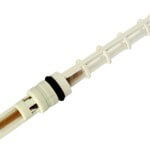
Orifice tubes are color coded. Buy the same color if you replace yours.
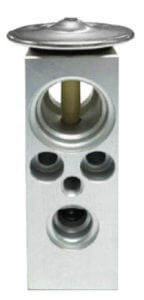
H-block style expansion valve
+
©, 2018 Rick Muscoplat
Posted on by Rick Muscoplat