
Bad Battery or Alternator? How to Tell
How to Tell If a No-Start Issue Is Caused by a Bad Battery or Alternator
When a car won’t crank, the first question I ask myself is simple: Am I dealing with a bad battery or alternator? Knowing which component is at fault saves money, time, and frustration. As someone who has spent years under the hood, I’ll walk you through the exact steps I use to diagnose battery and alternator problems. These are simple tests you can do yourself to nail down whether you’re fighting a weak battery or alternator failure.
A bad battery can cause false alternator test results. Why? Because an alternator needs power in order to generate power. Don’t get fooled into thinking the alternator is bad without performing Steps 1 and 2.
Step 1: Eliminate Resistance for Accurate Results
Before testing the battery or alternator, I always eliminate high resistance. Corroded battery terminals, poor alternator connections, or faulty ground points can limit the amount of charging the battery receives and can actually give you faulty battery testing results.
It doesn’t take long to clean the battery terminals and posts, and it eliminates high resistance as a potential cause. So I always start by cleaning the battery terminals with a wire brush. Even if they look fine, I disconnect them and scrub the posts. Only once everything is clean do I move to actual testing. See my post on battery terminal cleaning for more information.
Step 2: Check the Battery’s State-of-Charge and State-of-Health
Many DIYers confuse a battery’s charge with its state of health. The battery voltage can be in the normal range, but still cause a no-start because the battery has high internal resistance and severe plate deterioration. A voltage test can’t detect those issues. Here’s how you test both: State-of-Charge (SOC) and State-of-Health (SOH)
Connect your voltmeter directly to the battery terminals. A fully charged battery should show around 12.6 volts with the engine off. Any reading of 12.2 volts or lower means the battery is severely discharged. You can’t accurately test a battery or
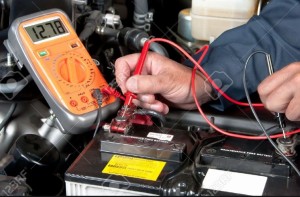
Check battery voltage with a multimeter
alternator when the battery is discharged. So you’ll have to recharge it before proceeding with the next tests.
What you need to conduct a SOH test
I personally use the Clore Solar BA9 battery tester to check batteries. Find the Clore Solar BA9 on Amazon for $51.50. The BA9 tests the internal resistance of the plates and bus connections and performs a simulated load test. If the battery fails this test, I know it’s bad.

Clore Automotive SOLAR Digital 12V Battery and System Tester
However, before jumping to conclusions, remember that a bad alternator could be draining the battery and causing it to lose charge. That’s why we’ll continue testing.
Step 3: Inspect the Alternator Belt and Tensioner
I never skip the alternator belt inspection. A cracked, slipping, or loose belt can prevent the alternator from spinning fast enough to charge the battery. If the belt tensioner is weak, it mimics a failing alternator. Checking this step helps me avoid misdiagnosing battery or alternator problems.
Step 4: Test the Alternator Under Load
With the battery fully charged, I start the engine and put my meter across the battery terminals. A healthy alternator should bring the voltage above 13.5 volts at idle. If it doesn’t, I know something’s wrong.
On newer vehicles with smart charging systems, the alternator may not charge unless there’s a demand. That’s why I turn on the headlights, the blower motor, the heated seats, and the defogger, then rev the engine to 2,000 RPM. Voltage should jump above 13.5 volts. If it lingers below 13.5 or drops over time, the alternator is failing.
If I don’t see charging voltage at all, I check the large power wire at the back of the alternator for battery voltage. A blown fuse or fusible link in that circuit can make a good alternator look dead.
Step 5: Look for Parasitic Battery Drain
Sometimes both the battery and alternator test fine, but the car still won’t start after sitting. That’s when I suspect a parasitic drain. A module that refuses to sleep or a shorted alternator diode can pull the battery down overnight. I perform a parasitic draw test to confirm.
A parasitic drain can be caused by a computer that doesn’t go into sleep mode and continues to draw high power.
Or, you can have an alternator diode that’s shorted to ground. Either way, you must conduct a parasitic battery drain test to locate the problem.
For more information on how an alternator works, see this post
Understanding Modern Alternator Systems
Older alternators relied on simple voltage regulators, but today’s systems are far smarter. GM’s Regulated Voltage Control (RVC) and Stand-Alone RVC (SARVC) systems use battery sensors and modules to control charging rates. These strategies extend battery life, improve fuel economy, and even shed loads when needed. Knowing this helps me avoid calling a good alternator bad just because the PCM is managing voltage differently than in the old days.
• RVC systems—Using a battery current sensor mounted on the negative battery terminal, the body control module (BCM) reads and communicates how much current is drawn from the battery. The BCM also monitors voltage from the positive battery terminal and ignition circuits. It communicates those values to the PCM. Since the PCM knows engine RPM and vehicle speed, it commands a pre-determined charging rate for the generator.
• SARVC systems—These stand-alone systems don’t involve the BCM. They have a control module mounted on the negative battery terminal to interpret battery current, voltage, and battery temperature. The control module connects directly to the L-terminal on the generator.
Both types maintain the battery at 80% or higher state of charge. If the systems can’t maintain that level of charge, they will automatically shut down electrical accessories in order of priority to protect the battery. This is called load shedding. The system can also boost engine RPM to increase charging rates.
NOTE: Ricksfreeautorepairadvice receives a commission from amazon links posted in this article.
Final Word: How I Nail Down the Culprit
When a car won’t start, you need to determine if the problem is a faulty battery or alternator. By cleaning connections, checking battery state of health, testing charging voltage under load, and ruling out parasitic drains, I can confidently diagnose battery and alternator issues every time. These steps let me replace the right part the first time and save my customers from unnecessary costs.
©, 2015 Rick Muscoplat
Posted on by Rick Muscoplat