
Brake Fluid Explained: DOT 3 vs DOT 4 Differences
Brake Fluid and DOT 3 vs DOT 4 Boiling Point Comparison
Quick Summary
The biggest differences between DOT 3 and DOT 4 brake fluid come down to boiling point, moisture absorption, and long-term performance. DOT 4 handles heat better but absorbs moisture faster, while DOT 3 is more stable over time. Use the wrong one, and you can end up with brake fade or even total brake failure.
The Different Types of Brake Fluid
There are three main brake fluid families you’ll encounter: DOT 3 & 4, DOT 5, and DOT 5.1
DOT 3 Brake Fluid — This is the most common brake fluid used in everyday vehicles. It’s reliable, cost-effective, and works well under normal driving conditions.
DOT 4 Brake Fluid — This is an upgraded version of DOT 3, offering higher performance in high heat. You’ll find it in performance vehicles, European cars, and vehicles that see heavier braking loads.
DOT 5 is silicone-based (not compatible with DOT 3/4 systems) — mostly used in high-performance vehicles and race cars
DOT 5.1 — Glycol-ether-based, just like DOT 3 and DOT 4 — it’s chemically engineered to have a lower viscosity and a higher boiling point—two key properties that give it an edge for late model vehicles equipped with automatic emergency braking, stability control, and accident avoidance systems.
For most drivers—and most shops—you’re dealing with DOT 3 vs DOT 4.
DOT 3 vs DOT 4 Brake Fluid: The Real Differences
1. Boiling Points: Brake fluid must resist boiling. Once it boils, it creates vapor—and vapor compresses. That’s when you lose braking force.
DOT 3:
Dry boiling point: 401°F
Wet boiling point: 284°F
DOT 4:
Dry boiling point: 450°F
Wet boiling point: 311°F
If you’re driving aggressively, towing, or going downhill for extended periods, DOT 4 gives you a much bigger safety margin.
2. Chemical Composition: DOT 3 & 4 are formulated with different percentages of glycol ether
DOT 3: ~80% glycol ether
DOT 4: 50–65% glycol ether + 20–30% borate esters
Those borate esters are what boost the boiling point in DOT 4. But they also introduce trade-offs.
3. Moisture Absorption (Hygroscopic Behavior): Brake fluid absorbs moisture from the air. That’s not a flaw—it’s by design. It prevents water from pooling and freezing in the system. But over time, that moisture lowers the boiling point. And this is where DOT 4 has a downside.
DOT 4 absorbs moisture about 20% faster than DOT 3. That means:
• DOT 4 performs better initially
• But degrades faster over time
This is why many manufacturers still specify DOT 3 for standard vehicles.
4. Compatibility Rules: Brake fluid is vehicle and usage-specific
• You CAN use DOT 4 in a DOT 3 system
• You should NEVER use DOT 3 in a DOT 4 system
Why are glycol ethers used in brake fluid?
1. High boiling point — prevents the fluid from vaporizing under normal braking loads
2. Hygroscopic absorption of water — glycol ethers absorb water uniformly throughout the fluid, preventing pockets of moisture from freezing.
3. Lubrication of seals and components — Glycol ethers are compatible with the rubber seals and metal components inside calipers, master cylinders, and ABS units. So it provides adequate lubrication without causing seal swelling or degradation.
4. Low viscosity across temperature ranges — Glycol ether fluids maintain a relatively stable, low viscosity across that range, ensuring fluid flows quickly when you press the pedal.
5. Compatibility with metal parts —It resists corrosion of the steel, aluminum, and cast iron components in a brake system.
Common glycol ethers in brake fluid:
• Polyethylene glycol (PEG) and its derivatives
• Diethylene glycol monoethyl ether (DGME
Because glycol ether brake fluid absorbs water, it needs to be replaced periodically (typically every 2 years), as the wet boiling point drops with moisture accumulation.
DOT 5 brake fluid, by contrast, uses silicone rather than glycol ether — it’s non-hygroscopic but less common.
How Often Should You Change Brake Fluid?
This is where a lot of people get burned. Brake fluid doesn’t get “used up,” so people ignore it. But it ages chemically.
Carmakers usually recommend changing brake fluid every:
• Every 2–3 years for DOT 3
• Every 2 years (or less) for DOT 4
• If you’re driving in humid climates or doing heavy braking, shorten that interval.
Is Brake Fluid Color and Indication of Its Condition?
Color can offer some clues, but it’s not a reliable diagnostic tool on its own.
Fresh brake fluid is typically clear to light yellow (DOT 3, 4, and 5.1). DOT 5 silicone fluid is usually purple, which helps distinguish it from glycol-based fluids.
What color can indicate:
Darker yellow to amber — This is normal aging. It darkens gradually as it oxidizes and accumulates dissolved contaminants from aging rubber in the brake system.
Dark brown or black — This indicates more significant degradation. This often means the rubber seals and hoses in the system are breaking down and shedding particles into the fluid. It can also indicate heavy oxidation. At this point, a flush is generally warranted.
Milky or cloudy — This is a more serious sign — it usually means the fluid’s water contamination has gone beyond the normal hygroscopic absorption, or in rare cases, that incompatible fluids have been mixed.
Why color alone isn’t enough to justify a brake fluid flush
The most important property of brake fluid — its boiling point — cannot be judged by color at all. Fluid can look relatively clean and still have absorbed enough moisture to have a dangerously low wet boiling point. Conversely, slightly amber fluid may still perform fine.
There are better ways to assess its condition:
• Test strips — Inexpensive strips that measure
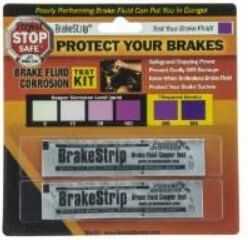
Brake Fluid Test Strips that test for copper content
the pH balance of the fluid and the levels of copper (copper leaches from brazing in the steel brake lines as fluid degrades and is a reliable degradation marker)
• Refractometer — Measures the refractive index of the fluid, which correlates with moisture content
• Boiling point testers — Electronic tools that directly measure the boiling point of the fluid
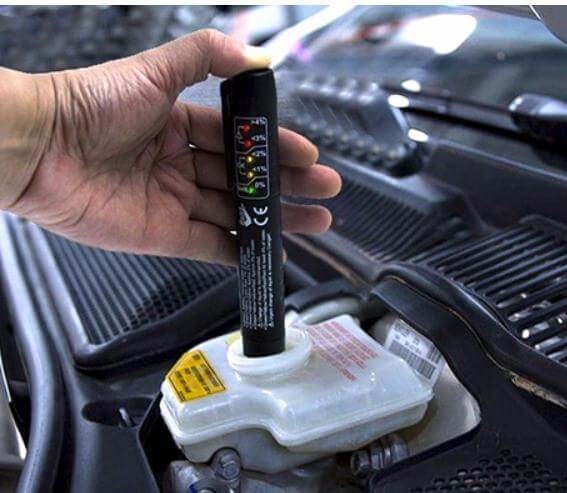
This picture shows an Inexpensive moisture tester used to check the water content of brake fluid
In other words:
• Color is a rough, supplementary indicator at best. Most mechanics and manufacturers recommend replacing it every 2 years, regardless of color, or whenever the moisture content exceeds about 3%. If the fluid looks dark brown or milky, that’s a clear signal to flush — but clear fluid doesn’t mean it’s in good shape.
For more information on the differences, along with a boiling chart, see this post
©, 2021 Rick Muscoplat
Posted on by Rick Muscoplat