
Catalytic Converter Cleaner: Miracle Fix or Temporary Band-Aid?
Why Catalytic Converter Cleaner Rarely Works Long-Term
Quick Summary
A catalytic converter cleaner may, in certain cases listed below, temporarily eliminate a P0420 or P0430 trouble code.
1) Your cat is borderline failing and has carbon buildup or deposits that are reducing the converter’s efficiency
2) The underlying problem is due to excessive oil consumption, coolant leaks, or running rich, which has fouled but not damaged the catalyst
3) You catch it early, before the substrate is physically degraded
Catalytic Converter Cleaners Don’t Work When:
1) The catalyst substrate is physically damaged, melted, or broken apart
2) The catalyst has been permanently poisoned by coolant, excessive oil, or silicone
3) There’s an exhaust leak affecting sensor readings
In other words, if the converter is lightly coated with soot, oil residue, or carbon, a cleaner may restore efficiency just long enough to pass an emissions test. However, if the converter is clogged, melted, poisoned, or physically damaged, no catalytic converter cleaner will help.
Article
Can a Catalytic Converter Cleaner Really Fix P0420 and P0430?
I’ve been diagnosing emissions failures and check-engine lights for decades, and few products generate more false hope than catalytic converter cleaner. When drivers see a P0420 or P0430 code pop up, the price of a replacement converter is enough to make anyone search for a cheaper option. Cleaner manufacturers know this—and they market their products accordingly.
So let’s get straight to the truth. A catalytic converter cleaner can work, but only under narrow conditions. And even then, the fix is usually temporary. To understand why, you first need to understand what actually causes a P0420 or P0430 code.
What P0420 and P0430 Really Mean
A P0420 code means the catalytic converter on bank 1 is no longer storing and burning oxygen efficiently. A P0430 code means the same thing, but on bank 2. In plain English, the engine computer is comparing upstream and downstream oxygen sensor signals and deciding that the converter isn’t doing its job anymore.
That failure can happen for several reasons, but only one of them is even remotely fixable with a catalytic converter cleaner.
Why Catalytic Converters Fail (And Why Cleaners Usually Don’t Work)
Over the years, I’ve seen four real-world failure modes that trigger P0420 and P0430 codes. One is chemical. The other three are terminal.
The only scenario where a catalytic converter cleaner has a fighting chance is when the ceramic honeycomb is lightly coated with oil residue, soot, or carbon. That coating can block exhaust gases from contacting the precious metals inside the converter, reducing efficiency just enough to trip a fault code. In that narrow case, a cleaner may dissolve or burn off part of the coating, restoring efficiency—for a while.
The other failure modes are not reversible. If the substrate is melted from overheating, physically clogged with debris, chemically poisoned, or cracked from impact damage, the converter is done. No chemical product can un-melt ceramic, repair shattered honeycomb, or reverse chemical poisoning. When those conditions exist, a catalytic converter cleaner is nothing more than an expensive bottle of wishful thinking.
Catalytic Converters Are Already Self-Cleaning By Design
This is the detail most marketing hype leaves out. A properly functioning catalytic converter routinely operates between roughly 750°F and 1,400°F. At those temperatures, light carbon deposits burn off naturally. That’s why converters are considered self-cleaning devices.
So when a converter builds up carbon or soot, it’s not because it needs help—it’s because something is wrong upstream. Excess fuel, oil burning, misfires, or sensor failures overload the converter faster than it can clean itself. If you don’t fix that underlying problem, any benefit from a catalytic converter cleaner will be short-lived, and the P0420 or P0430 will return.
How Catalytic Converter Cleaners Are Supposed to Work
In theory, the solvents in a catalytic converter cleaner break down soft carbon deposits, allowing higher exhaust temperatures to finish the job. Keep in mind that the cleaners burn during the combustion cycle and only the reactive components of those cleaners enter the catalytic converter. It’s the reactive remains that loosen or burn away surface contamination on the honeycomb.
In mild cases, the reactive components can slightly improve airflow and oxygen storage efficiency. I’ve seen converters recover just enough to turn off a P0420 or P0430—temporarily. But chemistry has limits. Severe carbon buildup, melted ceramic, or physical blockage simply cannot be fixed by chemicals that are mostly burned before they even reach the converter.
Bottom Line: Do Catalytic Converter Cleaners Actually Work?
Yes—sometimes. And that “sometimes” matters.
If the converter is only lightly fouled and the engine problem that caused the fouling has already been corrected, a catalytic converter cleaner may reduce emissions enough to clear a P0420 or P0430 code. This is why these products occasionally help people pass emissions testing.
But this is not a permanent repair. In most cases, the improvement lasts weeks or months, not years. If oil burning, rich fuel mixtures, misfires, or sensor failures continue, the converter will re-contaminate quickly, and the code will return.
What Chemicals are Used in Catalytic Converter Cleaners?
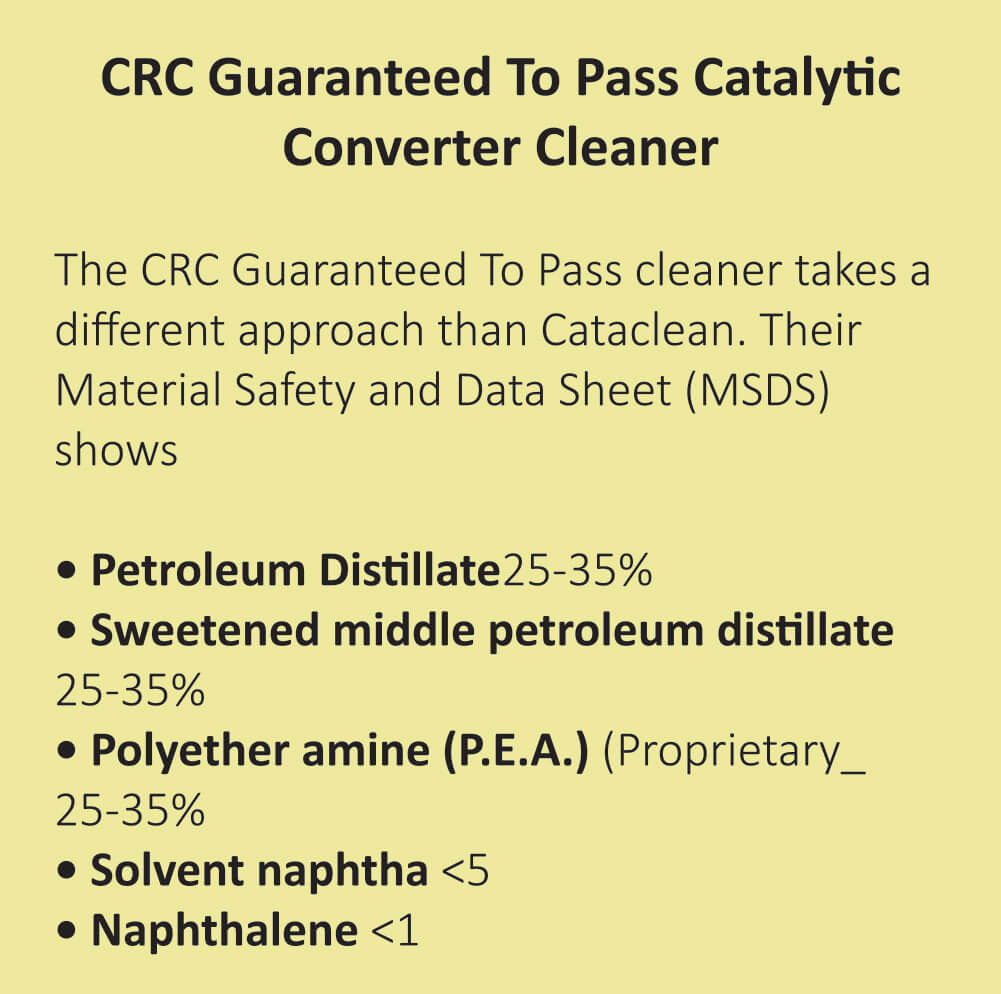
Most catalytic converter cleaner products 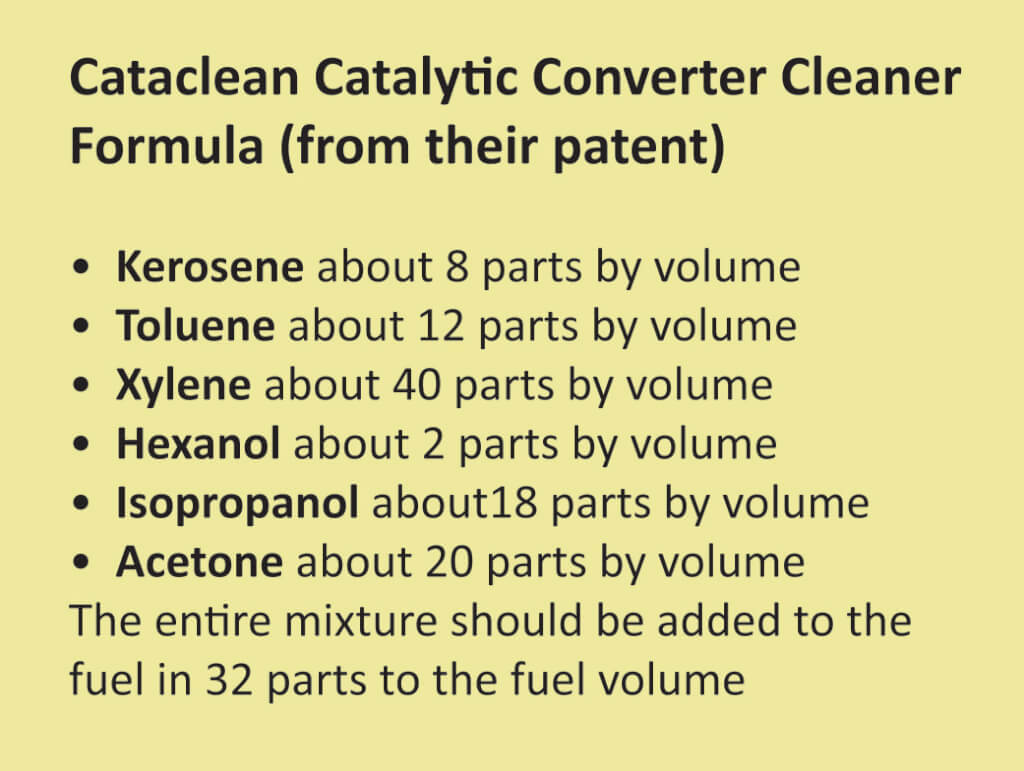 rely on aggressive solvents. Products like Cataclean use blends of toluene, xylene, acetone, alcohols, and petroleum distillates. CRC’s Guaranteed To Pass takes a slightly different approach by including polyether amine (PEA), a detergent commonly used in Top Tier fuels.
PEA can help clean injectors and combustion chambers, thereby indirectly reducing converter loading. But it does not rebuild converters, restore melted substrates, or reverse poisoning. At best, these chemicals address symptoms—not root causes.
The Real Causes Behind P0420 and P0430 Codes
When oil consumption coats the converter, worn piston rings or valve seals are usually to blame. When fuel mixtures run rich, failed oxygen sensors, weak ignition systems, restricted air filters, or low compression often play a role. When converters melt, overheating from misfires or raw fuel is almost always involved. When converters are poisoned, coolant leaks, leaded fuel, zinc additives, or silicone sealants are the culprits.
In every one of those scenarios except light soot buildup, a catalytic converter cleaner cannot provide a lasting fix. Until the underlying issue is corrected, the P0420 or P0430 code is only resting, not gone.
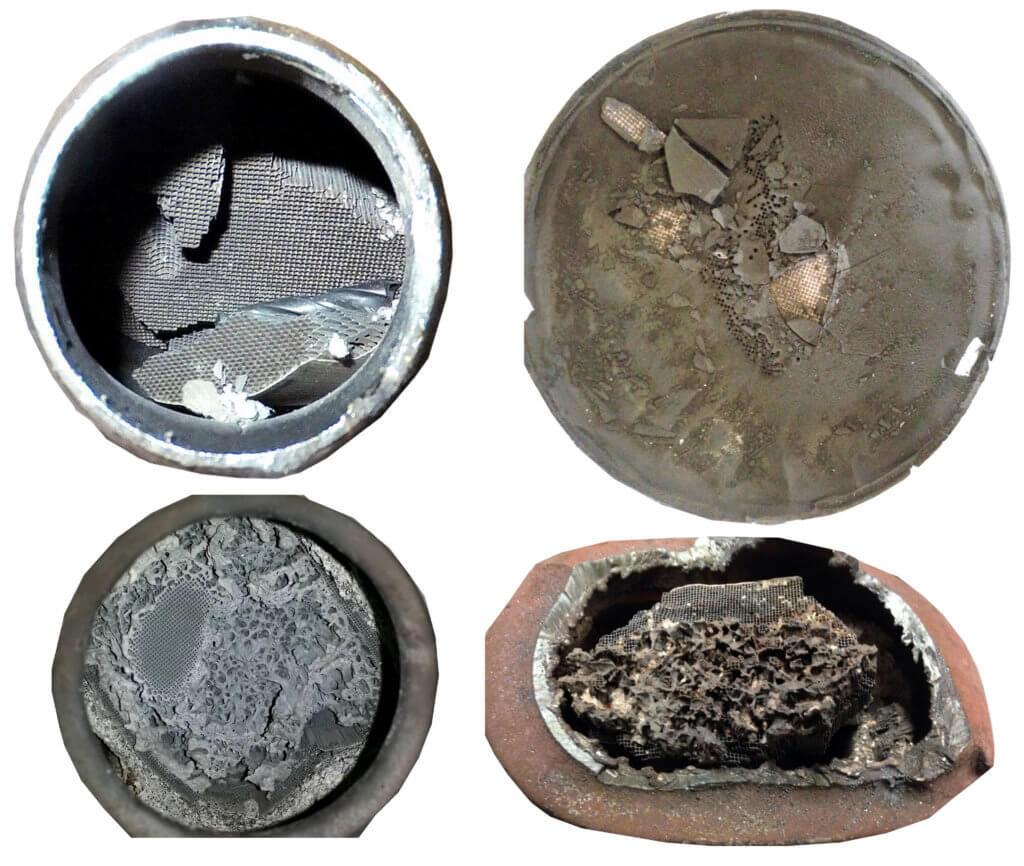
Nothing will fix these clogged and melted catalytic converters. They must be replaced
Common Catalytic Converter Cleaning Myth
I’m often asked whether removing the converter and soaking it in degreaser works. Sometimes it does—briefly. But unless the root cause is fixed, contamination will return. I’m also asked about pouring lacquer thinner or acetone into the fuel tank. That’s a terrible idea. Gasoline already contains similar solvents, and adding more only increases the risk of converter overheating and fuel system damage.
The Bottom Line on Catalytic Converter Cleaners
A catalytic converter cleaner is not a repair—it’s a temporary chemical intervention. It can sometimes help clear a P0420 or P0430 code when contamination is mild, and the underlying problem has already been fixed. It will not fix converters that are melted, clogged, poisoned, or damaged. And it will never replace proper diagnosis.
If you use a cleaner to pass emissions, understand what you’re doing. You’re buying time—not solving the problem.
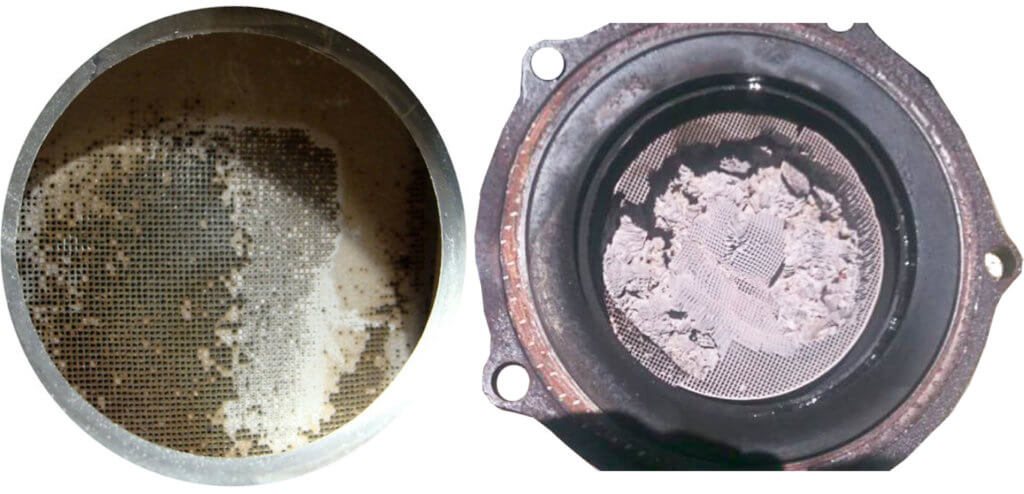
Catalytic converter myths
Can I Clean My Catalytic Converter With Soap and Water?
Perhaps temporarily. Removing the catalytic converter and soaking it in a degreaser solution may remove oil, soot, or carbon deposits, allowing it to function again.
However, if you don’t fix the underlying problem that caused the oil or carbon buildup, the coating will just reform. In other words, even if the cleaning works for a short period, it won’t fix the underlying problem.
Can I Clean My Catalytic Converter With Lacquer Thinner or Acetone?
No. Gasoline already contains Xylene, Acetone, and 1-Propanol. Adding more of those chemicals will only cause a cat converter meltdown and damage fuel system components.
©, 2021 Rick Muscoplat
Posted on by Rick Muscoplat