
How to fix a reduced engine power message
Reduced Engine Power in GM Vehicles: What It Means and How to Fix It
I’ve seen it countless times in my years of diagnosing GM vehicles — that dreaded “Reduced Engine Power” or “Engine Power Reduced” message suddenly lights up on the dash, and your car feels like it’s lost all its strength. Acceleration drops, your top speed might barely reach 40 mph, and the check engine light joins the party. It’s unsettling, but I’ll break down exactly what’s happening, what causes it, and how to fix a reduced engine power warning message the right way.
What “Reduced Engine Power” Really Means
When your car displays a reduced engine power message, it’s your vehicle’s computer (the ECM or PCM) going into a self-protection mode. GM designed this feature to prevent serious damage when it detects a fault in critical engine or throttle systems.
In short, the ECM limits power output, restricting throttle response and speed. You can usually still drive short distances — enough to limp home or to a repair shop — but performance will feel heavily reduced.
When reduced engine power mode is activated, you may notice these symptoms:
• Significant reduction in acceleration
• Limited top speed (usually around 35-45 mph)
• Rough or unstable idle
• Illuminated check engine light
This isn’t a minor warning — it’s your vehicle telling you something serious needs attention.
Top Causes of a Reduced Engine Power Message
The causes usually fall into a few common categories:
1. Faulty Electronic Throttle Body— Late model GM vehicles use electronic throttle control instead of a mechanical cable. If the throttle body or its position sensors fail, the ECM can’t accurately control air intake. That triggers the engine power-reduced mode almost instantly.
Symptoms include:
• Rough or unstable idle
• Stalling when shifting to drive or reverse
• Hesitation when accelerating
Cleaning the throttle plate sometimes helps, but if the internal sensors fail, the only fix is throttle body replacement.
2. Dirty or Faulty Mass Airflow (MAF) Sensor— The MAF sensor measures how much air is entering the engine. If it gets dirty or fails, it sends incorrect readings to the ECM, throwing off the air-fuel ratio and triggering reduced engine power mode.
You’ll notice:
• Poor fuel economy
• Hard starting
• Hesitation under load
I recommend removing the MAF sensor and cleaning it with a dedicated MAF cleaner spray — never use brake cleaner or compressed air. If the code returns, replace the sensor.
3. Wiring Harness Damage or Broken Connections— GM has documented an issue that’s caused many engine power-reduced complaints — a broken wire in the engine harness near the mass airflow sensor. The wire breaks internally due to an overly tight zip tie at the factory.
In fact, GM issued Service Bulletin #22-NA-008 covering:
2020–2022 Buick Encore GX
2021–2022 Chevrolet Trailblazer
The root cause is a broken wire in circuit 492 at the multifunction sensor. The harness flexes with engine movement, eventually snapping the conductor.
To fix the reduced engine power warning message, inspect the wiring harness about two clips back from the MAF sensor. With the engine running, gently move the harness — if the idle stumbles, the wire is broken.
Repair it using the proper GM pigtail repair kits:
P/N 85518225 (L3T engine)
P/N 85519071 (LIH engine)
Be sure to maintain a 3.4-inch distance between the fixed clips to allow proper flex during acceleration. Seal all connections with waterproof connectors.
4. Sensor Signal Errors (Service Bulletin Codes)— You may also find these codes stored in memory along with the engine power reduced message:
P0101 — Mass Air Flow Circuit Range/Performance
P0102 — Mass Air Flow Circuit Low Input
P1101 — MAF Sensor Out of Self-Test Range
P14B6 — MAF Signal Message Counter Incorrect
U1345/U060F — Communication error on LIN bus
These codes point directly toward MAF sensor or throttle control issues. Using a professional scan tool is the fastest way to confirm the exact cause.
What to Do When You See the Message
If you encounter the “Reduced Engine Power” message on your GM vehicle:
1) Safely pull over and turn off the engine.
2) Wait a few minutes, then restart the vehicle.
3) If the message clears, drive cautiously and have your vehicle checked as soon as possible.
4) If the message persists, it’s best to have your vehicle towed to a qualified mechanic to prevent further damage.
Step-by-Step: How I Diagnose and Fix Reduced Engine Power
When I’m faced with a reduced engine power complaint, here’s my diagnostic routine:
1) Scan for Trouble Codes – A quality OBD-II scan tool reveals where to start.
2) Inspect the Throttle Body and Wiring Harness – Look for carbon buildup, corrosion, or damaged insulation.
3) Check for TSBs (Technical Service Bulletins) – Like GM bulletin 22-NA-008.
4) Test the MAF Sensor Output – Verify voltage and frequency readings using a digital multimeter or oscilloscope.
5) Verify Ground and Power Circuits – A bad ground can mimic component failure.
6) Perform a Road Test After Repairs – Always confirm throttle response and engine performance under load.
If you’re unsure, a qualified technician can complete these steps using factory diagnostic data.
Service Bulletin vs Recall — Know the Difference
Many drivers assume that a bulletin means a free fix, but that’s not the case. A service bulletin like GM #22-NA-008 notifies technicians of a known issue and recommended repair procedure. It’s not a safety recall and isn’t covered under warranty unless the vehicle is still within its factory coverage period.
A recall, by contrast, is issued when the problem affects safety, such as stalling or fire risk. Recalls are regulated by the government through NHTSA and are always repaired at no cost.
GM service bulletin
GM has issued a service bulletin #22-NA-008 to address a GM reduced engine power message on the vehicles listed below. You may also find the following trouble codes U060F,U1346, P0101, P0102, P1101 AND/OR P14B6 on the vehicles listed below
Code Definitions:
P0101 Code – Mass or Volume Air Flow Circuit Range/Performance Problem
P0102 Code – Mass or Volume Air Flow Circuit Low Input
P1101 Code – Mass Air Flow Sensor Out of Self-Test Range
P14B6 Code – Mass Air Flow Sensor Signal Message Counter Incorrect
U1345 Code – Engine Control Module LIN Bus 1
Vehicles covered by GM #22-NA-008 service bulletin
2020-2022 Buick Encore GX
2021-2022 Chevrolet Trailblaer
Cause of the GM reduced engine power and trouble
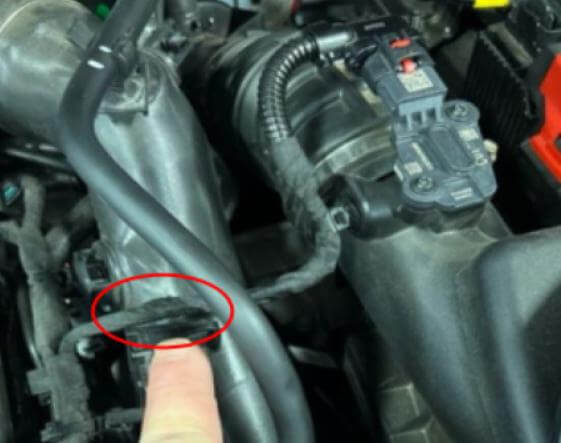
The location of the broken wire
GM has determined that the problem may be caused by a broken wire in the wiring harness for the multifunction sensor, circuit 492. A zip tie installed at the factory was pulled too tight, causing the wire to break when the harness flexes.
Fix for the GM reduced engine power message and associated and trouble codes
GM recommends inspecting the 2nd retainer back from the MAF sensor while the engine is running. The wire is most likely broken at or near the zip tie and malfunctions during acceleration. Wiggle or pull on the harness at this point to identify the break in the wire.
Repair the broken wire using a the replacement pigtails listed below and using waterproof connectors. Pay attention to the distance from the fixed clip mounted to the charge air cooler inlet hose to the fixed clip mounted on the air cleaner housing. The distance must be 3.4” to allow for proper flex during acceleration.
Pigtail connector kit
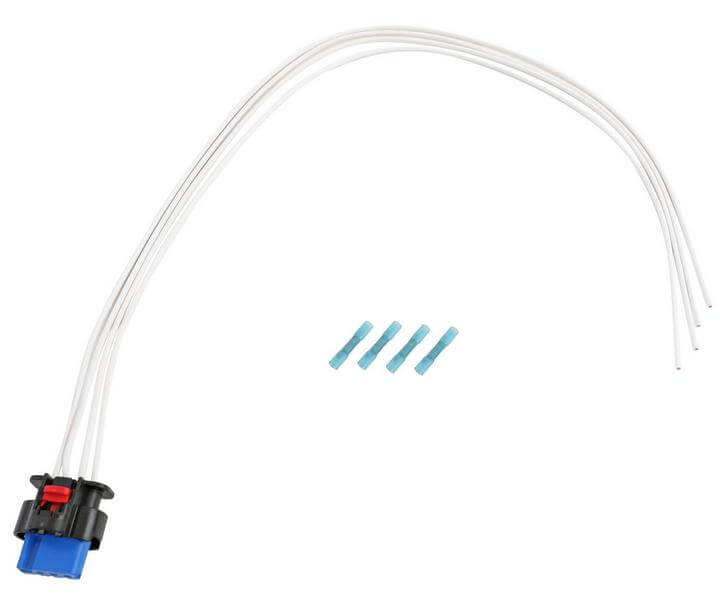
85518225 pigtail kit to fix a GM reduced engine power message
85519071 (LIH) $32.39 from this Chevrolet Dealer
85518225 (L3T) $39.30 from this GM dealer
A service bulletin is not a recall, and the fixes shown are not free.
A service bulletin is issued by a vehicle manufacturer to notify dealers and vehicle owners of a potential issue that may exist in some vehicles. Service bulletins provide recommended actions to address the issue, such as inspections, repairs, or part replacements. Compliance with service bulletins is not mandatory.
An auto recall is an official notice issued when a manufacturer has determined that a vehicle component is defective and poses a safety concern. Recalls are regulated by the National Highway Traffic Safety Administration (NHTSA). When a safety-related defect is identified, the manufacturer must notify NHTSA and vehicle owners. Recalls require the free repair, replacement, or refund of the defective part by authorized dealers. Vehicle owners are legally obligated to comply with recall notices.
While service bulletins may indicate potential problems, recalls denote actual safety hazards confirmed by the manufacturer and NHTSA. Service bulletins provide guidelines for repairs, but recalls necessitate the correction of the defect. Both aim to prevent issues and ensure vehicle safety, but recalls carry more stringent requirements and compliance is mandated by law.
©, 2023 Rick Muscoplat