
Avoid Costly Errors: Proper Intake Valve Cleaner Usage
How to Properly Use Intake Valve Cleaner to Avoid Costly Mistakes
Intake valve cleaner is a specialized chemical solution designed to remove carbon deposits, gum, varnish, and other contaminants from the intake valves and ports of an engine. It works by breaking down these deposits, allowing them to be safely burned off during normal engine operation.
Using valve cleaner the wrong way can damage your catalytic converter
You’ll find lots of YouTube videos and articles showing you the wrong way to use an intake valve cleaner by injecting it into a vacuum line. Following those videos can cost you a lot of money because injecting an intake valve cleaner into a vacuum line creates an unmetered air leak. The computer sees that leak and adds fuel. Between the cleaning solvent and the added fuel, you have so much flammable fuel going into the catalytic converter that it can overheat your catalytic converter and destroy it.
Why injecting intake valve cleaner into a vacuum line is wrong on modern engines
Most late model engine management systems use a MAF sensor located right after the air filter. The ECU uses data from the MAF to determine the amount and density of the air coming into the engine. Based on the MAF data, the ECU calculates the proper air/fuel mixture.
However, the instant you remove a vacuum line from a running engine, you create a vacuum leak of unmetered air. The added air causes the upstream O2 sensor to report a lean condition. The ECU responds to the lean condition by adding fuel. At that point, if you inject a cleaner into the vacuum line, you’re adding more fuel to the already increased fuel from the ECU.
All that extra fuel can cause the catalytic converter to overheat. If you continue to add intake valve cleaner, you can actually cause the catalytic converter to melt and self-destruct.
Why YouTube videos show the wrong way
Seafoam upper intake cleanings were commonly injected through a vacuum line on older carbureted engines. But those old engines didn’t have MAF sensors. So it really didn’t matter if you disconnected a vacuum line since incoming air wasn’t even metered.
But newer fuel-injected engines do have MAF sensors, and the YouTubers don’t understand that the old procedure shouldn’t be used on newer engines.
The correct way to use upper intake valve cleaner
Your goal is to inject the upper intake valve cleaner without creating an air leak.
Simply disconnect the air filter box lid and insert the aerosol can straw into the air duct so the end of the straw is past the delicate sensing elements in the MAF sensor. This method avoids creating an unmetered air leak, and it prevents the spray from damaging the MAF sensor elements. Further, it prevents the spray from creating a false MAF sensor reading
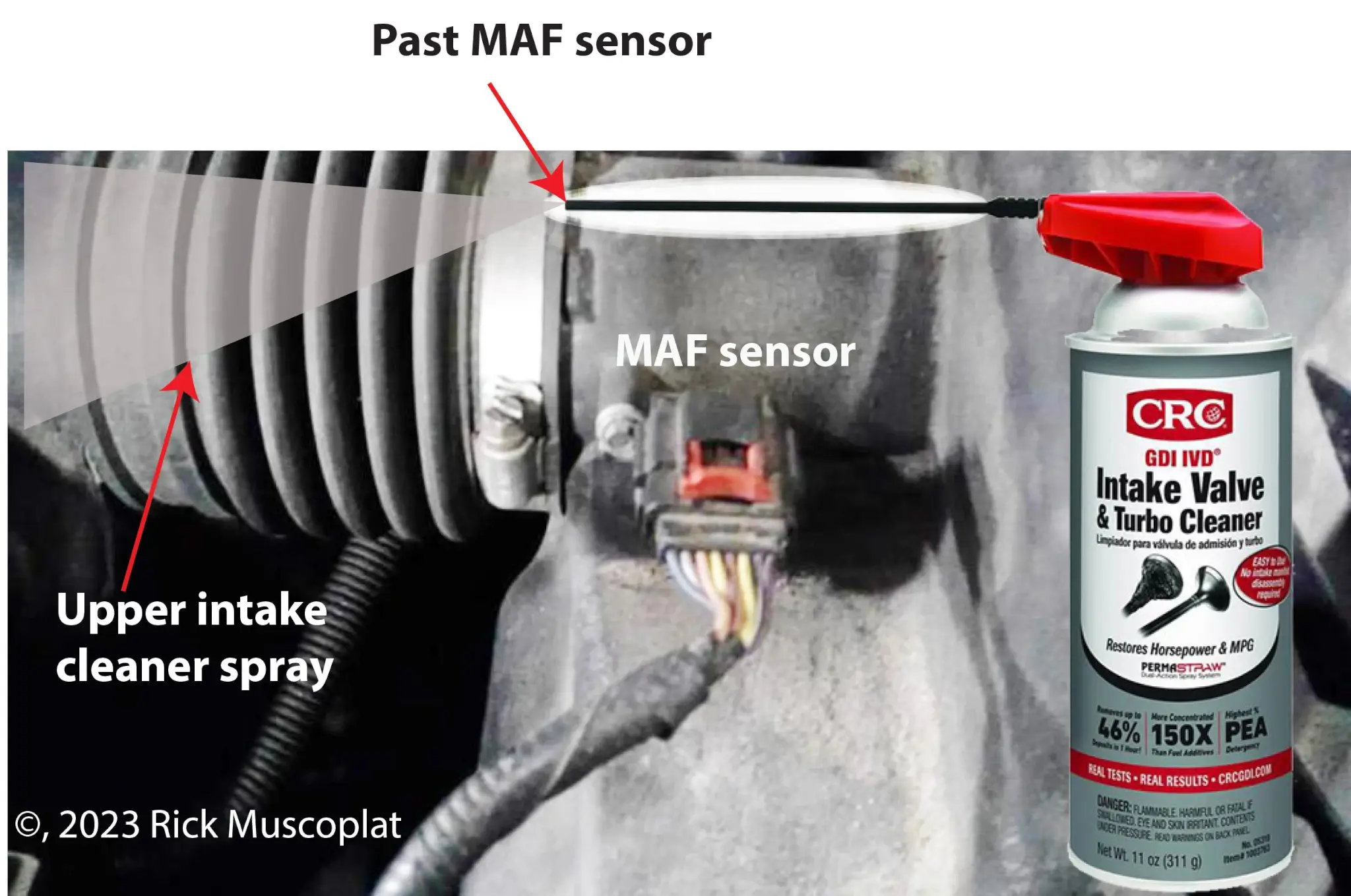
Follow the manufacturer’s instructions on how long to spray the cleaner. Many recommend 2-second bursts with a rest between sprays.
©, 2023 Rick Muscoplat
Posted on by Rick Muscoplat