
Differential Fluid Explained: The Key to Long Drivetrain Life
What Differential Fluid Does Inside Your Vehicle
Quick Summary
Differential fluid is one of the most overlooked maintenance items I see, yet it’s critical to drivetrain survival. Differential fluid—often called gear oil—lubricates gears, bearings, and clutch packs inside the differential. It prevents metal-to-metal contact, reduces heat, and ensures smooth power delivery to the wheels. Depending on driving conditions and the type of gear oil used, it should typically be changed every 30,000 to 60,000 miles. Ignore it, and you risk noisy gears, overheating, premature wear, and eventually a very expensive differential rebuild or replacement.
What Differential Fluid Does (And Why It’s So Critical)
I’ve rebuilt enough differentials over the years to tell you one thing: when differential fluid fails, it doesn’t fail quietly. The differential is a high-load, high-pressure environment where ring, pinion, and spider gears, along with bearings, are constantly meshing under torque.
Differential fluid, a specialized type of gear oil, serves several key purposes:
1) Creates a protective film between gear teeth — Without that film, the extreme pressure would cause metal surfaces to weld and tear apart—a condition called scuffing or galling.
2) Removes heat — As gears mesh, they generate friction and heat. Good gear oil carries that heat away and dissipates it through the differential housing. Without proper lubrication, temperatures spike quickly, leading to the breakdown of internal components.
3) Protects against corrosion and contamination — Additives in differential fluid neutralize acids and prevent rust, which is especially important in climates like Minnesota where moisture and temperature swings are common.
4) Controls clutch engagement in limited-slip differentials — In these systems, the wrong differential fluid—or old, worn-out fluid—can cause chatter, binding, or poor traction.
Types of Differential Fluid and Gear Oil
Not all differential fluid is created equal, and choosing the right gear oil matters more than most people realize.
The most common types of gear oil you’ll see are based on viscosity ratings like 75W-90, 80W-90, and 75W-140. The first number refers to cold-flow characteristics, while the second number reflects high-temperature protection. For example, 75W-90 flows well in cold weather but still provides strong protection when the differential is at full operating temperature.
Two Types of Differential Fluid
Conventional — A thick, high-viscosity mineral oil typically rated at 75W-90, 80W-90, or 85W-140 (GL-4 or GL-5 API service classification) that contains extreme-pressure (EP) additives — usually sulfur-phosphorus compounds — to protect gear surfaces under heavy load and shock stress.
Conventional gear oil:
• Breaks down faster than synthetic gear oil under high heat,
• Providing less protection at temperature extremes, and generally
• Requires more frequent service intervals than full-synthetic alternatives
Synthetic gear oil — Synthetic differential fluid is a fully engineered lubricant made from chemically synthesized base stocks (typically polyalphaolefins or PAOs) rather than refined mineral oil. It’s designed to meet the same GL-4/GL-5 API service ratings as conventional gear oil but delivers significantly enhanced performance across the board.
Synthetic gear oil advantages over conventional fluid:
• Temperature performance — Flows better at much lower temperatures for better cold-weather startup protection
• Resists thinning and oxidation at high operating temperatures far better than petroleum-based oil
• Film strength — Maintains a stronger, more consistent lubricating film under heavy loads and shock stress, reducing wear on ring/pinion gears and bearings
• Longer service life — Resists thermal breakdown and oxidation significantly longer, typically allowing service intervals of 50,000–100,000+ miles versus 30,000–60,000 for conventional
• Reduced friction — Lower internal fluid friction translates to minor but measurable drivetrain efficiency gains and slightly cooler operating temps
• Better shear stability — Holds its viscosity rating more consistently over time, meaning it doesn’t thin out as quickly under prolonged stress
• Moisture and corrosion resistance — Offers improved protection against rust and corrosion within the differential housing
Differential Additives and Modifiers
Limited-slip differentials (LSDs) usually require friction modifiers in the differential fluid to allow clutch packs to engage smoothly. Some gear oils already include these additives, while others require you to add them separately.
How Often Should You Change Differential Fluid?
This is where I see the biggest disconnect between what’s recommended and what actually gets done. Many drivers never change their differential fluid at all.
As a general rule, I recommend changing differential fluid every 30,000 to 60,000 miles. If you’re towing, hauling heavy loads, or driving in severe conditions—think stop-and-go traffic, extreme temperatures, or off-roading—I lean toward the 30,000-mile interval or even sooner.
Some manufacturers claim “lifetime” gear oil, but I don’t buy into that. Lifetime usually means the expected life of the warranty, not the vehicle. Gear oil degrades over time due to heat, shear forces, and contamination from metal particles.
When I drain old differential fluid, I often find it dark, burnt-smelling, and full of metallic debris. That’s a clear sign it’s past its prime.
What Happens If You Don’t Change Differential Fluid?
Ignoring differential fluid is one of the fastest ways to turn a relatively cheap service into a major repair.
The first thing you’ll usually notice is
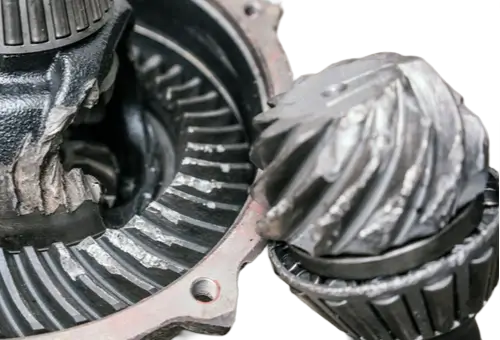
Worn-out ring and pinion gear
noise. A worn-out differential fluid loses its protective properties, and you’ll start hearing whining or howling noises—especially during acceleration or deceleration. That noise is gear wear in progress.
As the condition worsens, heat builds up inside the differential. Overheated gear oil breaks down even faster, creating a vicious cycle. Bearings begin to wear, and gear teeth start to pit and chip.
In limited-slip differentials, old fluid can cause clutch chatter—felt as a jerking or grabbing sensation when turning.
Eventually, the gears can fail completely. I’ve seen ring-and-pinion sets destroyed simply because the differential fluid was never changed. At that point, you’re looking at a repair bill that can easily run into the thousands.
My Professional Take on Differential Fluid Maintenance
If there’s one piece of advice I give consistently, it’s this: don’t ignore your differential fluid. It’s cheap insurance.
Changing gear oil is a straightforward service compared to the cost of rebuilding a differential. And unlike engine oil, differential fluid doesn’t get nearly as much attention, which makes it even more critical to stay on top of it.
I always recommend using a high-quality synthetic gear oil that meets your vehicle’s specifications, and sticking to a regular service interval. If you’ve never changed it and you’re past 60,000 miles, it’s time.
©, 2026 Rick Muscoplat
Posted on by Rick Muscoplat