
Learn The Pros and Cons of Installing Larger Tires
The Pros and Cons of Installing Larger Tires on Your Truck
Installing larger tires and wheels on your vehicle is the latest craze. They look cool, but if it’s not done properly, you can be setting yourself up for some serious and mighty expensive repairs. While bigger tires can offer a range of benefits, they also come with potential drawbacks. Before making the switch, it’s essential to weigh the pros and cons of installing larger tires to ensure that the upgrade aligns with your needs and preferences.
The Pros of Installing Larger Tires
1. Better Ground Clearance— Larger tires raise the overall height of the truck, providing additional ground clearance. This is particularly beneficial for tackling deep water crossings or navigating over uneven terrain. Increased clearance reduces the risk of the undercarriage scraping or getting stuck, allowing for a more confident off-road experience.
2. Enhanced Aesthetic Appeal— Many truck enthusiasts opt for larger tires simply for the more aggressive stance and vehicle profile. For some, this visual upgrade is worth the investment, as it contributes to the truck’s overall rugged and commanding look.
3. Increased Towing and Payload Capacity— In certain cases, larger tires can enhance a truck’s towing and payload capabilities. The added size can help distribute the load more effectively, potentially improving stability when hauling heavy cargo or towing a trailer. This is especially true for trucks that have been specifically designed to handle larger tires, as they may come with reinforced suspension components to accommodate the change.
4. Better Visibility— With larger tires, your truck will sit higher off the ground, offering improved visibility of the road ahead. This can be particularly advantageous in traffic situations or on challenging roads where seeing over obstacles or other vehicles can enhance safety.
Cons of Installing Larger Tires
1. Increased Fuel Consumption— One of the primary downsides of larger tires is the impact on fuel efficiency. Bigger tires are heavier and create more rolling resistance, requiring more power to move. As a result, you may notice a decrease in miles per gallon (MPG), leading to higher fuel costs. This is an important consideration for those who prioritize fuel economy or frequently drive long distances.
2. Altered Handling and Ride Quality— Larger tires can affect a truck’s handling and ride quality. The increased tire height can lead to a higher center of gravity, making the vehicle more prone to body roll during cornering. Additionally, the ride quality may become firmer or rougher, as larger tires can transmit more road imperfections to the cabin. This could make daily driving less comfortable, especially on smooth or paved roads.
• The higher the plus sizing, the worse the ride quality; it’ll feel more like an off-road vehicle. It’ll rattle your brain and knock out your fillings.
3. Potential for Increased Wear and Tear— The added strain on suspension components and drivetrain parts from larger tires can accelerate wear and tear. The vehicle’s alignment may be thrown off, leading to uneven tire wear and potentially requiring more frequent adjustments or replacements. Additionally, the increased load on the transmission and differential can result in higher maintenance costs over time.
4. Reduced Braking Performance— Larger tires can impact braking performance due to their increased weight and rolling resistance. The additional mass requires more effort to stop, which can result in longer stopping distances. This is a crucial safety consideration, especially if you frequently drive in heavy traffic or on steep inclines.
5. Legal and Insurance Implications— Before installing larger tires, it’s essential to check local regulations and insurance policies. Some areas have restrictions on tire sizes, and deviations from factory specifications could result in legal issues or voided warranties. Additionally, insurers may raise premiums or refuse coverage if the modification is deemed to increase the risk of accidents or damage.
Installing larger tires is called Plus Sizing
For example, A “Plus 0” tire is the same diameter as the OE tire but has a larger tread width or larger sidewall ratio. A “Plus One” size is a tire that has a 1” larger diameter than the OE tire. Plus Two is a tire that has a 2” larger diameter than the OE tires.
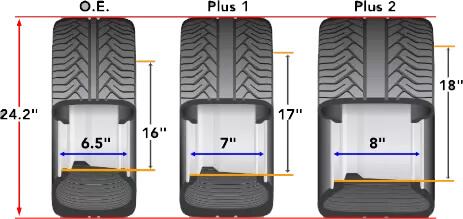
You can also install a Minus Sizing where the tire diameter is smaller than the OE tire. Minus sizing is sometimes used when installing new wheels and winter tires since the smaller wheels are a little cheaper and the minus sizing results in more sidewall height.
• Installing larger tires will decrease acceleration and braking and reduce ride quality. The increased tire diameter changed acceleration and braking leverage physics.
Tire pressure for plus sized tires
When you change to a larger tire, you usually wind up with a tire with a different maximum load rating, which usually means you use a different tire inflation pressure. Use this tire inflation chart to find the recommended pressure for your tires.
©, 2020 Rick Muscoplat