
Bad Motor Mount Symptoms You Should Never Ignore
What Motor Mounts Do and Bad Motor Mount Symptoms
Quick Summary
The most common bad motor mount symptoms include:
• Excessive engine vibration
• Clunking when shifting gears
• Engine rocking during acceleration
• Rattling noises
• Harsh drivetrain movement
• Leaking hydraulic mounts
• Visible cracked or collapsed rubber
• Engine sagging on one side
Catching these symptoms early can prevent expensive secondary damage and restore smooth vehicle operation.
If there’s one thing I’ve learned after decades of diagnosing drivability complaints, it’s this: many drivers ignore bad motor mount symptoms until the vehicle starts shaking hard enough to rattle their teeth. By then, what could have been a relatively straightforward repair often turns into damaged hoses, broken exhaust components, or even drivetrain problems.
The good news is that the symptoms of a failing engine mount are usually easy to spot once you know what to look for. Excessive vibration, clunking noises when shifting, visible engine movement, and harsh engagement into Drive or Reverse are some of the most common signs. In this guide, I’ll explain what motor mounts actually do, how they fail, and the warning signs that indicate it’s time to replace them before they cause bigger problems.
The Most Common Bad Motor Mount Symptoms
Excessive Engine Vibration — This is usually the first symptom drivers notice. A healthy motor mount absorbs engine vibration before it reaches the cabin. When the rubber deteriorates or separates, those vibrations transfer directly into the steering wheel, dashboard, seats, and floorboards.
I’ve diagnosed countless vehicles where customers complained about:
• Steering wheel vibration at idle
• Dashboard buzzing
• Seat vibration while stopped at a light
• Increased vibration when the A/C turns on
One classic bad motor mount symptom at idle is a vibration that slightly disappears as RPM increases.
Clunking When Shifting Into Drive or Reverse — Another common complaint is a heavy “thud” or “clunk” when shifting gears. I’ve seen customers replace perfectly good transmissions when the real issue was a collapsed motor mount.
When a mount fails, the engine can suddenly shift position as torque loads the drivetrain. That movement creates a dull impact noise that many drivers mistake for a transmission problem.
This symptom is especially common on:
• Front-wheel-drive vehicles
• Vehicles with hydraulic mounts
• High-mileage SUVs and trucks
• Engine Movement During Acceleration
One of the easiest ways I check for a broken motor mount is by observing engine movement under load.
With the hood open:
• Have someone firmly hold the brake pedal.
• Shift into Drive.
• Apply light throttle.
If the engine lifts dramatically or rocks excessively, you likely have failed mounts. Healthy mounts allow minimal movement. A failed mount can let the engine move several inches. Excessive movement is one of the clearest signs of a broken engine mount.
Rattling or Thumping During Acceleration — When mounts weaken, the drivetrain can shift during acceleration or deceleration.
That movement often creates:
• Metallic rattles
• Thumping noises
• Exhaust banging sounds
• Drivetrain jolts
These noises are especially noticeable:
• During hard acceleration
• When climbing hills
• While downshifting
• During sudden throttle changes
This is one reason many people confuse bad motor mount symptoms with suspension or transmission problems.
Leaking Hydraulic Motor Mount — Many modern vehicles use fluid-filled hydraulic mounts. When they fail, dark oily fluid leaks from the mount housing. Once that fluid escapes, the mount loses most of its vibration-dampening ability. A leaking motor mount almost always means replacement is necessary.
I frequently see hydraulic mount failures on:
• Honda vehicles
• Nissan vehicles
• Luxury cars
• Turbocharged engines
If you spot oily residue near a mount, don’t ignore it.
Visual Signs of a Failed Motor Mount — Sometimes, the easiest diagnosis is simply looking at the mount itself.
Common visual clues include:
• Cracked rubber
• Separated rubber isolators
• Rusted brackets
• Sagging engine position
• Torn torque struts
• Fluid leakage from hydraulic mounts
• In severe cases, the engine may visibly sit lower on one side.
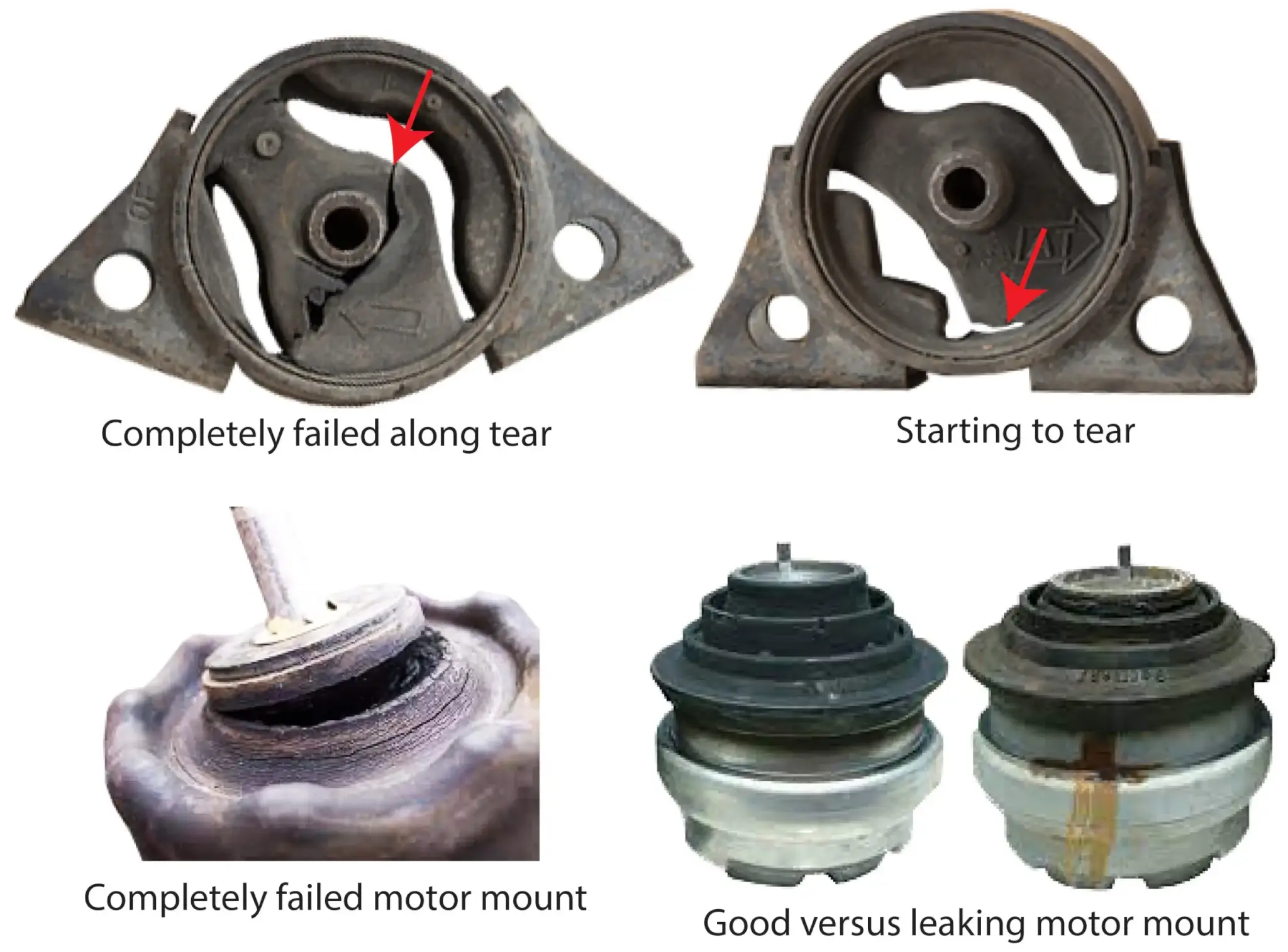
Typical motor mount failures
What Causes Motor Mount Failure?
Aggressive driving accelerates mount wear. Hard launches, towing, and rapid throttle changes place enormous strain on the mounts.
Motor mounts live in one of the harshest environments in the vehicle.
They’re constantly exposed to:
• Engine heat
• Oil leaks
• Coolant contamination
• Torque stress
• Road salt
• Repeated vibration cycles
• Oil contamination is one of the biggest killers. Once oil saturates the rubber, it softens and deteriorates rapidly.
What Happens If You Ignore Bad Motor Mount Symptoms?
This is where things can get expensive. A completely failed mount allows the engine to move far beyond its intended limits. I’ve personally seen failed mounts cause:
• Torn radiator hoses
• Broken exhaust flex pipes
• Damaged CV axles
• Broken wiring harnesses
• Cracked air intake tubes
• Transmission case damage
In extreme cases, the engine can shift enough to create unsafe driving conditions. Ignoring bad motor mount symptoms is never a good idea.
Can You Drive With a Bad Motor Mount?
Technically, yes — for a while. But I don’t recommend it. A mildly worn mount may simply create vibration. A severely broken mount can damage surrounding components very quickly.
If you notice:
• Severe clunking
• Violent engine movement
• Heavy vibration
• Harsh shifting impacts
You should schedule repairs immediately.
What Motor Mounts Actually Do
Most drivers never think about motor mounts because they’re buried deep in the engine compartment. But as a technician, I can tell you that they’re among the most important components in the drivetr

A typical motor mount on a late model vehicle
ain.
The engine creates an enormous twisting force every time you accelerate. Without motor mounts controlling that movement, the engine would violently rock inside the engine bay. Motor mounts secure the engine and transmission to the vehicle frame while also isolating vibration from the passenger compartment.
Modern vehicles use several different types of mounts:
• Conventional rubber mounts
• Hydraulic motor mounts
• Electronically controlled active mounts
• Torque strut mounts (“dog bone” mounts)
Over time, heat, oil contamination, age, and repeated torque loads break down the rubber or hydraulic fluid inside the mounts. That’s when bad motor mount symptoms begin showing up.
To learn more about the four different types of motor mounts and how they work and fail, see this post
In a traditional engine, there are motor mounts on the right and left sides; however, in a transverse mount engine, there can be three or four motor mounts. See this post on how motor mounts work and how they fail.
My Expert Advice on Replacing Motor Mounts
In my professional opinion, replacing a broken motor mount isn’t a “maybe later” repair. Once you notice the symptoms of a bad motor mount, schedule service as soon as possible.
Replacement costs vary widely depending on whether your car uses conventional rubber mounts or fluid-filled electronic ones. However, catching a leaking motor mount early will always cost less than waiting for engine damage caused by excessive movement.
Remember — what motor mounts do is protect not just your comfort but the structural and mechanical integrity of your entire drivetrain.
©, 2023 Rick Muscoplat
Posted on by Rick Muscoplat