
Short Term Fuel Trim Diagnostics Guide for Rich Conditions
Professional Diagnostic Strategy to Diagnose and Fix a Negative Short Term Fuel Trim Condition
Quick Summary
A negative short term fuel trim (STFT) at idle—especially in the –10% to –25% range tells me the engine is running rich, and the PCM is actively pulling fuel to compensate. In my experience, the root cause almost always comes down to excessive fuel entering the engine at low airflow. The most common culprits are:
• Leaking fuel injectors
• A stuck open EVAP purge valve
• High fuel pressure
• Or faulty sensor inputs
The key is not guessing—it’s following a structured diagnostic strategy that isolates the cause quickly and accurately.
What Negative Short Term Fuel Trim Means
Let’s start with how short term fuel trim actually works. The PCM continuously adjusts the injector pulse width based on feedback from the oxygen sensors. These adjustments show up as STFT, which is the real-time correction.
When STFT is negative, the PCM is:
• Removing fuel from the mixture
• Responding to a rich condition
At idle, a reading like –20% STFT is significant. That means the PCM is cutting fuel by 20% just to maintain the proper air-fuel ratio. In other words, something is adding fuel that shouldn’t be there.
Idle conditions matter because airflow is low, so even a small amount of extra fuel has a big impact. That’s why negative short term fuel trim at idle is one of the most valuable clues in diagnostics.
Why It Happens at Idle
I always pay attention to whether the problem is isolated to idle. If STFT is strongly negative at idle but improves at higher RPM, that tells me the issue is load-sensitive.
At idle:
• Injector pulse widths are very short
• Manifold vacuum is high
• Small leaks or fuel delivery issues are amplified
So when I see negative short term fuel trim only at idle, I immediately suspect:
• Fuel entering the intake when it shouldn’t
• A component behaving incorrectly under high vacuum
That narrows the field quickly.
The Most Likely Causes of Negative STFT at Idle
1) Stuck Open EVAP Purge Valve — The EVAP
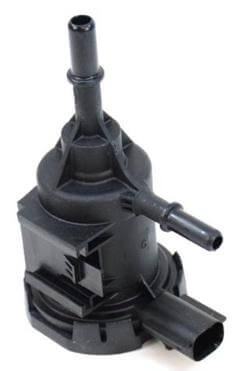
A stuck open purge can cause negative short term fuel trims
purge valve is designed to remain closed at idle. When it sticks open, the engine vacuum sucks in fuel vapor from the charcoal canister, causing a rich condition.
In other words, that fuel vapor is unmetered; fuel the ECM didn’t expect to see. So the ECM sees a rich condition from the upstream oxygen sensor and responds by pulling fuel, resulting in a high negative short term fuel trim. This is one of the most overlooked causes—and one I catch regularly.
An open purge valve should normally set a trouble code and a check engine light, so start by checking trouble codes.
2) Leaking Fuel Injectors — This is the second most common cause I’ve diagnosed. A slightly leaking injector can drip fuel into the cylinder even when it’s supposed to be closed. At idle, that extra fuel overwhelms the mixture, driving STFT negative.
I often confirm this with a fuel-pressure leakdown test or by inspecting the spark plugs for one cylinder running richer than the others.
3) Excessive Fuel Pressure — Too much fuel pressure increases injector flow beyond what the PCM expects. Even with normal injector commands, more fuel enters the engine.
A failed regulator or restricted return line is usually behind it.
4) Faulty Mass Airflow Sensor — A skewed mass airflow sensor can over-report airflow. The ECM adds fuel based on that incorrect data, and the oxygen sensor feedback forces short term fuel trim negative. A bad MAF tends to affect trims beyond idle, but I’ve seen it present primarily at idle if it’s contaminated. Try cleaning the MAF.
5) Oxygen Sensor Bias — The oxygen sensor may falsely report a rich condition. When that happens, the ECM removes fuel even if the mixture is correct. This is less common because if the O2 is off, it would normally set an O2 sensor-related trouble code. But it’s something I verify by observing sensor-switching patterns and cross-checking against fuel trims.
My Professional Diagnostic Strategy
When diagnosing negative short term fuel trim, I don’t guess—I follow a repeatable process.
Step 1: Compare Idle vs Higher RPM — I bring the engine up to about 2,500 RPM and watch STFT.
• If trims improve → suspect purge valve or injector leak
• If trims stay negative → suspect fuel pressure or sensor input
This one step often cuts diagnostic time in half.
Step 2: Check Fuel Pressure — I always verify fuel pressure against spec. Elevated pressure confirms the engine is being over-fueled mechanically, not electronically.
Step 3: Isolate the EVAP System — I temporarily block or pinch off the purge line. If short term fuel trim moves toward zero, I’ve found the issue. This is one of the fastest and most effective tests you can perform.
Step 4: Perform Injector Leak Down Testing — I monitor fuel pressure after shutdown. A rapid drop indicates leaking injectors. On advanced setups, I’ll use an injector balance test.
Step 5: Evaluate Sensor Inputs —Review these sensor readings:
• MAF readings (grams per second at idle)
• Oxygen sensor switching
• Coolant temperature data
If any input is skewed, the PCM will make incorrect fueling decisions, driving STFT negative.
How I Think About It in the Shop
After years of diagnosing drivability issues, I’ve learned to simplify the logic:
• Negative short term fuel trim at idle means the engine is getting too much fuel—and the ECM is trying to fix it.
The job is to answer one question:
Where is that extra fuel coming from?
Once you approach it that way, the diagnosis becomes straightforward and efficient.
©, 2026 Rick Muscoplat
Posted on by Rick Muscoplat