
The Best Fuel Injector Cleaner and fuel system cleaners
The Best Fuel Injector Cleaner: What Actually Works (And What I Recommend)
Quick Summary
If you’re looking for the best fuel injector cleaner, don’t waste your money on products that are little more than solvents in a bottle. After years of researching fuel system chemistry and evaluating Safety Data Sheets (SDS) from the major manufacturers, I’ve found that the most effective products all have one thing in common—they contain high concentrations of Polyether Amine (PEA) or Polyisobutene Amine (PIBA) detergents.
My top recommendations are:
1. Red Line SI-1 Complete Fuel System Cleaner — Best Overall
If I had to recommend only one product, this would be it. Red Line SI-1 contains one of the highest concentrations of PEA available in a consumer fuel system cleaner.
It’s particularly effective for:
• Rough idle
• Hesitation during acceleration
• Dirty injectors
• Carbon-coated intake valves
• Vehicles with 75,000 miles or more
Because of its high detergent concentration, it’s especially good for engines that haven’t received regular fuel system maintenance.
2. Chevron Techron Concentrate Plus — Best Value
Chevron helped pioneer PEA detergent technology. Techron remains one of the most respected products in the automotive industry because it delivers professional-level cleaning at a reasonable price.
I often recommend it for:
• Preventive maintenance
• Minor injector deposits
• Slight loss of fuel economy
• Vehicles using lower-quality gasoline
It’s also one of the easiest premium cleaners to find locally.
3. Gumout Regane High Mileage Fuel System Cleaner — Best for Older Vehicles
High-mileage engines often suffer from years of carbon accumulation.
Gumout Regane combines PEA detergents with quality carrier oils, making it an excellent choice for older vehicles that have begun showing symptoms of injector deposits.
It works well for:
• Rough idle
• Mild misfires
• Hesitation
• Loss of power
• Reduced fuel economy
These three products consistently rank among the highest because they contain substantial concentrations of proven detergent chemistry.
These products clean more than just fuel injectors—they also remove deposits from intake valves, combustion chambers, and portions of the fuel system while helping prevent new deposits from forming. They consistently stand above the competition because of their advanced detergent chemistry.
The Best Fuel Injector Cleaner Isn’t Always the Most Expensive
One of the questions I’m asked most often is, “What’s the best fuel injector cleaner?” The answer surprises many people. Price doesn’t determine quality. Marketing doesn’t determine quality. Even brand recognition isn’t the deciding factor.
What matters is chemistry
I’ve spent decades working in the automotive industry, interviewing engineers, studying technical service bulletins, and researching lubricant and fuel additive technology. When I evaluate a fuel system cleaner, I don’t pay attention to the flashy label—I look at what’s actually inside the bottle.
That’s where many products fall short.
Some cleaners rely almost entirely on petroleum solvents that dissolve light varnish but have little effect on stubborn carbon deposits. Others contain modern detergent packages capable of breaking apart hardened carbon that has accumulated over tens of thousands of miles. The difference in cleaning performance can be dramatic.
What Makes the Best Fuel Injector Cleaner Work?
Not all detergents are created equal. The best fuel injector cleaner formulas use one or more of these advanced cleaning agents:
• Polyether Amine (PEA) – The gold standard for removing heavy carbon deposits.
• Polyisobutene Amine (PIBA) – Excellent for preventing injector and intake valve deposits.
• Mannich amines and related detergents – Improve cleaning performance, especially during cold starts.
Quality cleaners also include carrier oils and stabilizers that:
• Protect injector tips
• Lubricate upper cylinders
• Reduce future deposit formation
• Help maintain injector spray patterns
• Protect fuel pumps and fuel rails against corrosion
Together, these ingredients restore fuel delivery while helping the engine maintain peak efficiency.
Detergent Additives: PEA, PIBA, and Mannich Amines Explained
Detergent Surfactants
• Polyether amines (PEA): PEA breaks the molecular bonds in heavy carbon and varnish layers, lifting them for safe combustion.
• Polyisobutene amines (PIBA): Target mid-range deposits, preventing port fouling and knock.
• Mannich amines & polyolefin amines: Enhance low-temperature solubility, ensuring cleaning action even in cold starts.
Carrier Oils & Film-Formers
• Poly-Alpha-Olefins (PAO): Create a microscopic protective film on injector tips and intake valves, reducing deposit re-formation.
• Poly-Ethers & Poly-Glycols: Improve spray-pattern lubrication, extending injector life and smoothing throttle response.
• Precision Solvents— Light hydrocarbon fractions: Quickly dissolve light varnish without attacking seals or O-rings.
• Advanced esters: Maintain formulation stability, ensuring detergents remain evenly dispersed in your tank.
• Corrosion Inhibitors & Stabilizers— Guard against moisture-induced rust in fuel rails and pumps and preserve fuel quality during storage, making these fuel system cleaners ideal for both daily drivers and seasonal equipment.
Why These Fuel System Cleaners Excel
Red Line SI-1 leverages ultra-high PEA concentration (30–50% by weight) for deep-cleaning under all load conditions.
Chevron Techron employs a proprietary polyetheramine blend (25–35% weight) proven to outperform dealer-installed services.
Gumout Regane balances PEA (10–30%) with robust carrier oils for high-mileage engines prone to thick deposits.
Cheaper alternatives often include less effective solvents, such as naphtha or Stoddard solvent. If you want results, stick with the best fuel injector cleaners from the brands I’ve listed.
The most effective detergents break down stubborn carbon deposits while forming a protective barrier to prevent future buildup. High-quality cleaners also use carrier oils such as Poly-Alpha-Olefins or Poly-Ethers to coat injector ports and valves, reducing wear and tear.
Want to learn more about how fuel injector cleaners work? See this article: How Fuel Injector Cleaners Work — Unpacking the Chemistry
How to Choose and Use the Best Cleaner
When shopping for a cleaner, read the product’s label or its Safety Data Sheet (SDS) for details on its formulation. Look for a high concentration of the active detergents listed above.
Add the cleaner to your gas tank following the manufacturer’s instructions. If you have a buildup in the fuel system, you should notice a difference within one tank of gas.
You’ll most likely have to buy Red Line online or from O’Reily Auto Parts, Advance Auto Parts, Amazon, or Walmart. You can find Chevron Techron and Gumout Regane at Walmart and most brick-and-mortar auto parts stores.
Here’s a list of fuel injector cleaners, along with the amount of their primary active cleaners
These fuel injector cleaners are arranged by highest concentration of the most effective cleaners
Red Line® SI-1 Complete Fuel System Cleaner POLYETHER AMINE (P.E.A.) 28–34% by weight
Chevron Techron Concentrate Plus POLYETHER AMINE (P.E.A.) 15–20% byweight
Gumout Regane High Mileage Fuel System Cleaner POLYETHER AMINE (P.E.A.) 10-30%
Gumout Regane Complete Fuel System Cleaner POLYETHER AMINE (P.E.A.) 10-30%
Gumout All-In-One Complete Fuel System Cleaner POLYETHER AMINE (P.E.A.) 10-30%
Lucas Oil 10512 Deep Clean Fuel System Cleaner No PEA listed. But it does list Monoalkylaryl alkoxylate aminated: 10–30% by weight
Royal Purple MAX-CLEAN Fuel System Cleaner and Stabilizer Current Product Data Sheet (2025): States that Max-Clean is formulated with PEA detergents, but does not specify the percentage.
Royal Purple FAQ: Confirms that Max-Clean contains polyetheramine (PEA) and that PEA is the active detergent responsible for removing fuel system deposits.
Sea Foam Concentrated Fuel Injector Cleaner — Sea Foam Concentrated Fuel Injector Cleaner does not contain Polyether Amine (PEA). The confusion comes from older ingredient lists that identified its detergent as polyolefin alkyl phenol alkyl amine, which is not the same chemistry as PEA.
Current formulation (2023–2026 SDS)
The current Safety Data Sheet for Sea Foam Concentrated Fuel Injector Cleaner (IC5) lists:
Hydrotreated heavy paraffinic oil 60–80%
Light aromatic solvent naphtha 7–13%
Polyolefin alkyl phenol alkyl amine 7–13%
Other solvents Small amounts
Gumout One-N-Done Complete Fuel System Cleaner POLYETHER AMINE (P.E.A.) 3-7%
STP® Super Concentrated Fuel Injector Cleaner STP® Super Concentrated Fuel Injector Cleaner does not contain disclosed Polyether Amine (PEA). The current Safety Data Sheet identifies its primary detergent as:
Polyolefin alkyl phenol alkyl amine: 1–5% by weight
This is not the same chemical as Polyether Amine (PEA).
According to the manufacturers’ safety data sheets, these brands’ fuel system cleaners do NOT include the above-listed cleaners:
Berryman B-12 CHEMTOOL TOTAL FUEL SYSTEM CLEAN-UP
BG BG 44K
Sea Foam Motor Treatment
These products consist mainly of solvents like Naphtha, Stoddard solvent, 1,2,4-trimethylbenzene, and naphthalene.
If in doubt, search for the cleaner name followed by “SDS” to read the company’s safety data sheet. Scroll down to Section 3 Composition/information on ingredients.
GM #88865595 CLEANER, FUEL SYSTEM TREATMENT 12 OZ. (For GASOLINE only engines) or
GM # 88865596 CLEANER, FUEL SYSTEM TREATMENT 12 OZ. (For FLEX FUEL engines).
Fuel Injector Cleaner vs Fuel System Cleaner
Many people use these terms interchangeably, but there’s a subtle difference.
1) A fuel injector cleaner primarily targets injector deposits.
2) A fuel system cleaner is formulated to clean:
Fuel injectors
Intake valves
Combustion chambers
Fuel rails
Portions of the fuel pump
Most premium products today are actually complete fuel system cleaners, which is why I generally recommend them over injector-only products.
How Do Fuel Injector Cleaners Actually Work?
As gasoline passes through your engine, tiny amounts of fuel oxidize and leave behind carbon deposits.
Over time, those deposits can:
1)Restrict injector flow
2)Distort the injector spray pattern
3)Reduce combustion efficiency
4)Increase emissions
5)Lower fuel economy
6)Cause hesitation and rough idle
PEA detergents chemically attack these deposits at the molecular level, gradually dissolving them so they burn harmlessly during combustion.
Unlike harsh solvents, PEA remains stable at combustion temperatures, allowing it to continue cleaning even inside the combustion chamber.
That’s one reason it’s considered the industry’s premium cleaning chemistry.
Signs Your Vehicle May Need a Fuel Injector Cleaner
A quality cleaner may help if your vehicle has:
• Rough idle
• Hesitation when accelerating
• Reduced fuel economy
• Loss of engine power
• Hard starting
• Mild engine knock
• Dirty intake valves
• Carbon buildup from short-trip driving
However, remember that these symptoms can also be caused by ignition problems, vacuum leaks, bad sensors, or low fuel pressure.
Always diagnose the vehicle properly before assuming dirty injectors are the culprit.
When Fuel Injector Cleaner Won’t Help
Pour-in cleaners aren’t miracle products.
They won’t repair:
• Plugged injectors
• Failed injector solenoids
• Broken injector nozzles
• Weak fuel pumps
• • Low fuel pressure
Ignition problems
• Vacuum leaks
• Mechanical engine damage
If an injector has failed electrically or is physically clogged beyond cleaning, replacement or professional ultrasonic cleaning is the only solution.
Why Many Automakers Don’t Recommend Routine Fuel Injector Cleaning
Many people are surprised to learn that manufacturers generally don’t recommend routine fuel injector cleaning as preventive maintenance. Why?
Because today’s Top Tier gasoline already contains detergent additives designed to keep injectors clean.
In addition, many dealerships have sold unnecessary injector cleaning services for years as profitable maintenance upsells.
Manufacturers, including GM, have issued service information explaining that fuel injector cleaning should generally be performed only when diagnostics indicate deposit-related drivability problems. GM instead recommends using Top Tier gasoline and, when appropriate, an approved fuel system treatment.
Frequently Asked Questions
Can fuel injector cleaner improve gas mileage?
Yes—if dirty injectors are causing poor fuel atomization. Once deposits are removed, combustion often becomes more efficient, which can improve fuel economy.
How often should I use fuel injector cleaner?
For most drivers using Top Tier gasoline, every 5,000 to 10,000 miles is more than sufficient. If you regularly buy discount fuel or make frequent short trips, you may benefit from more frequent use.
Is fuel injector cleaner safe?
High-quality products are safe when used according to the manufacturer’s directions. Avoid overdosing, as using more than recommended rarely improves cleaning performance.
Can I use fuel injector cleaner in direct injection (GDI) engines?
Yes, but remember that pour-in cleaners primarily clean the injectors and combustion chamber. They cannot clean intake valve deposits caused by crankcase vapors in many GDI engines because fuel never washes over those valves.
Final Thoughts
If you’re searching for the best fuel injector cleaner, focus on proven detergent chemistry rather than flashy marketing.
After comparing formulations and reviewing manufacturer ingredient disclosures, I continue to recommend Red Line SI-1 Complete Fuel System Cleaner, Chevron Techron Concentrate Plus. They don’t promise miracles—but when carbon deposits are actually the problem, they’re among the most effective over-the-counter solutions available.
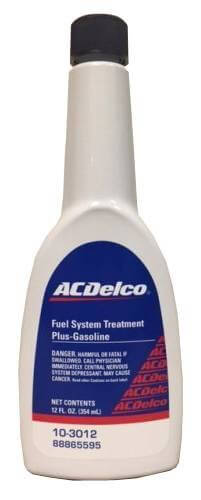
GM 88865595 Cleaner
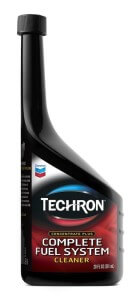 If you can’t find these cleaners, buy Chevron Techron fuel injector cleaner and Chevron Techron Fuel System cleaner at any auto parts store.
Add the cleaner to your gas tank according to the directions on the bottle.
For more information on DIY fuel system cleaning, read this post.
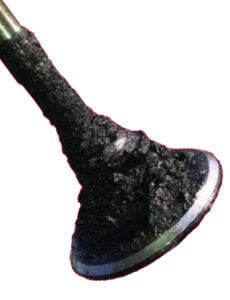
Buildup on the back face of an intake valve
©. 2018 Rick Muscoplat
Posted on by Rick Muscoplat