
The Best Tire Pressure Gauge for Accurate Readings
Finding the Best Tire Pressure Gauge: A Comprehensive Guide
Incorrect tire pressure can lead to poor fuel efficiency, uneven tire wear, and accidents. A reliable tire pressure gauge is a vital tool for ensuring your tires are properly inflated. With various types and models available on the market, finding the best tire pressure gauge can be a daunting task. This guide will help you understand what to look for when choosing a tire pressure gauge, the different types available, and some top recommendations.
Types of Pressure Gauges
Tire pressure gauges come in three main types: stick, dial, and digital. Each type has its advantages and disadvantages.
• Stick Gauges (also called a pencil gauge)— Pros: A sticky-style tire pressure gauge is the least expensive, compact, and easy to use. Doesn’t need batteries, so it can sit in your glove box forever. Cons: They’re the least accurate of all types and can be harder to read.
• Dial Gauges— Pros: More accurate than stick gauges and they’re easier to read with an analog dial. Cons: Cost more than stick gauges and they’re bulkier, taking up more space in your glove box or center console.
•Digital Gauges— Pros: Highly accurate, easy to read with digital displays, often come with additional features like backlighting and automatic shut-off. Cons: Require batteries with a shelf life. So you can find yourself with a dead battery when you need it most. If you buy a digital gauge to keep in the vehicle, also buy a stick gauge as a backup if the battery dies.
How to read a mechanical stick-style gauge
 Cost ranges from .99 to $3.00.
Remove the protective cap.
Align the gauge with the valve stem.
Perform a quick straight-in push to depress the valve core and seat the gauge until the pressure stick pushes out.
Rotate the gauge to find the reading closest to the gauge.
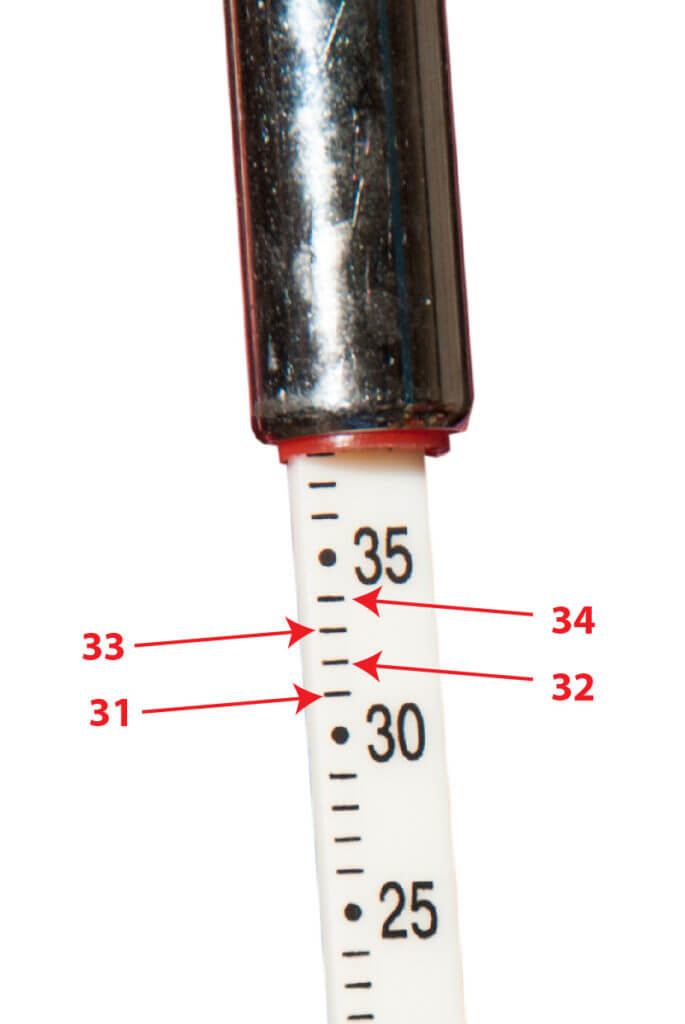
This tire pressure gauge shows 38-psi because the 38 line is closest to the gauge.
©, 2019 Rick Muscoplat and Alex Steil
Posted on by Rick Muscoplat