
Toyota P1315 code: Step-by-step troubleshooting guide
How to diagnose and fix a Toyota P1315 code for misfires on cylinder #4
Quick Summary
When I see a Toyota P1315 code, I don’t jump straight to replacing parts—and you shouldn’t either. This code points to an ignition coil igniter circuit problem on cylinder #4. This is not ordinarily a spark plug problem. In my experience, the most common causes are:
• Faulty ignition coil (internal transistor failure)
• Wiring or connector issues
• Loss of battery voltage to the coil
• Poor or missing ground to the ignition coil
• Crankshaft position sensor signal problems
What the Toyota P1315 Code Means
The Toyota P1315 code is a manufacturer-specific trouble code that, on Toyota vehicles, generally indicates a malfunction in the ignition control or misfire detection signal. In plain English, the engine control module (ECM) is expecting to see a consistent combustion event in each cylinder. When that signal becomes erratic—or disappears altogether—the ECM sets the Toyota P1315 code. This code is closely tied to Toyota’s misfire monitoring. Instead of relying on a single sensor, the system uses:
• Ignition feedback signals
• Crankshaft speed variations
• Combustion quality data
If those inputs don’t line up, the ECM flags a fault.
The Most Common Causes of the Toyota P1315 Code
After diagnosing countless ignition-related codes, I can tell you the Toyota P1315 code almost always points to the ignition coil or its wiring.
Here’s what I check first:
1. Faulty Ignition Coil (Most Common) — Unlike traditional ignition systems, where the ignition coil ground is toggled on and off by the ignition module, Toyota Direct Ignition System coils incorporate a transistor switch right into the coil. So the ground switching takes place in the coil, not in a remote ignition module. So, a Toyota P1315 usually indicates that the coil for cylinder #4 has failed. A quick way to confirm this is to swap the coil from cylinder #4 with cylinder #3 — if the code then moves to cylinder #3 (P1310), that confirms the coil pack has failed.
2. Damaged or Corroded Wiring/Connectors — An open or shorted harness on the ignition coil #4 circuit, or poor electrical connections with bent, broken, or corroded connector pins, are common culprits.
3. IGT/IGF Circuit Issue — The code indicates a malfunction in the IGT or IGF circuit — the signal lines running between the ECU and the igniter. If swapping coils doesn’t move the code, the problem likely lies in this wiring rather than the coil itself.
4. Faulty Spark Plug — A defective spark plug, or an extremely worn spark plug, can cause the ignition coil to overheat and fail. So it’s worth inspecting cylinder 4’s plug while you’re in there to prevent the new coil from failing in the same way.
5. ECM Failure (Rare) — In uncommon cases, a malfunctioning engine control module can trigger this code, though this is usually only suspected after ruling out everything else.
6. Crankshaft Position Sensor Issues — The ECM relies heavily on crankshaft data to detect misfires. A weak or erratic signal can trigger a Toyota ignition failure code like P1315.
7. Camshaft Position Sensor Problems — Less common, but still important for timing synchronization.
Common Symptoms of a Toyota P1315 Code
In my experience, when a Toyota P1315 code sets, the symptoms are usually obvious and drivability-related.
The most common symptoms include:
• Engine misfire (especially under load)
• Rough idle or shaking engine
• Hesitation during acceleration
• Loss of power
• Hard starting
• Check engine light illuminated
In more severe cases, I’ve seen:
• Engine stalling
• Flashing check engine light (active misfire)
This is not a “silent” code—you’ll feel it.
Understanding the Toyota Direct Ignition System
How Toyota ignition coils are wired
Each coil has four wires: Battery power, IGF signal return (ignition confirmation), primary ground (at ECM), and IGT trigger. Power is supplied to the Toyota ignition coils from the ignition switch/fuse/relay. Battery voltage powers the internal transistor and receives ground through the ECM.
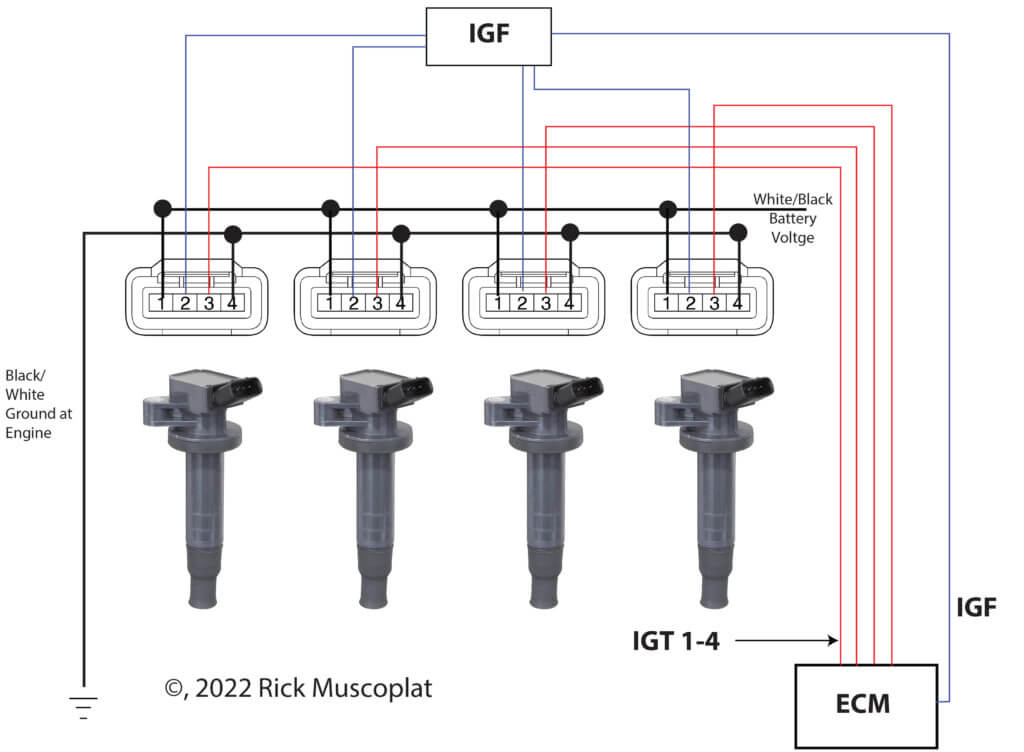
How the Toyota Direct Ignition System Fires the Ignition Coil
Unlike traditional ignition systems, where the ignition module or ECM disconnects the primary coil ground to fire the coil, the Toyota Direct Ignition System (DIS) instead uses a transistor and triggering signal. Here’s how it works:
1) The ECM tracks cam and crank signals using the camshaft and crankshaft position sensors, and incorporates engine load data and the engine coolant temperature.
2) To fire the coil, the ECM sends a digital (on/off) IGT trigger pulse to the corresponding ignition coil. When the IGT signal voltage is 0, the transistor interrupts the primary ground, causing the magnetic field to collapse rapidly and inducing a high-voltage spike in the secondary winding, which fires the spark plug.
3) ECM reads the IGF. Once the coil fires, it sends an IGF signal back to the ECM to confirm that ignition occurred. This signal is generated by monitoring current flow within the ignition coil circuit during the firing event. The ECM expects to receive an IGF pulse in response to every IGT signal it sends.
4) If the ECM sends an IGT signal but does not receive a corresponding IGF signal in return — indicating a misfire or coil failure — it will log a diagnostic trouble code (DTC) and may illuminate the check engine light.
Together, the IGT and IGF signals form a continuous feedback loop that allows the ECM to both command and verify each individual firing event, enabling precise ignition control and real-time misfire detection across all cylinders.
How I Diagnose a Toyota P1315 Code (Step-by-Step)
When it comes to the Toyota P1315 code, I follow a strict diagnostic routine. This prevents unnecessary parts replacement.
Step 1: Inspect Wiring and Grounds
Pay close attention to:
• Coil harnesses
• Sensor wiring
• Ground connections
Step 2: Test Ignition Coils —
• Swap coils between cylinders
• If the misfire moves, the coil is bad
This is one of the fastest and most reliable tests.
Step 3: Inspect Spark Plugs —Remove and inspect for:
• Carbon fouling
• Oil contamination
• Excessive wear
If they’re worn, replace them—it’s often the root cause.
Step 4: Check Mode $06 for Misfire Data —
• Use a scan tool to identify misfire counts
• Look for a specific cylinder pattern
Step 5: Check Crankshaft and Camshaft Signals
• Use live data or a scope
• Look for signal dropouts or inconsistencies
Step 6: Verify Engine Mechanical Condition
• Perform compression test if needed
• Rule out internal engine problems
©, 2022 Rick Muscoplat
Posted on by Rick Muscoplat