
Toyota P2118 Troubleshooting Made Simple
Common Causes of Toyota P2118
Quick Summary
This Toyota P2218 code is defined as: Throttle Actuator Control Motor Current Range/performance. That leads many DIYers and some techs to head right toward a throttle body replacement. When I diagnose a Toyota P2118 code, I don’t jump straight to replacing the throttle body—and neither should you. In my experience, the real cause is usually something much simpler:
• A low-voltage event (dead battery, jump-start issue)
• A blown ETCS fuse
• A missed throttle body relearn procedure
Only after I verify power, ground, and motor resistance do I even consider replacing parts. If you follow a methodical approach, you can fix this code quickly and avoid unnecessary repairs.
However, if voltage, wiring, or throttle motor resistance is out of range, the throttle body itself may be at fault. Understanding how the Toyota P2118 sets is key to fixing it quickly and avoiding unnecessary part replacements.
Toyota P2118: Understanding the Throttle Actuator Control Motor
Shops are seeing a sharp increase in Toyota vehicles coming into shops with a Toyota P2118 code, and the reason isn’t mysterious once you understand how sensitive Toyota’s electronic throttle system is to voltage disruptions.
At its core, Toyota P2118 means the engine control module commanded the throttle to move, but the electrical current or throttle position feedback didn’t match what it expected. When that happens, Toyota doesn’t take chances—it immediately goes into protection mode.
That’s why you’ll notice these symptoms:
• Limited throttle response
• Reduced engine power
• The vehicle is barely accelerating
This isn’t random—it’s Toyota protecting the engine and drivetrain.
The Most Common Causes of a Toyota P2118 Code
After years of diagnosing these, I can tell you this: most Toyota P2118 problems are electrical—not mechanical.
The most common causes I see include:
• Low battery voltage or a dead battery
• Improper jump-starting (especially reversed polarity)
• Blown ETCS fuse (very common)
• Skipped throttle body relearn procedure
• Corroded or damaged wiring
• Faulty throttle actuator motor (less common)
A voltage disruption is the #1 trigger.
That’s why I always ask customers:
“Did this happen right after a battery replacement or jump-start?”
Most of the time, the answer is yes.
The First Thing I Check: ETCS Fuse
If you take one thing from this article, it’s this:
• Always check the ETCS fuse first. On many Toyota models, it’s a 10-amp fuse in the under-hood fuse box.
If that fuse is blown:
• The throttle motor loses power
• The ECM sees no response
• The system triggers the Toyota P2118 code
Replacing the fuse often restores operation—but you’re not done yet.
Why Skipping the Relearn Procedure Causes Problems
After any battery disconnect, the ECM loses its learned throttle values.
If you skip the relearn:
• The throttle angle may be slightly off
• Airflow doesn’t match expectations
• The ECM interprets this as a performance fault
That’s enough to trigger a Toyota throttle body code like P2118.
Toyota Throttle Body Idle Relearn Procedure
Turn the ignition switch off and wait for at least 30 seconds.
Start the engine and warm it up until the engine coolant temperature is 80°C (176°F) or higher.
After the engine is warmed up, allow it to idle for 5 minutes with the air conditioning and all accessories off.
Confirm that the idle speed is within the standard range.
How I Diagnose a Toyota P2118 Code (Step-by-Step)
I follow a strict process—because guessing gets expensive.
Step 1: Check battery condition — Verify proper voltage (12.6V engine off, ~14V running)
Step 2: Inspect the ETCS fuse — Replace if blown. Investigate why it failed
Step 3: Perform throttle relearn — Don’t skip this step
Step 4: Verify power and ground — Confirm battery voltage at the throttle connector. Confirm solid ground
Step 5: Check throttle motor resistance — Disconnect the connector. Measure across motor terminals
Typical range: 0.3–100 ohms. If resistance is out of range → throttle body is faulty
When the Throttle Body Actually Needs Replacement
Here’s the truth: throttle bodies do fail—but not nearly as often as people think.
I only replace one when:
• Power and ground are verified
• Fuse is good
• Relearn is completed
• Resistance is out of spec
Internal motor windings can fail, especially after:
• Reverse polarity jump-starts
• Severe voltage spikes
But again—this is the last step, not the first.
How to Fix Toyota P2118 Code the Right Way
If you follow my approach, fixing a Toyota P2118 code is straightforward:
• Restore proper battery voltage
• Replace the blown ETCS fuse
• Perform throttle body relearn
• Verify wiring integrity
• Replace the throttle body only if testing proves failure
That’s how I avoid unnecessary part replacements—and it’s how you should approach it, too.
Other Toyota P2118 trouble code tests
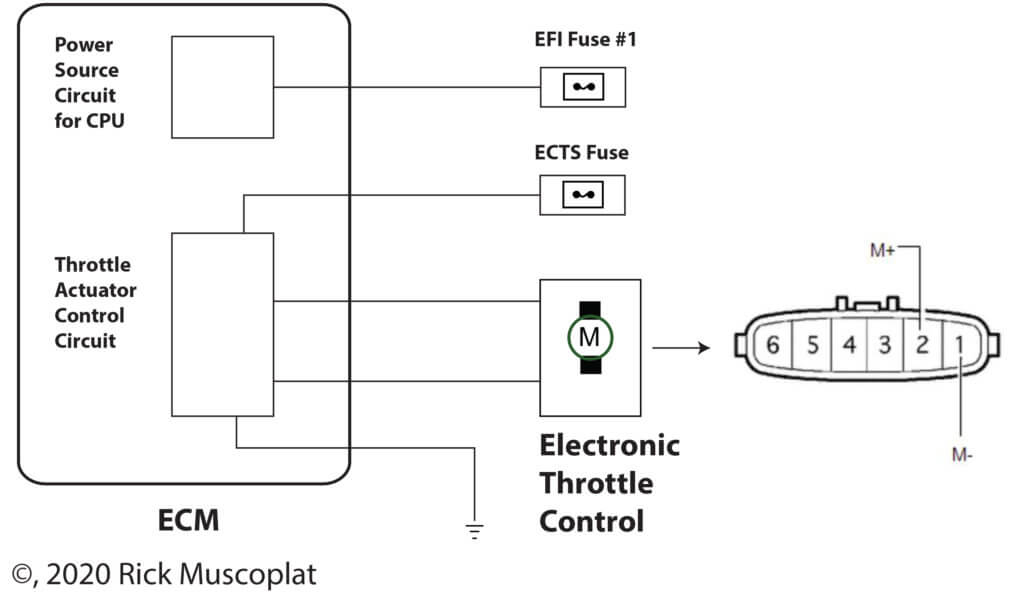
Refer to the Toyota throttle body wiring diagram below. Confirm battery voltage at the throttle body connector M2. Confirm the ground on the throttle body connector M1. If you have both, disconnect the connector at the throttle body and check for resistance across M1 and M2. At room temperature, you should see 0.3-100Ω. If not, you may have a bad throttle body.
Final Thoughts: Stop Guessing and Start Testing
The biggest mistake I see with the Toyota P2118 code is jumping straight to replacing the throttle body.
Don’t do that.
This is a diagnostic code, not a parts code. It tells you something didn’t match—not what failed.
If you follow a structured process, you’ll fix it faster, cheaper, and correctly the first time.
©, 2020 Rick Muscoplat
Posted on by Rick Muscoplat