
Engine Basics Every DIY Mechanic Must Know
Engine Basics Made Simple for DIY Car Owners
Quick Summary
If you want to work on your own vehicle, understanding engine basics is the first step. Every gasoline engine operates on the same principles: it pulls in air and fuel, compresses the mixture, ignites it, and converts the resulting explosion into rotational force that turns the wheels. Once you understand the major engine components and how they work together, diagnosing problems and performing maintenance becomes much easier.
In this guide, I’ll explain engine basics in plain English, covering the four-stroke cycle, the major engine parts, common engine systems, and the most important concepts every DIY mechanic should know before picking up a wrench.
Understanding How Your engine Really Works
I’ve spent decades working on engines, from small engines and lawn equipment to modern fuel-injected vehicles. One thing I’ve learned is that many people are intimidated by engines simply because they don’t understand what is happening inside.
The truth is that engine basics aren’t complicated once you break them down into simple steps. Every gasoline engine, whether it’s in a compact sedan, pickup truck, motorcycle, or lawn tractor, follows the same basic process.
The engine is essentially an air pump. Its job is to bring air and fuel into the cylinders, ignite the mixture, and convert the expanding gases into usable power.
Once you understand that concept, everything else starts to make sense.
The Four-Stroke Cycle: The Foundation of engine Basics
Modern gasoline engines operate on what’s known as the four-stroke cycle. Each cylinder repeats four events thousands of times per minute:
1) Intake Stroke — The intake valve opens while the piston moves downward. This creates a vacuum that draws air and fuel into the cylinder.
2) Compression Stroke — Both valves close, and the piston moves upward. The air-fuel mixture becomes compressed, making it easier to ignite and produce power.
3) Power Stroke — The spark plug ignites the compressed mixture. The resulting combustion rapidly expands, forcing the piston downward. This is the only stroke that actually produces power.
4) Exhaust Stroke — The exhaust valve opens, and the piston moves upward again. Burned gases leave the cylinder through the exhaust system.
Then the entire cycle repeats.
A four-cylinder engine running at 2,000 RPM completes this process thousands of times every minute.
The Major Engine Components Every DIYer Should Know
Understanding the major parts is one of the most important aspects of learning engine basics.
Engine Block — The engine block is the main structure of the engine.
It contains:
• Cylinders 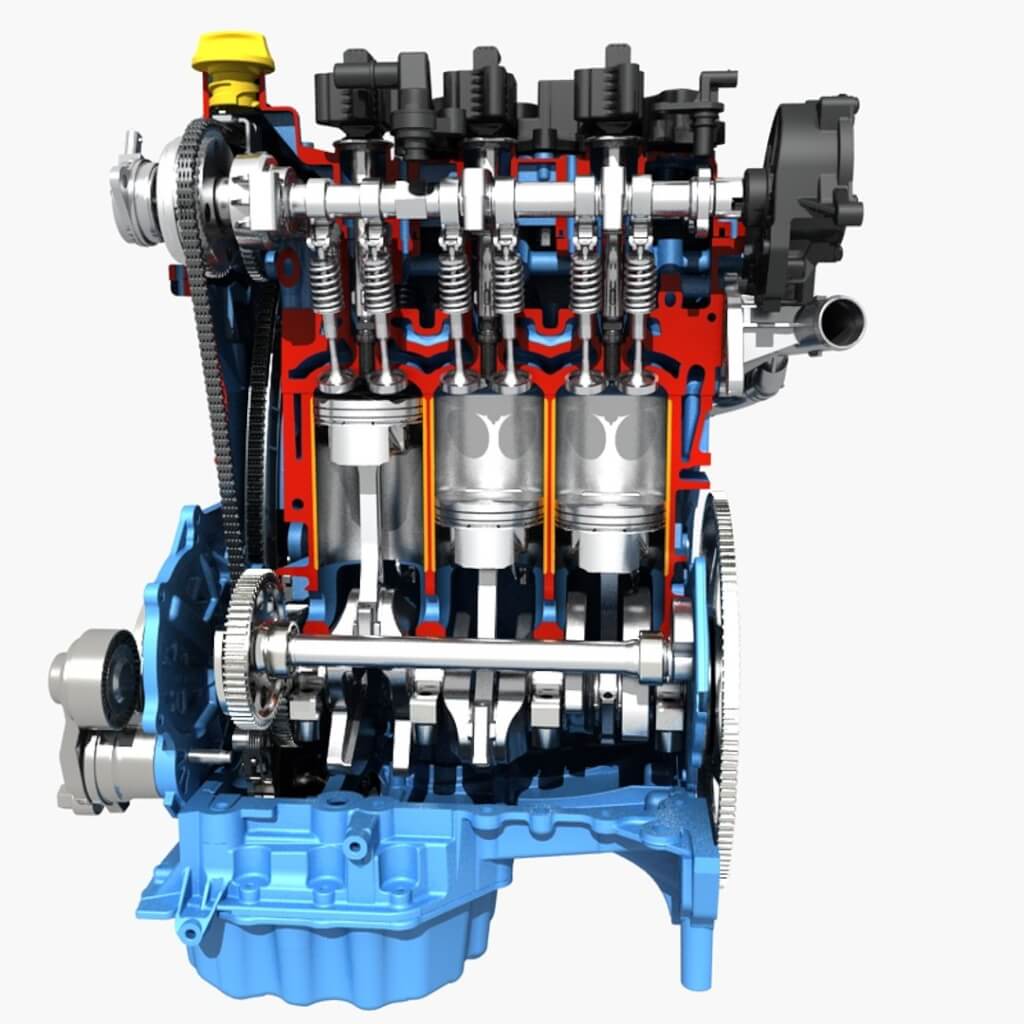
• Coolant passages
• Oil passages
• Crankshaft supports
Think of it as the foundation of the entire engine.
Pistons — Pistons move up and down inside the cylinders. They transfer combustion force into mechanical movement.
Connecting Rods — Connecting rods attach the pistons to the crankshaft. They convert the piston’s up-and-down motion into rotational motion.
Crankshaft — The crankshaft transforms reciprocating movement into rotation. This rotational force eventually drives the transmission and wheels.
Cylinder Head — The cylinder head sits atop the engine block.
It contains:
• Intake valves
• Exhaust valves
• Combustion chambers
• Spark plugs
• Camshafts on many engines
• Valves
Valves control airflow into and out of the cylinders.
• Intake valves allow a fresh air-fuel mixture to enter.
• Exhaust valves allow burned gases to leave.
Camshaft — The camshaft opens and closes valves at precisely timed intervals. Without accurate valve timing, the engine cannot run properly.
Understanding Compression
One of the most critical engine basics concepts is compression. Engines depend on compression to create efficient combustion.
When compression drops due to worn piston rings, burned valves, or head gasket failure, performance suffers.
Common low-compression symptoms include:
• Hard starting
• Rough idle
• Loss of power
• Increased oil consumption
• Engine misfires
Compression testing is one of the first diagnostic procedures I perform when evaluating engine condition.
The Three Things Every Engine Needs
Every gasoline engine requires three basic ingredients:
1) Air — Air enters through the intake system. Modern engines carefully measure airflow using sensors such as:
• Mass Air Flow (MAF) sensors
• Manifold Absolute Pressure (MAP) sensors
2) Fuel — Fuel injectors precisely meter gasoline into the intake stream or combustion chamber. Too much or too little fuel causes driveability issues.
3) Spark— Spark plugs ignite the air-fuel mixture. Without a spark, combustion cannot occur.
Whenever an engine won’t start, I immediately verify these three requirements: Missing any one of them prevents the engine from running.
• Air
• Fuel
• Spark
The Importance of Lubrication
Oil is the lifeblood of an engine. Motor oil performs several critical functions:
• Lubricates moving parts
• Reduces friction
• Carries away heat
• Cleans contaminants
• Prevents corrosion
The oil pump continuously circulates oil through the engine. Ignoring oil changes is one of the fastest ways to shorten engine life. I’ve seen engines fail prematurely simply because owners neglected basic oil maintenance.
For more information on motor oil read When to Change Oil: Understanding Auto Maintenance Intervals
Why Cooling Systems Matter
Combustion creates tremendous heat. Temperatures inside combustion chambers can exceed several thousand degrees Fahrenheit. Without cooling, engine components would quickly fail.
The cooling system includes:
• Radiator
• Water pump
• Thermostat
• Cooling fans
• Coolant passages
The system maintains operating temperatures typically between 190°F and 220°F.
Overheating can lead to:
• Head gasket failure
• Warped cylinder heads
• Cracked engine blocks
• Severe engine damage
• Understanding Timing
Timing is one of the most overlooked aspects of engine basics. The crankshaft and camshaft must remain perfectly synchronized.
Manufacturers use either:
• Timing belts
• Timing chains
If timing becomes incorrect, the engine may:
• Run poorly
• Misfire
• Lose power
• Fail to start
On interference engines, a broken timing belt can allow valves and pistons to collide, causing catastrophic damage.
Common Engine Problems DIYers Encounter
As a DIY mechanic, you’ll frequently encounter a few common engine issues.
Misfires — Usually caused by:
• Faulty spark plugs
• Ignition coils
• Fuel injector problems
• Compression issues
Oil Leaks — Common leak sources include:
• Valve cover gaskets
• Oil pan gaskets
• Front crankshaft seals
• Rear main seals
Overheating — Typically caused by:
• Low coolant
• Failed thermostat
• Water pump problems
• Cooling fan failures
• Check engine Light
Modern engines continuously monitor performance using sensors. Diagnostic trouble codes help identify system faults and greatly simplify troubleshooting.
Final Thoughts on Engine Basics
The most important thing to remember about engine basics is that every engine follows the same fundamental principles. Air enters the engine, fuel is added, the mixture is compressed and ignited, and the resulting energy moves the pistons and crankshaft.
Once you understand the four-stroke cycle, the major engine components, and the importance of air, fuel, spark, lubrication, cooling, and timing, you’ll have the foundation needed to perform maintenance, diagnose problems, and become a more confident DIY mechanic.
In my experience, the best technicians aren’t necessarily the ones with the most tools. They’re the ones who understand how the engine works. Learn the fundamentals first, and every repair becomes easier from that point forward.
© 2026 Rick Muscoplat
Posted on by Rick Muscoplat