
When to Change Oil: Understanding Auto Maintenance Intervals
Learn how often you need to change your oil
Changing the oil in your car or truck is a fundamental maintenance task that ensures your engine runs smoothly and efficiently. There’s a lot of controversy on how often you need to change your oil, but that controversy isn’t coming from the carmakers. Instead, it’s coming from self-proclaimed know-it-alls who think they know better than the engineers who built your car or truck. The truth is, how often to change your oil is stated pretty clearly in your owner’s maintenance guide, and the change intervals depend on how you drive. Let’s look at what goes into determining an oil change interval and then talk about what the service modes mean.
Why Oil Changes Are Important
Motor oil has three jobs: Lubrication, Protection, and Cooling. It lubricates moving parts to reduce friction, removes heat from high-friction areas, and protects your engine from the harmful effects of corrosion and wear. Over time, oil breaks down and becomes contaminated with dirt, debris, and combustion byproducts. If not changed regularly, this degraded oil can lead to increased engine wear, reduced performance, and even engine failure.
Here are the factors that determine when to change oil
1) Oil change intervals depend on the engine design
Engineers determine what type of oil an engine needs and how long it can last based on the engine’s design. For example, A turbocharger can spin at speeds up to 300,000 RPM, and that high speed creates a lot of heat. The engineers cool the turbo with oil and engine coolant to keep the bearings from disintegrating. However, even with an oil cooler in the system, that heat level causes higher levels of viscosity breakdown and oxidation, so engines equipped with turbos often need more frequent oil changes.
That high heat causes higher levels of viscosity breakdown

A turbo charger runs hot and can degrade oil faster. If you have a turbo, don’t go beyond the car maker’s oil change recommendations
and oxidation, so engines equipped with turbos often need more frequent oil changes. Some engines with turbos have an oil change interval of just 3,750 miles, while the same engine without a turbo can go up to 7,000 miles.
If you follow the advice to change your oil every 10,000 miles on a vehicle with a turbo, you could easily destroy your engine and be looking at a $4,000 repair bill.
In addition to the effects turbos have on motor oil, engines also have variable valve timing (VVT) systems that alter camshaft timing by pulsing oil pressure to chambers in a hydraulic unit that rotates the camshaft slightly. Pulsing oil under pressure can cause it to foam, so the oil’s anti-foaming additives are depleted faster.
2) How often you start your engine when it’s cold has an effect on oil life
Engines require more gas to start when cold (it hasn’t run in over 3 hours) because the cold metal “quenches” the flame faster. When the combustion is quenched, some gas doesn’t get burned. A small portion of that unburned fuel bypasses around the piston rings and winds up in the engine’s crankcase, mixing it with the oil. The gas dilutes the oil and stresses the additives, wearing them out faster.
All combustion produces moisture, but a cold engine produces more of it due to the richer fuel mixture. Some of that moisture ends up in the crankcase, where it, too, mixes with the oil, causing emulsification.
Lastly, cold starts produce more soot from partial burns. So you wind up with soot, raw fuel, and water in the crankcase.
3) How far you drive also affects oil life
As a general rule, driving less than five miles in warm weather or less than 10 miles in cold weather automatically puts you into the “severe service” category. Short drives never allow the engine oil to get hot enough to evaporate off the raw fuel and water, and they don’t run long enough to filter out the soot that was created during the cold start.
3) Towing, driving in mountains, and stop-and-go traffic affect oil life
Multi-viscosity oil incorporates a thickening agent to prevent the oil from thinning out too much as it accumulates heat. The thickening agent is called a viscosity improver (VI). It’s actually a polymeric molecule that’s coiled when cold and uncoils as it heats up. It’s almost like adding flour to gravy to thicken it, except this product is reversible.
Unfortunately, VI doesn’t lubricate—it just adds bulk to the oil. So when it’s forced through a small opening or compressed during heavy acceleration, the molecules can “shear”—get cut in half (picture a meat grinder). As more molecules shear, the oil loses its ability to thicken when hot. Thin oil squirts out between rotating metal components, lowering the oil’s ability to lubricate and separate metal parts.

Viscosity improver polymers uncoil/expand as they heat
Once VI starts to shear, the shearing process snowballs. That’s why towing, driving in the mountains, and stop-and-go driving are all considered severe services.
4) How you check your oil level and top it off affects oil life
All engines burn oil—even new ones right out of the factory. Running an engine while it’s low on oil wasn’t as big a deal back when drivers changed their oil every 3,000 miles. Most engines didn’t burn very much oil during that short period. But newer engines can sometimes run as long as 10,000 miles between oil changes. Chances are you’ll burn almost a full quart of oil during that period of time.
However, if your engine was originally filled with 4.5 quarts and you burn off a quart but don’t check the oil level or top it off, you’ve dramatically reduced the life of the remaining 3.5 quarts. Even if the vehicle is equipped with an oil life monitoring system, that system assumes you’ve been checking the oil level and adding more oil to compensate for the burned oil. It doesn’t know that you’re driving around while a quart low. If you’re not checking your oil and adding more when it’s low, you can’t depend on the oil life monitor to give you an accurate result—running an engine while low on oil stresses the remaining oil so much that you’re actually damaging your engine.
5) The quality of the oil filter affects oil life
Before synthetic oil was introduced, oil filters were built to last only 3,000 miles. 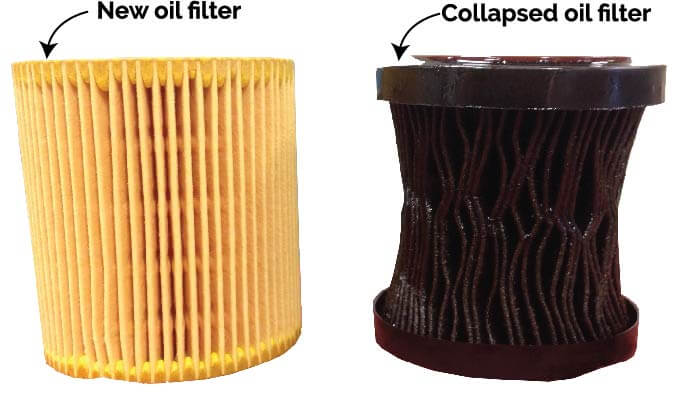 Oil filter manufacturers used one of only eight different types of filter paper. That’s changed quite a bit with the newer engines and synthetic oil. Today, oil filter manufacturers use over 80 different types of filter media, and the type of filter media is engine-specific. However, some oil filter manufacturers still make inexpensive paper filters, selling them in bulk to quick oil change places.
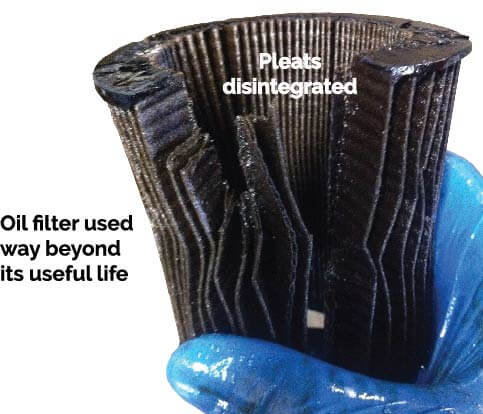
This image shows what happens if you use a cheap oil filter and then run your oil for 7,500 or 10,000 miles. The filter media disintegrates.
Those older filters deteriorate at around 3,000 miles. Or, they load up with contaminates and go into “by-pass” mode, where the oil no longer circulates through the filter media but around it instead. In those cases, you may think you’re protected when you’re not.
You can count on the car dealer to install the correct filter. Most independent shops install a filter that’s rated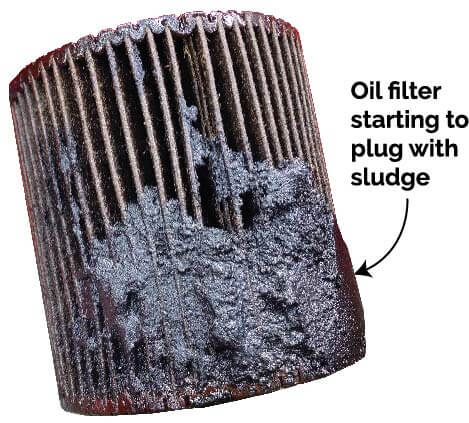 for extended service. It’s the quick change oil places that you have to worry about. Even if they talk you into switching to synthetic oil, chances are good that they’ll install an inexpensive paper filter that won’t last as long as the oil.
Determine which service mode to follow
Most drivers follow the “Normal” service intervals listed in their owner’s maintenance guide. Yet, the majority of those drivers should be following the Severe Service guidelines. Every carmaker has their own definition of severe service, but generally, it follows the factors listed here:
You fit into the Severe Service category if you drive your vehicle mainly under one or more of the following conditions:
• Driving less than 5 miles per trip in cold weather or less than 10 miles in warm weather.
• Driving in hot (over 90°F) conditions.
• Extensive idling or long periods of stop-and-go driving.
• Driving with a rooftop carrier, towing, or driving in mountainous conditions.
• Driving on muddy, dusty, or de-iced roads.
©, 2016 Rick Muscoplat
Posted on by Rick Muscoplat