
How to Test Water Heater Heating Elements and Thermostats
Test Water Heater Heating Elements
Quick Summary
If your electric water heater isn’t producing enough hot water, trips the reset button, or only delivers lukewarm water, the problem is often a failed heating element or thermostat. The fastest way to diagnose the issue is with a digital multimeter.
To test water heater heating elements and thermostats, follow these steps:
1) Turn off the power to the heater
2) Remove the covers to the upper and lower heating elements
3) Remove the insulation covering the elements and thermostats
4) Verify voltage is absent using your multimeter or voltage sniffer
5) Remove the wires from each element
6) Set your meter to the Ohms scale and the resistance values for each heating element
7) A good element will have a resistance between 5 and 25 Ohms, depending on wattage.
8) Thermostats should show continuity when calling for heat and open when satisfied.
How an Electric Water Heater Works
Most residential electric water heaters contain:
• Upper heating element
• Lower heating element
• Upper thermostat
• Lower thermostat
• High-limit safety switch (ECO)
Residential electric water heaters are available as either 4,500 or 5,500-watt units. 4,500W at 240V is by far the most common for standard residential 40–50-gallon tanks. The 5,500W element is frequently used in 50+ gallon tanks or in high-demand installs.
The upper thermostat operates first. Once the top portion of the tank reaches the set temperature, power is transferred to the lower thermostat and lower heating element.
When either component fails, hot water production suffers.
Symptoms of a Burned-Out Water Heater Element
1)No hot water — If the circuit breaker hasn’t tripped and the water heater is getting power, suspect a burned-out upper element failure. Here’s why:
The upper element energizes first and heats the water until the thermostat transfers power to the lower element. If the upper element fails, the thermostat never hands off power to the lower element, and you don’t have any hot water.
2) Breaker trips repeatedly — This is the sign of a shorted heating element that’s drawing excessive current.
3) Some hot water, but it runs out quickly —Lower element failure. The top element heats water near the top of the tank, but that runs out quickly and the lower element never kicks in.
4) Recovery time is extremely slow after use — This can be caused by failure of either element. You may also experience these symptoms:
• The water is lukewarm but never truly hot
• You hear popping or rumbling sounds during heating. That’s caused by heavy scale buildup on the elements, often preceding failure
• Discolored or rusty hot water (element sheath breach allowing corrosion)
• Higher electric bills — a partially failed element may still draw current inefficiently
Most Common Water Heater Heating Element Resistance Values
The resistance value depends on the element wattage and voltage.
Typical 240-Volt Heating Element Resistance
Element Wattage Resistance
3,000 watts 19.2 ohms
3,500 watts 16.4 ohms
4,000 watts 14.4 ohms
4,500 watts 12.8 ohms
5,000 watts 11.5 ohms
5,500 watts 10.5 ohms
Most modern residential water heaters use 4,500-watt elements, so expect approximately 12 to 13 ohms.
How to Test Water Heater Heating Elements
Step 1: Disconnect the wires from the element — Remove the wires from each element to prevent false resistance readings between the water heater and the circuit breaker.
Step 2: Set the Multimeter to Resistance (Ω) — Select the lowest available resistance range.
Step 3: Measure Across Both Terminals — Touch one probe to each screw terminal. A good element should display resistance close to the manufacturer’s specification.
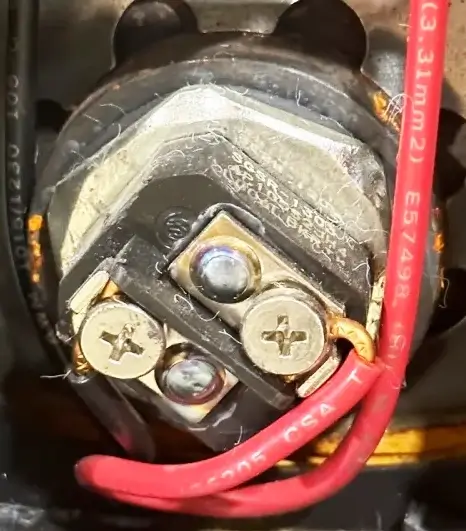
Touch the meter probes to the two screws on the heating element
Examples:
4,500-watt element 12.8 ohms = good
4,000-watt element 14.4 ohms = good
Signs of a Bad Element
OPEN
An open element will read OL, infinity (∞), or no reading on your meter. Any of those readings means the internal heating wire has burned apart
SHORTED
The resistance will be substantially lower than the specifications
GROUNDED
To test for a grounded element, place one meter probe on a terminal and the other probe touching the metal tank. If the meter reads OL or infinity (∞), the element has not grounded itself to the tank. However, if you see any measurable resistance, that’s an indication that the element is shorted to ground and must be replaced.
How to Test Water Heater Thermostats
Thermostat testing is slightly more involved because thermostat contacts open and close depending on water temperature.
Testing the Upper Thermostat
With power OFF: Set the meter to continuity or resistance. Place probes across the thermostat output contacts. If the water is cold, the thermostat should be calling for heat.
Expected reading: 0 ohms. If the thermostat is calling for heat but shows OL or Infinity, it’s defective.
Testing the Lower Thermostat
The lower thermostat works the same way. When the tank temperature is below the thermostat setting:
• Contacts should be closed
• The meter should show continuity
When satisfied:
• Contacts open
• Meter shows OL
Testing the High-Limit Reset Switch
The red reset button contains a safety switch. Place the meter probes on each side.
A good switch should show:
• Continuity
• Near-zero resistance
No continuity means the switch has failed.
How to Remove a Faulty Heating Element
Once you’ve confirmed a failed element, replacement is straightforward.
Tools Required
• Water heater element wrench
• 1-1/2-inch socket
• Breaker bar
• Garden hose
• Screwdriver
A dedicated water heater element wrench provides the best fit.
Removal Procedure
1) Turn off the power.
2) Turn off the cold-water supply.
3) Connect the hose to the drain valve.
4) Drain water below the element level.
5) Remove wires from the element.
6) Insert the element wrench.
7) Turn the wrench counterclockwise.
Some elements require significant force to loosen due to mineral buildup. For this reason alone, I don’t recommend using a stamped steel wrench. Instead, invest in a socket and breaker bar.
How to Buy Replacement Heating Elements
Match:
• Voltage (usually 240V)
• Wattage
• Length
• Thread size
Common choices include:
Standard Copper Elements
• Lowest cost
• Best for soft water
Stainless Steel Elements
• Better corrosion resistance
Low-Density Elements
• Run cooler
• Resist scale buildup
• Longer service life
Fold-Back Elements
• Designed for smaller openings
When in doubt, match the model number from the existing element.
Installing a New Water Heater Heating Element
1) Clean the threads in the tank opening.
2) Install a new rubber gasket.
3) Start threading the new element by hand.
4) Tighten the element securely.
5) Refill the tank completely. THIS IS CRITICAL! If you power the element before the water heater is filled with water, the new element will burn out!
6) Open the hot water faucet to purge air.
7) Verify full water flow.
8) Restore power.
Never energize an element before the tank is completely full. A dry-fired element can burn out within seconds.
Replacing a Water Heater Thermostat
Thermostat replacement is even easier.
1) Turn off the power.
2) Photograph wire locations.
3) Remove wires.
4) Release the retaining clip.
5) Remove thermostat.
6) Install replacement.
7) Reconnect wires.
Always purchase a thermostat designed for your water heater’s voltage and wattage.
Final Thoughts
Learning how to test water heater heating elements and thermostats is one of the most valuable troubleshooting skills for homeowners. With a digital multimeter and a few minutes of testing, you can accurately diagnose most electric water heater problems without guessing. In many cases, a simple $20 element or thermostat replacement can restore full hot water production and add years of service life to your water heater.
how to test water heater heating elements and thermostats
water heater element resistance chart
test water heater thermostat with multimeter
electric water heater not heating
bad water heater element symptoms
water heater reset button keeps tripping
replace water heater heating element
water heater thermostat replacement
how many ohms should a water heater element have
water heater only makes lukewarm water
upper vs lower water heater thermostat
grounded water heater element test
electric water heater troubleshooting
water heater element wrench size
water heater thermostat continuity test