
Everything You Need to Know About Faucet Aerator Sizing
Faucet Aerator Sizing Guide: How to Measure, Identify, and Replace Any Faucet Aerator
Quick Summary
When it’s time to replace your faucet aerator, get up to speed on faucet aerator sizing before you head out to the hardware store, because there’s no such thing as a universal faucet aerator. To choose the correct replacement for your faucet, you’ll have to match thread type, thread diameter, thread pitch, and flow rate.
Most standard U.S. aerators use 15/16”-27 male or 55/64”-27 female threads, while many newer faucets use recessed cache aerators in metric sizes such as M16.5×1, M18.5×1, M21.5×1, or M24x1.
Key Takeaways
• Standard faucet aerators usually come in male or female thread styles.
• The most common U.S. sizes are 15/16”-27 male and 55/64”-27 female.
• Smaller lavatory faucets may use 13/16”-27 male or 3/4”-27 female aerators.
• Hidden cache aerators require a special key and are usually metric.
• Flow rate matters just as much as thread size.
• Never force an aerator that does not thread on easily.
Understanding the three types of faucet aerators
A faucet aerator has to match several things at once:
• Thread diameter
• Thread pitch
• Housing style
• Flow rate
Faucet aerators may be small, but choosing the wrong one can turn a five-minute fix into multiple trips back to the hardware store. These threaded attachments screw onto the tip of a faucet spout to mix air into the water stream, reducing splash and cutting water usage without sacrificing pressure. The catch is that not all faucets use the same connection type, and aerators generally fall into four categories:
• Male thread
• Female thread
• Insert/Recessed/Cache
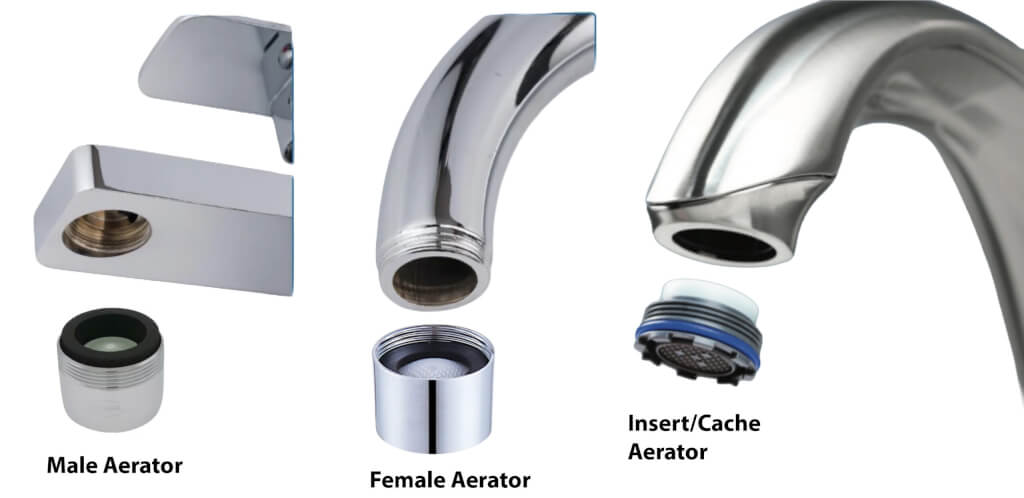
Male, female, and insert/cache aerators
Male vs. Female Faucet Aerators
The terms male and female refer to the threads on the aerator, not the faucet.
• A male aerator has threads on the outside. It screws into a faucet spout with internal threads.
• A female aerator has threads on the inside. It screws over a faucet spout with external threads.
Standard Faucet Aerator Sizes
Most U.S. faucet spouts are sized to receive a 13/16″, 15/16″ or 55/64″, or 3/4″ diameter with a thread pitch of 27 threads per inch. aerator.
Aerator Type Thread Size Common Use
• Standard male 15/16”-27 Kitchen and lavatory faucets
• Standard female 55/64”-27 Kitchen and lavatory faucets
• Junior male 13/16”-27 Smaller bathroom faucets
• Junior female 3/4”-27 Smaller bathroom faucets
Do not assume 15/16” and 55/64” are interchangeable. They are different diameters, even though both commonly use 27 threads per inch.
Dual-Thread Aerators
A dual-thread aerator is designed to fit both common standard thread styles. For example, some dual-thread aerators fit
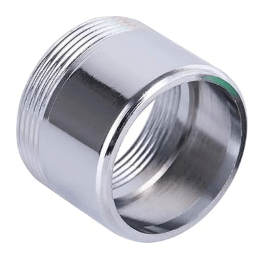
Dual thread aerator
15/16”-27 male or 55/64”-27 female applications.
That makes them handy for basic replacements, but they still will not solve every problem. They usually will not fit cache aerators, metric faucets, specialty designer faucets, or damaged threads.
Insert/Recessed/Cache Aerators Explained
A cache aerator is a hidden or recessed aerator that threads directly into the faucet spout.
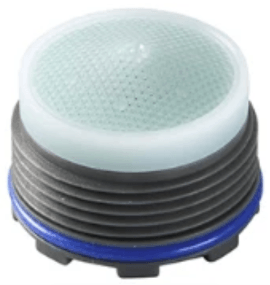
Cache aerator
You usually can’t remove it with your fingers or pliers. You need the correct aerator key.
Cache aerators have metric threads. Here are the most common sizes:
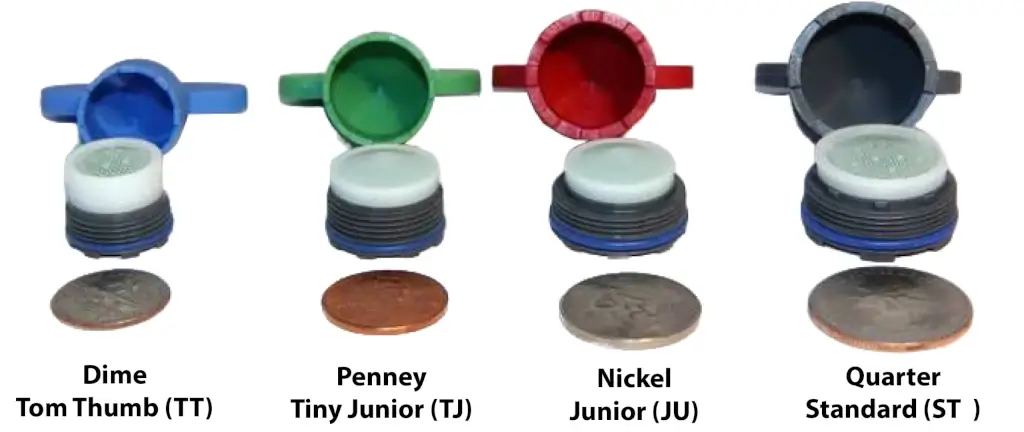
This image shows the different sizes and names for insert/recessed/cache aerators and the matching removal keys.
• M24 x 1 — 24 mm Standard
• M21.5 x 1 — 21.5 mm Junior
• M18.5 x 1 — 18.5 mm Tiny Junior
• M16.5 x 1 — 16.5 mm Tom Thumb
Metric and U.S. aerators may look close, but they are not the same. If it starts to bind after a half turn, stop.
Faucet Aerator Flow Rates
Thread size determines whether the aerator fits. Flow rate determines how the faucet performs.
The federal reference point for older faucets is commonly 2.2 gallons per minute (GPM). EPA WaterSense says WaterSense-labeled bathroom sink faucets and accessories must reduce the 2.2 GPM flow rate by 30% or more, to a maximum of 1.5 GPM. The EPA has also proposed lowering the WaterSense lavatory faucet specification from 1.5 GPM to 1.2 GPM.
Flow Rate Typical Use
0.35 GPM Public/restroom water-saving applications
0.5 GPM Commercial lavatories
1.0 GPM Water-saving bathroom faucets
1.2 GPM High-efficiency lavatory faucets
1.5 GPM Common WaterSense lavatory replacement
1.8 GPM Many modern kitchen faucets
2.2 GPM Older standard faucet flow
How to find the right replacement aerator
1) Remove the aerator from the faucet using pliers or an aerator key
2) Take it to the hardware store and use the aerator sizing tool to match the thread size.
If you have trouble determining the right aerator for your faucet, go to aerator.com for assistance.
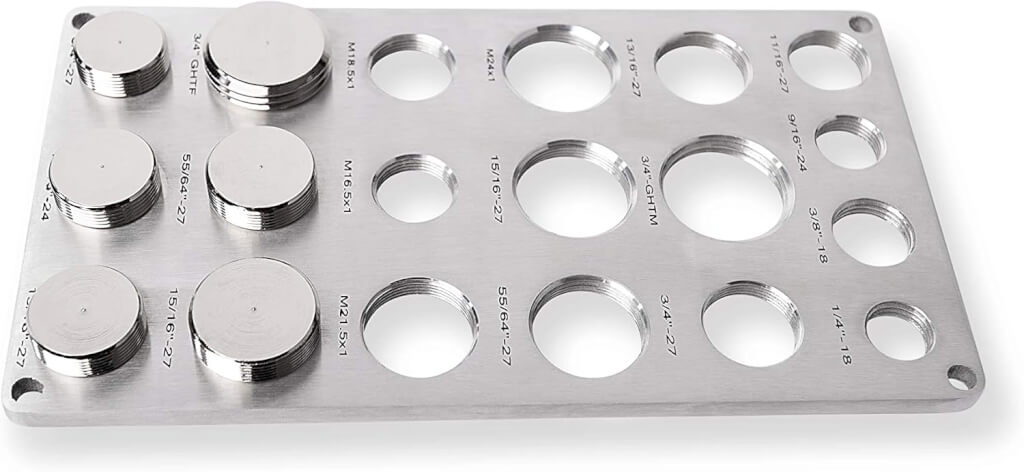
Aerator sizing tool
How to clean your aerator to correct a weak flow
A clogged aerator is one of the most common—and easiest to fix—causes of weak water flow. Mineral deposits, sediment, and debris build up inside the screen over time, restricting the stream. Cleaning it usually takes less than 15 minutes and requires no special tools.
What You’ll Need:
• Adjustable pliers or a wrench (optional, for stuck aerators)
• Old toothbrush or small brush
• White vinegar
• Small bowl or cup
• Toothpick or pin (for stubborn debris)
• Cloth or rag (to protect the faucet finish)
Steps:
1) Close the drain — Plug the sink drain or place a cloth over it first, so small parts don’t fall in while you’re working.
2) Remove the aerator — Wrap a rag or electrical tape around the aerator to protect the finish, then turn it counterclockwise by hand. If it won’t budge, use pliers or a wrench with the rag as a buffer to avoid scratching the metal.
3) Remove the insert from the housing — Remove the washer. Then hold the housing while pushing the insert out.
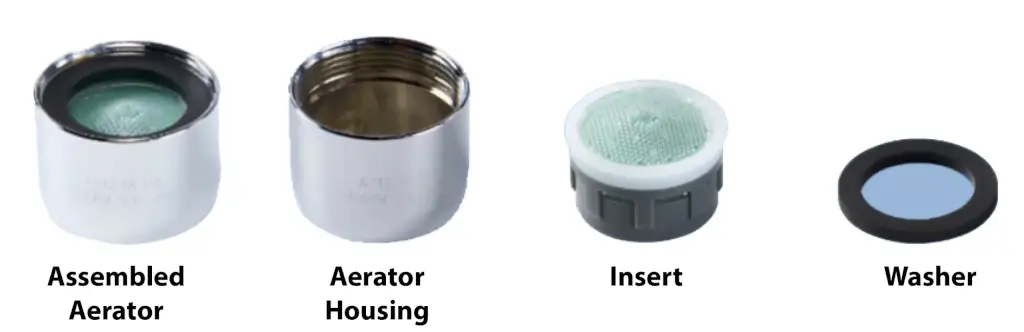
4) Clean the screen — Wash off any debris on the top screen. Use an old toothbrush to poke small debris out of the holes.
5) Disassemble the insert —The insert holds several parts. Pry the cap off and separate the pieces. Note the orientation of the parts as you disassemble—most aerators have 3–4 stacked pieces (housing, screen, washer, and sometimes a flow restrictor). Rinse off loose debris. Hold the parts under running water and rinse away any visible sediment or grit.
6) Soak in vinegar — If your aerator has mineral 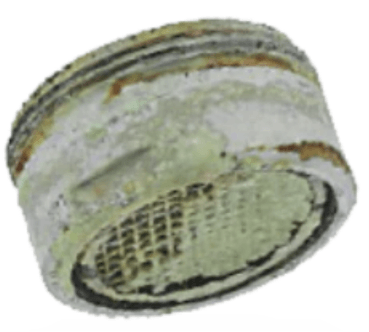 buildup, submerge it in undiluted white vinegar for 30 minutes to an hour. This dissolves mineral buildup (calcium and lime deposits) that plain water won’t remove. For heavier buildup, soak overnight.
Scrub the screen and housing. Run each part under water to flush out loosened debris and vinegar residue.
7) Reassemble in the correct order — Stack the components back in the same sequence they came out—reversing the order can affect flow or cause leaks.
8) Reinstall the aerator — Screw it back onto the spout by hand, turning clockwise until snug. Avoid overtightening, which can strip the threads.
Test the flow. Turn on the faucet and check for improved pressure and any leaks around the connection. If flow is still weak, remove the aerator again and repeat the soak, or check the flow restrictor disc for a stubborn blockage.
When to Replace Your Aerator Instead of Cleaning It
If the screen is torn, the housing is corroded, or cleaning doesn’t restore flow, it’s often cheaper and faster to replace the aerator than to keep troubleshooting—most cost just a few dollars at any hardware store.
Common Mistakes I See When Cleaning or Replacing a Faucet Aerator
Mistake 1: Buying by diameter only — Diameter is not enough. Thread pitch and male/female style matter.
Mistake 2: Forcing the aerator — If it does not screw on easily by hand, stop. Forcing it can strip the threads on the spout and ruin the faucet.
Mistake 3: Losing the washer — A missing washer can cause a leak even when the thread size is correct.
Mistake 4: Using Teflon tape — The aerator seals to the spout using just the washer, not the spout threads. If the aerator leaks after installation, you’ve got a washer problem, not a thread sealing problem. Don’t use Teflon tape to attempt to fix the washer issue. That’ll just hide the real problem.
Mistake 5: Assuming all faucets from one brand use the same aerator — They don’t. Always verify the exact faucet or measure the old part.
If you’ve damaged the housing on a decorator faucet
Many high-end faucets incorporate a matching aerator housing. If you damage the housing while trying to clean or replace the insert, you’ll have to order a replacement from the manufacturer. That’s especially true if you have a rare finish like oil-rubbed bronze, brushed nickel, black, or white.
Frequently Asked Questions
Are faucet aerators universal?
No. Some dual-thread aerators fit common standard faucets, but faucet aerators are not truly universal.
What is the most common faucet aerator size?
The most common standard sizes are 15/16”-27 male and 55/64”-27 female.
How do I know if I need a male or female aerator?
Look at the faucet spout. Outside threads require a female aerator. Inside threads require a male aerator.
What does “-27” mean?
It means 27 threads per inch.
What does M24x1 mean?
It means a 24 mm metric thread with a 1 mm thread pitch (1 thread per mm).
What is a cache aerator?
A cache aerator is a recessed aerator hidden inside the faucet spout. It usually needs a special key.
Can I replace a 2.2 GPM aerator with a 1.5 GPM aerator?
Usually, yes, if the thread size and style match. The faucet will use less water, but the stream may feel different.
Why won’t my new aerator screw on?
It may be the wrong thread diameter, wrong pitch, wrong male/female style, metric instead of standard, or cross-threaded.
Should I use Teflon tape on a faucet aerator?
No. The washer does the sealing.
Can I clean an aerator instead of replacing it?
Yes. Soak it in white vinegar to dissolve mineral buildup, then rinse and reinstall it.
Why does my faucet spray sideways?
The aerator screen may be clogged, damaged, missing, or installed incorrectly.
What flow rate should I choose for a bathroom faucet?
Common bathroom choices are 1.0, 1.2, or 1.5 GPM.
What flow rate should I choose for a kitchen faucet?
Many modern kitchen faucets use 1.5 to 1.8 GPM, though older faucets may be 2.2 GPM.
Can I connect a garden hose to a faucet aerator thread?
Yes, but you need the correct aerator-to-garden-hose adapter.
Can I connect a portable dishwasher to a faucet aerator?
Sometimes, yes. Portable dishwashers usually require a faucet adapter matched to the aerator thread. However, they don’t work well with pull-down kitchen faucets because those valves incorporate a backflow preventer that can cause problems with portable dishwashers.
Final Thoughts
Faucet aerator sizing is simple once you stop guessing. Match the thread style, thread diameter, thread pitch, and flow rate. If the faucet has a hidden aerator, identify the cache size and use the right key.
The most important rule is this: if the new aerator does not thread on smoothly by hand, it is not the right fit. Back it off, recheck the size, and save the faucet threads.
©, 2026 Rick Muscoplat
Posted on by Rick Muscoplat