
Understanding Car Battery Voltage and State of Charge
Car Battery Voltage Explained: State of Charge vs. State of Health
Quick Summary
Understanding car battery voltage, state of charge, and state of health is essential for diagnosing your car battery and the charging system. Voltage readings reveal how charged your battery is, while state of health indicates its long-term ability to hold that charge. In this guide, I’ll explain what those numbers mean, how to interpret them, and share practical tips to keep your battery performing at its best.
Article
The Expert’s Guide to Car Battery Voltage, State of Charge, and State of Health
When it comes to car maintenance, few things are as overlooked as your battery. I’ve seen countless drivers stranded because they didn’t understand what their car battery voltage was telling them. Let me break it down for you in plain language.
A car battery isn’t just a box of power—it’s a finely tuned system. At its core, your battery’s state of charge tells you how much energy it currently holds, while its state of health reflects its overall condition and ability to store energy over time. These two factors, combined with voltage readings, provide a complete picture of your battery’s state of health.
Why Voltage Matters
Your battery consists of six lead-acid cells, each producing about 2.1 volts at full charge. Since the cells are connected in series, your car battery can produce a maximum open-circuit voltage of 12.6 V. Once the engine is running, the alternator kicks in, boosting the voltage to somewhere between 13.5 and 14.7 volts. This isn’t random—it’s the sweet spot for keeping your battery charged without overloading it.
But here’s the catch: voltage alone doesn’t tell the whole story. Temperature and the battery’s age play a role. That’s why understanding the state of charge and state of health is so important.
Interpreting Voltage Readings Like a Pro
Here’s what those numbers mean in real-world terms:
12.6–12.8 Volts: Perfect. Your battery is fully charged and ready to go.
12.4–12.6 Volts: Still good, but keep an eye on it. If it dips here often, your battery might be losing capacity.
12.2–12.4 Volts: Warning zone. Cold mornings or heavy electrical loads could leave you stranded.
12.0–12.2 Volts: Low charge. Time to recharge or check your alternator.
Below 12.0 Volts: Critical. Your battery is either deeply discharged or failing.
11.8 Volts or Lower: Dead. Replace it or investigate parasitic drains.
State of Charge vs. State of Health
Think of the state of charge as your battery’s fuel gauge—it tells you how much energy is left right now. State of health, on the other hand, is like a physical at the Doctor’s office. Modern battery testers measure the battery’s interface resistance and conductance, which are proven indicators of its overall condition and how well it performs over time. A battery can show a good voltage reading but still have poor health due to high internal resistance, meaning it won’t hold that charge for long. That’s why regular testing matters.
How to check battery voltage using a multimeter
Grab a multimeter and follow these steps:
Set the meter to DC volts.
Connect the black lead to the negative terminal and the red lead to the positive.
Record the reading.
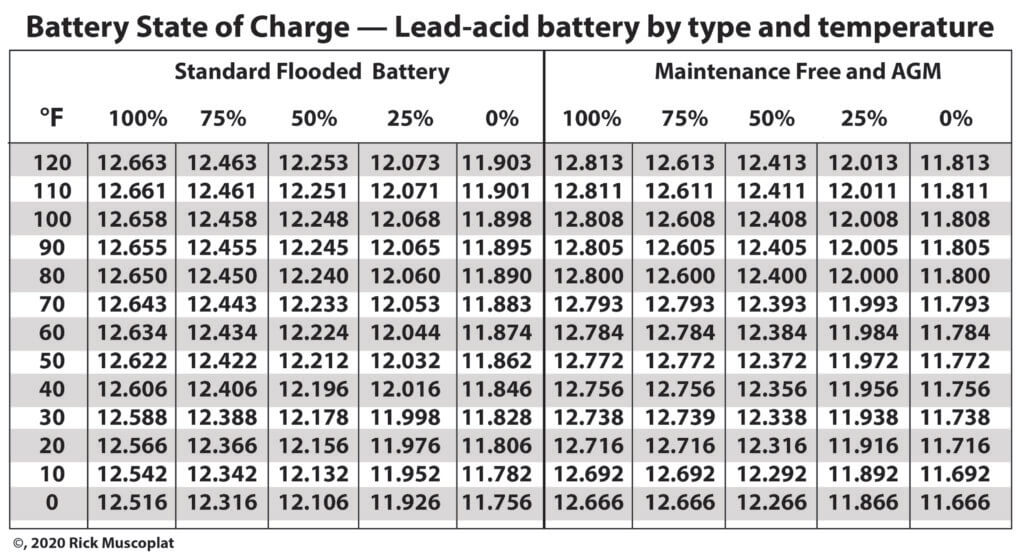
Measure the battery temperature and compare it against a voltage-temperature chart to verify accuracy.
This simple test can prevent unexpected breakdowns and costly repairs.
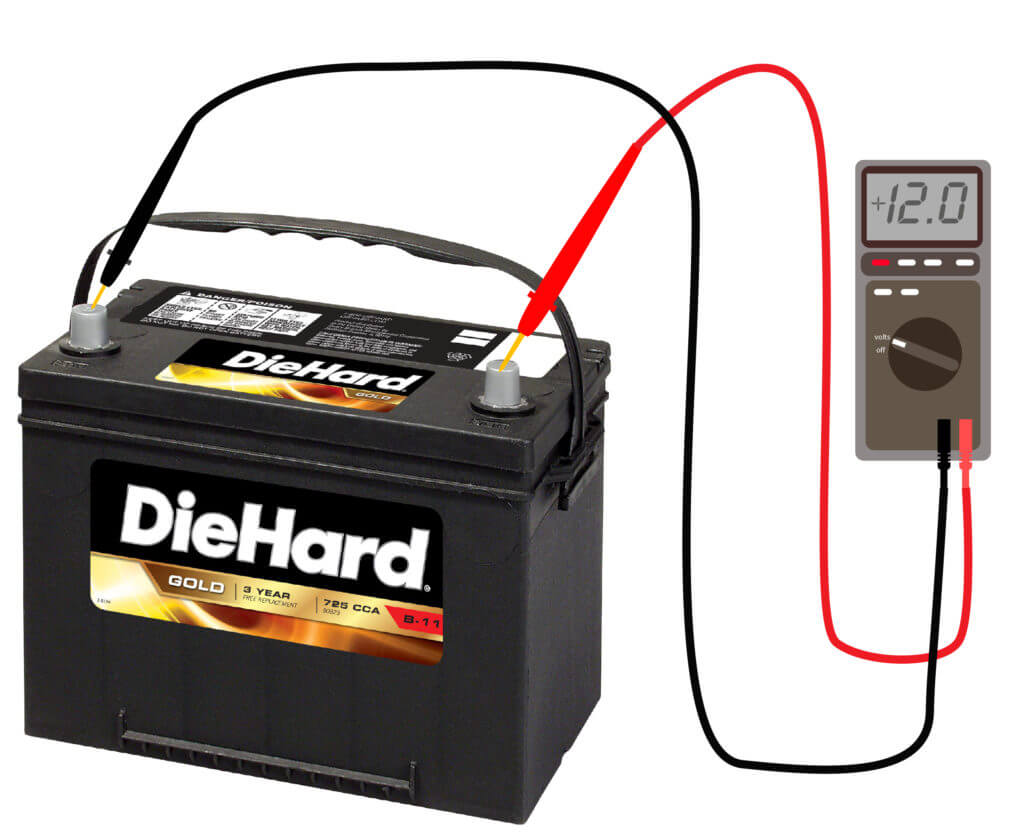
Set your meter to DC volts. Touch one probe to the positive terminal and the other to the opposite terminal. Record the reading. Then measure the battery’s temperature and compare it to the chart below.
Testing for voltage drop
A voltage drop across a car battery’s terminal and post refers to the small loss of electrical potential that occurs due to resistance at the connection point between the battery post and the cable terminal. This resistance can be caused by corrosion, dirt, or a loose connection, and it reduces the efficiency of current flow through the vehicle’s electrical system.
A high voltage drop prevents your car’s alternator from fully charging your battery and also prevents the battery’s full voltage from being available to start your engine.
Acceptable Voltage Drop
When testing under load (e.g., during engine cranking), the voltage drop between the battery post and the terminal should generally be less than 0.04 V (50 mV).
Anything above 0.1 volts indicates excessive resistance, which may require cleaning or tightening the connection.
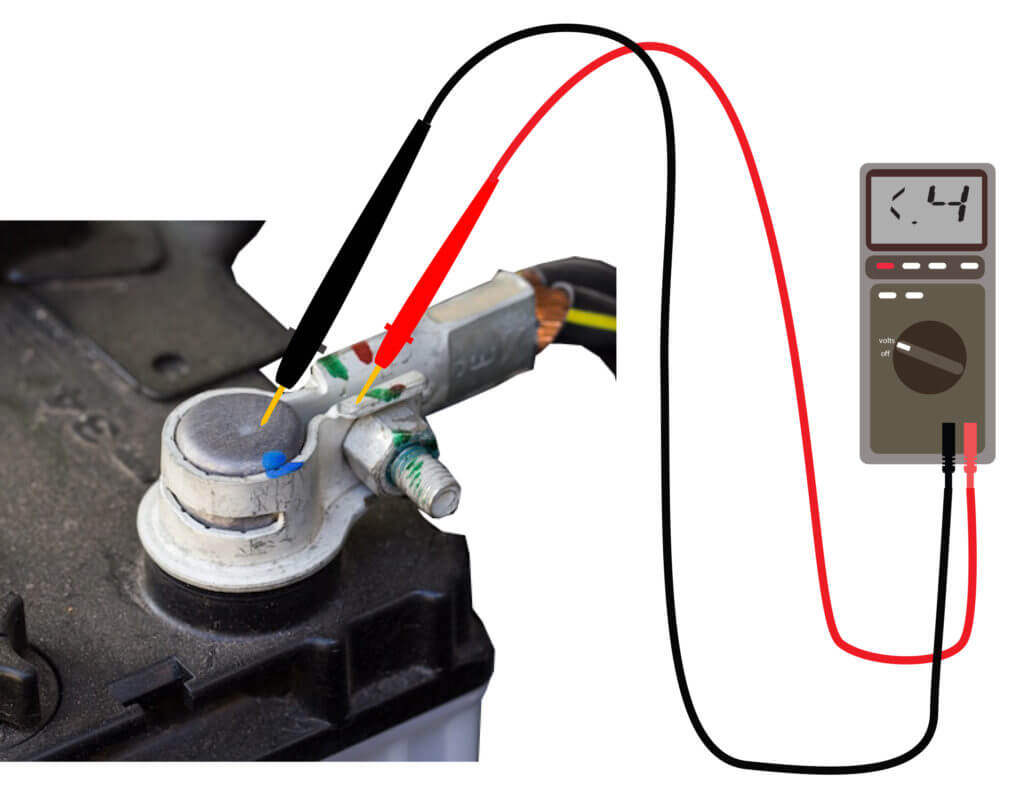
Test for voltage drop at the battery terminals and posts.
©, 2020 Rick Muscoplat
Posted on by Rick Muscoplat