
What Causes Wheel Bearing Failure?
What Really Causes Wheel Bearings to Go Bad — And What’s Involved in Wheel Bearing Replacement
In my years as an automotive technician, I’ve seen just about every kind of wheel bearing failure you can imagine—from bearings destroyed by water intrusion to those burned up by overpacking with grease. While modern wheel bearings are engineered to last well beyond 100,000 miles, they’re not indestructible. Understanding what causes them to go bad and what’s involved in wheel bearing replacement will save you money and prevent dangerous on-road failures
According to SKF, one of the largest bearing manufacturers in the world, over 90% of original-equipment (OE) bearings last the life of the vehicle. That means when a wheel bearing failure occurs, it’s usually caused by outside factors—things like contamination, overheating, improper installation, or impact damage.
• 1/3 fail due to fatigue
• 1/3 fail due to lubrication problems (wrong lubricant, wrong quantity, wrong lubrication interval)
• 1/6 fail due to contamination due to water ingress caused by failed seals
• 1/6 fail for other reasons like impacts from potholes or driving on rough roads, overloading, unbalanced tires, accident impacts (curb kisses), radical car modification, and improper bearing installation/replacement procedure.
Why Lubrication Failure Is the Top Cause of Wheel Bearing Failure
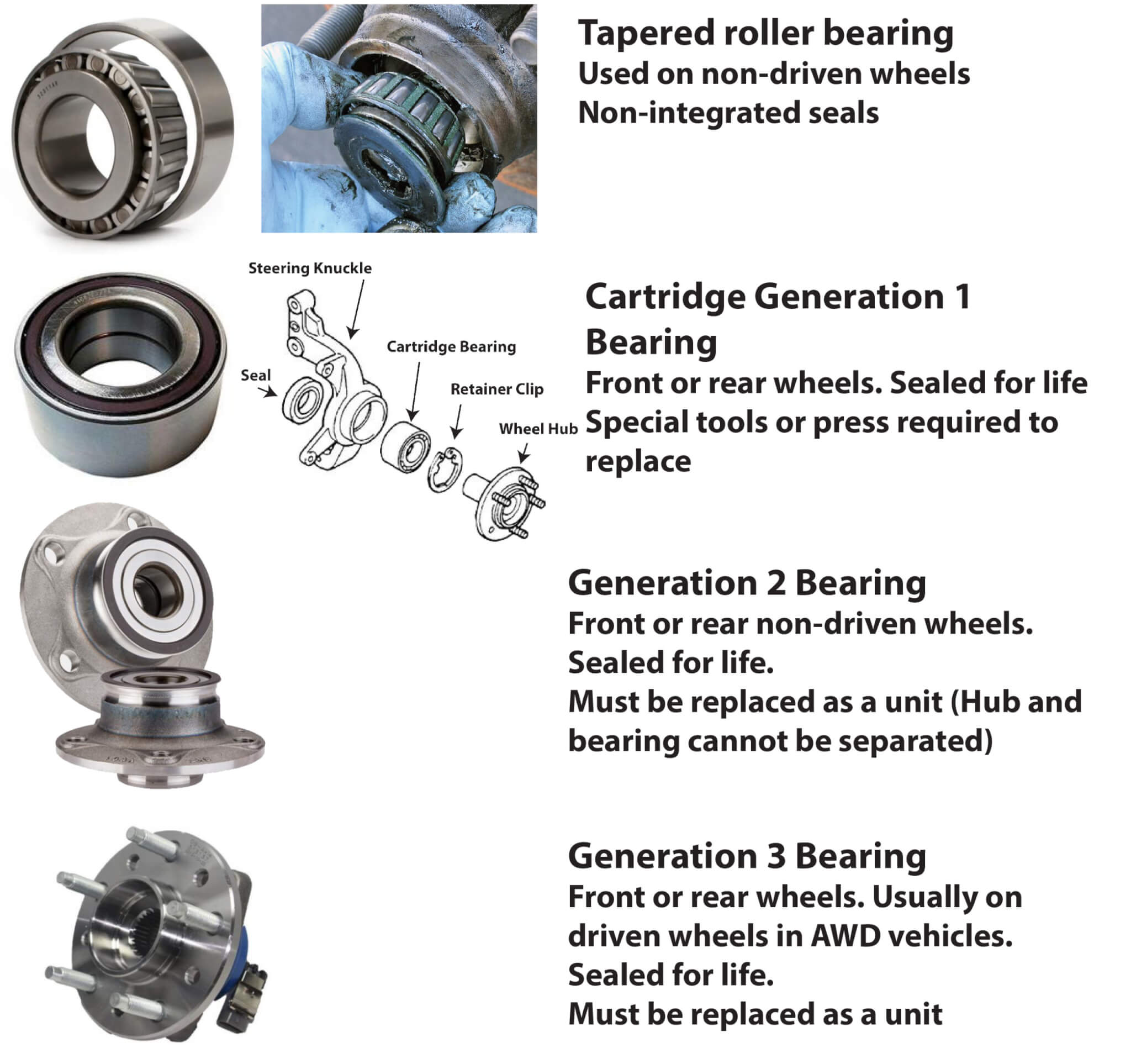
Every wheel bearing—whether it’s a traditional tapered roller, cartridge-style, or fully integrated hub unit—depends on clean, stable lubrication. The grease inside protects against metal-to-metal contact and acts as a barrier against corrosion.
When that grease is compromised—either by overheating, water contamination, or incorrect servicing—the bearing’s protective film breaks down. Once that happens, friction increases, metal surfaces begin to score and pit, and the process of wheel bearing failure accelerates rapidly.
Common lubrication-related causes of wheel bearing failure:
• Reusing old grease seals instead of installing new ones when repacking bearings.
• Driving through deep water or flood conditions that allow moisture to enter the bearing cavity.
• Using the wrong type or amount of grease. (Too much grease can actually cause overheating by churning.)
• Failing to clean the hub and races properly during wheel bearing replacement.
• Water Ingress, Rust, and Contamination
Once water breaches the bearing seal, corrosion sets in. The internal bearing races can rust, leading to microscopic pitting. Each rotation of the wheel grinds those rust pits into deeper craters, eventually causing spalling—where flakes of metal shear off from the bearing surface.
Impact Damage and Brinelling
Hard hits from potholes, rough roads, or “curb kisses” can cause two distinct types of bearing damage: true brinelling and false brinelling.
True brinelling occurs when the bearing balls or rollers dent the raceway due to excessive shock loads. You’ll see perfectly spaced indentations that match the roller pattern. This type of damage increases vibration and accelerates wear.
False brinelling happens when vibration causes micro-wear in a stationary bearing, but it’s rare in automotive applications.
If I remove a hub assembly and see true brinelling marks, I know the bearing experienced a hard impact—often from a pothole or curb strike. Once brinelling starts, no amount of grease or adjustment can fix it. The only solution is wheel bearing replacement.
Electrical Damage — The Hidden Wheel Bearing Killer
This one surprises many car owners: missing or corroded engine ground straps can cause wheel bearing failure. Here’s why—electricity always follows the path of least resistance. If the engine block isn’t properly grounded, the electrical current may seek an alternate route to the battery through the drivetrain and suspension components. That path often runs directly through the wheel bearings.
When current flows through a bearing, it arcs across the thin grease film, degrading the lubricant and etching the bearing surfaces. Over time, this “electrical erosion” leads to pitting and eventual bearing failure. I always check for solid engine and body grounds during wheel bearing replacement—it’s a simple step that prevents premature failure.
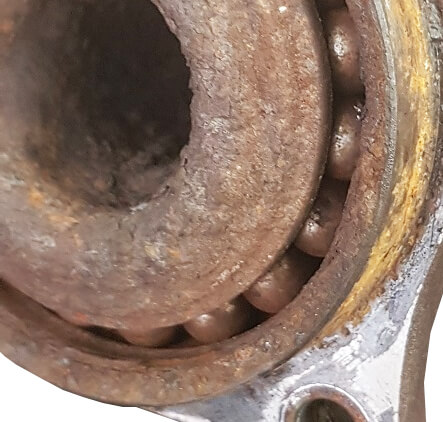
Water ingress, grease failure and rust
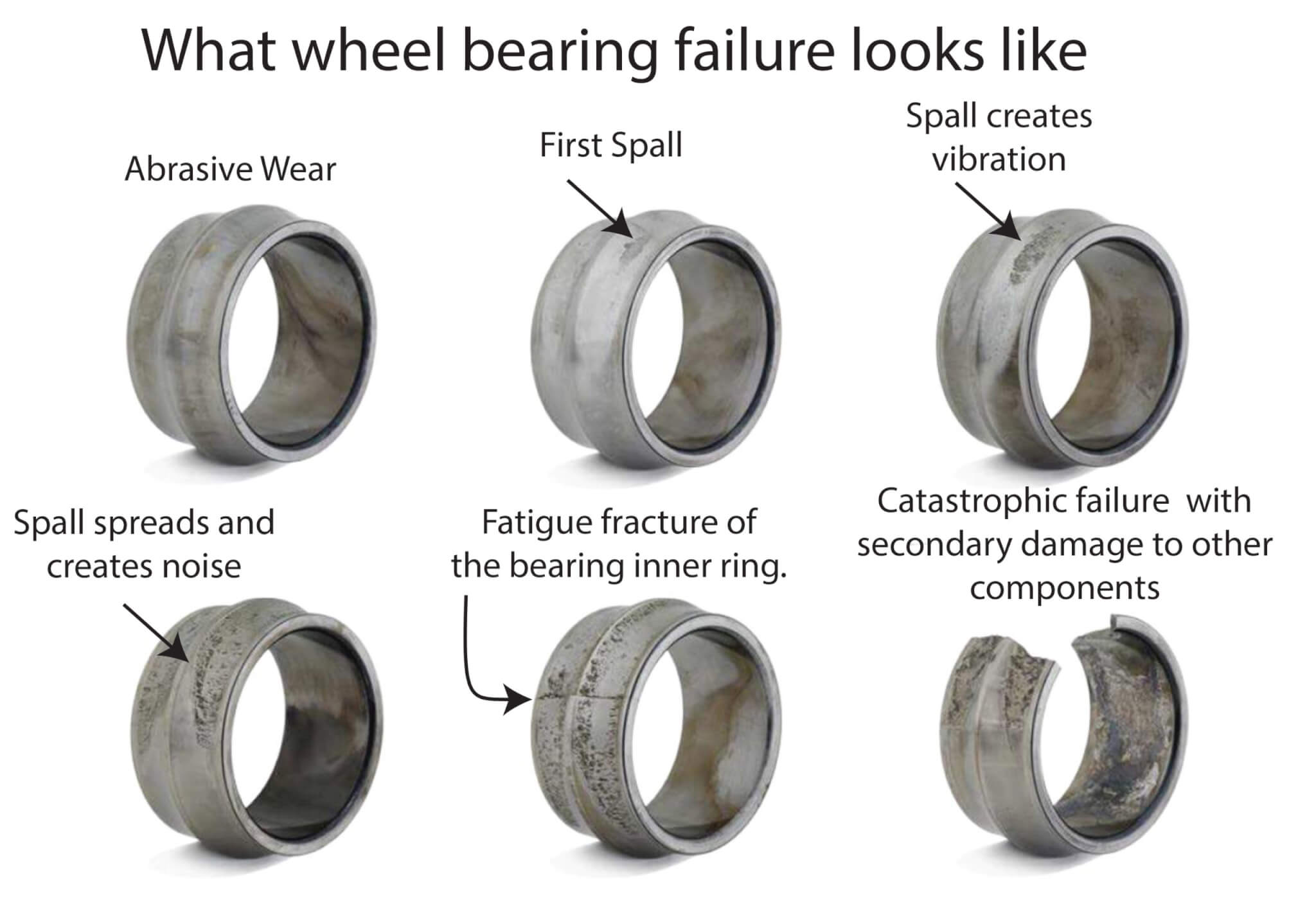
Wheel bearing spalling damage and how it progresses
Wear, pitting, and bruising
Any hard particles traveling with the lubricant can cause a “bruise” or dent on the bearing or race surface. The dents can also be caused by impacts (potholes and rough road surface). The raised metal around the dent acts as surface-stress risers that cause spalling. Spalling is the pitting or flaking away of bearing material on the races and rolling elements.
Brinell damage
There are two type of Brinell damage: true brinelling and false brinelling.
True brinelling is common in automotive applications
True brinelling is caused when the load on 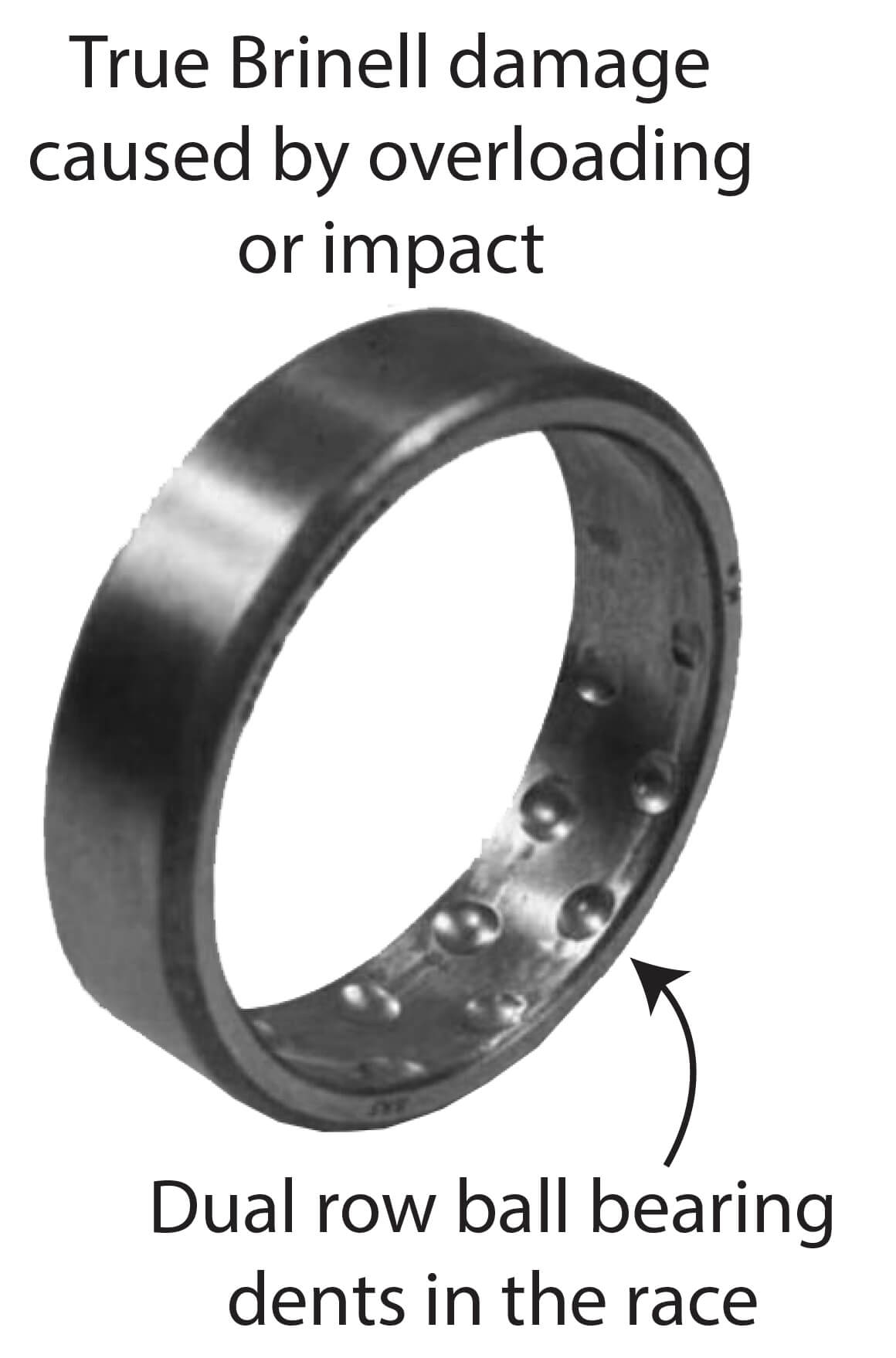 the bearing is greater than the elastic limit of the ring or bearing material. It can also be caused by shock or impact. It appears as regularly-spaced indentations in the bearing raceway and rolling elements, and an increase in vibration.
False Brinelling
False brinelling is caused by vibrations acting on the bearing while the bearing is in a non-rotating state. The vibration causes the bearing to wear against the race. This rarely happens in automotive bearings and is more common in industrial machines with strong vibrations.
What’s Involved in a Wheel Bearing Replacement
A proper wheel bearing replacement isn’t just a matter of pressing in a new bearing. It requires precision, cleanliness, and the right tools.
Here’s how I handle wheel bearing replacement in the shop:
• Diagnose accurately. Noise doesn’t always mean a bad bearing. I road-test the vehicle, load each corner during turns, and use a stethoscope or chassis ears to pinpoint the source.
• Disassemble carefully. I remove the wheel, brake caliper, rotor, and axle nut to access the hub.
• Press out the old bearing. For pressed-in designs, I use a hydraulic press and proper adapters to avoid distorting the hub bore.
• Clean the hub and bore. Contamination here can cause improper seating and early failure.
• Install the new bearing. I always press on the outer race (never the inner) and ensure correct orientation of the magnetic encoder ring if it’s part of an ABS system.
• Torque everything to spec. Over- or under-torquing the axle nut can ruin a new bearing before you even drive away.
That’s why wheel bearing replacement should never be rushed or improvised. Using the wrong grease, skipping seals, or hammering the hub into place will only guarantee another failure.
How to Prevent Wheel Bearing Failure
Preventing wheel bearing failure comes down to maintenance and smart driving habits:
• Avoid driving through deep water or pressure-washing directly at the hub area.
• Keep tires balanced and properly inflated to reduce bearing stress.
• Replace grease seals every time you service or repack bearings.
• Use the correct torque specs during wheel bearing replacement.
• Ensure your vehicle’s ground connections are intact to prevent electrical degradation.
Final Thoughts
In my experience, wheel bearing replacement is one of those repairs that rewards precision. When installed correctly with the right parts and procedures, a new bearing should last the rest of the vehicle’s life. Most wheel bearing failures aren’t random—they’re the direct result of contamination, improper service, or neglect.
If you start hearing that telltale hum or grinding noise that changes with speed or turns, don’t ignore it. Addressing it early can prevent a catastrophic failure and keep you safe on the road.
©, 2022 Rick Muscoplat
Posted on by Rick Muscoplat