
Automotive Fuse Types and Sizes: What The Letters Mean
Blade vs Cartridge vs Bolt-Down Automotive Fuse Types
Quick Summary
In the 1970s and 1980s, carmakers began switching from AGC fuses (also known as glass tube fuses or Buss AGC fuses) to ATO (Automotive Type Open) blade-type fuses. The glass fuses were typically 1/4-inch diameter by 1-1/4-inch long and were rated for various amperage values. The ATO fuse style uses two flat metal blades that plug directly into a fuse holder, replacing the older glass-tube design. In practical terms, an ATO fuse:
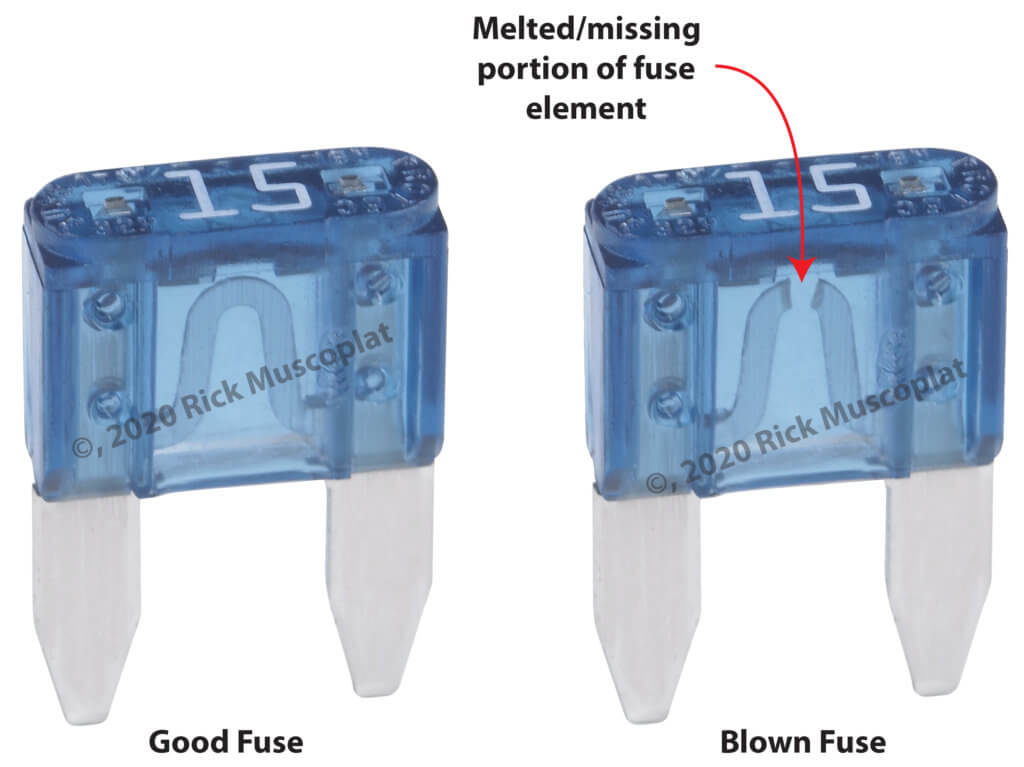
• Has a transparent plastic body so you can visually inspect the element
• Uses standardized color coding for amperage (red = 10A, blue = 15A, etc.)
• Provides a reliable push-in connection instead of spring clips
Why Carmakers Switched to Blade (ATO) Style Blade Fuses
I’ve worked on vehicles from both eras, and the shift to blade-style fuses wasn’t just convenience—it was a major leap forward in reliability and safety.
1. Better Electrical Contact — Older glass fuses relied on spring clips that could loosen, corrode, or create resistance. The blade design provides a tighter, more consistent connection, reducing voltage drop and heat buildup.
2. Improved Vibration Resistance — Vehicles vibrate constantly. Glass fuses could loosen or crack under vibration, while ATO blade fuses stay firmly seated in their terminals.
3. Faster Diagnostics — With ATO fuses, you can often see a blown element through the clear housing. That simple visual check saves time compared to testing glass fuses with a meter.
4. Standardization Across the Industry — Blade fuses introduced consistent sizing and color coding. That made it easier for manufacturers, technicians, and parts suppliers to work with a universal system.
5. Compact and Scalable Design — The ATO design paved the way for smaller versions like mini, micro, and low-profile fuses. As vehicles added more electronics, this scalability became critical for packaging fuse boxes in tight spaces.
The Three Main Types of Automotive Fuses In Use Today
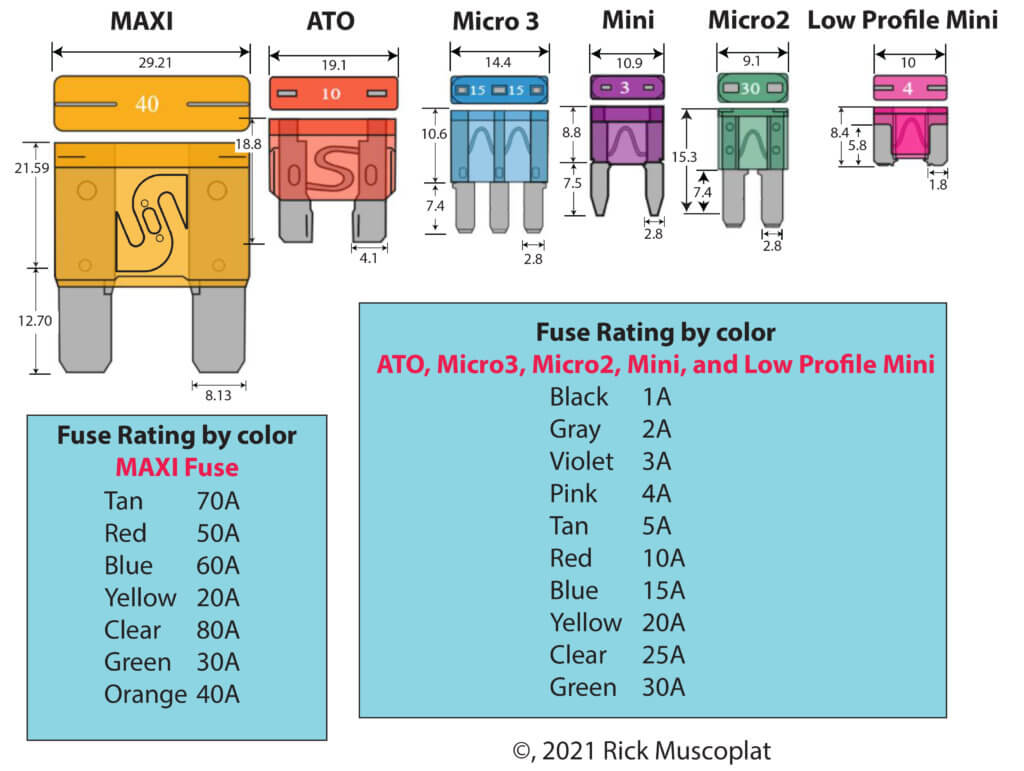
1. Blade Fuses (Most Common) — Blade fuses are what you’ll find in almost every modern vehicle. They’re easy to recognize by their plastic body and two metal prongs.
Within this category, there are several subtypes:
• Standard (ATO/ATC)
• Mini
• Micro2 and Micro3
• Low-profile mini
• Maxi (high-current version)
Each size exists because automakers are constantly fighting for space. Smaller fuses allow tighter packaging in fuse boxes.
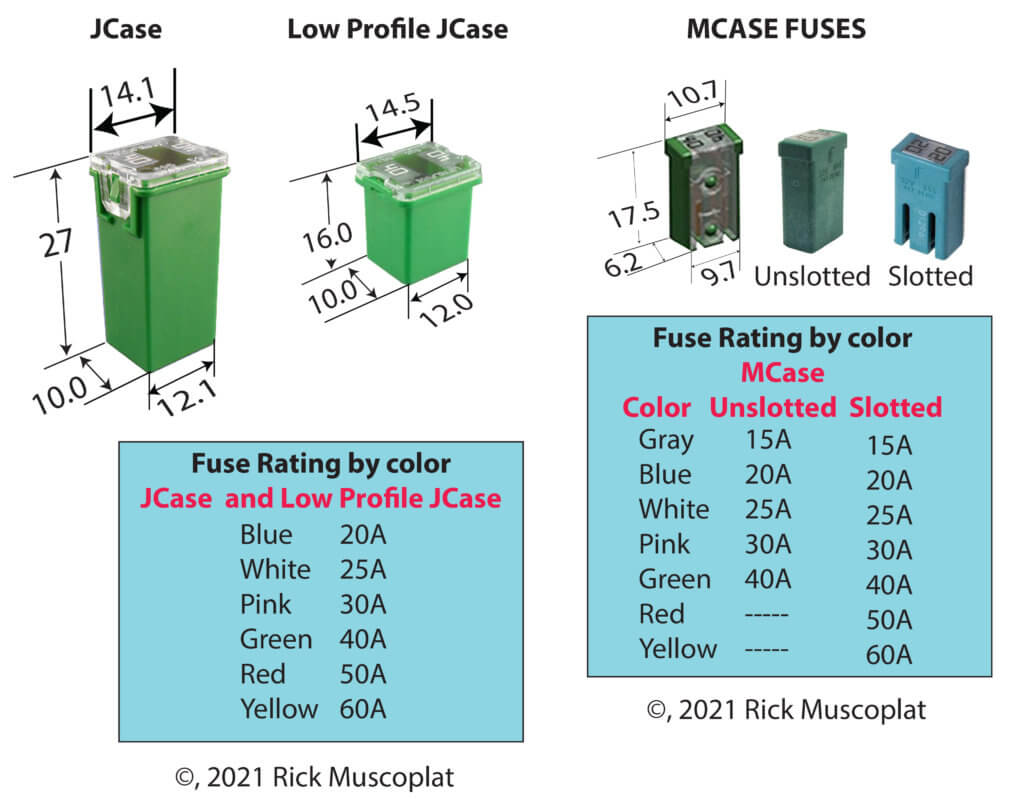
2. Cartridge Fuses (High-Load Protection) — Cartridge fuses handle higher current loads than blade fuses and are often used for major systems.
You’ll typically find these protecting:
• Cooling fans
• ABS systems
• Power steering modules
• High-current relays
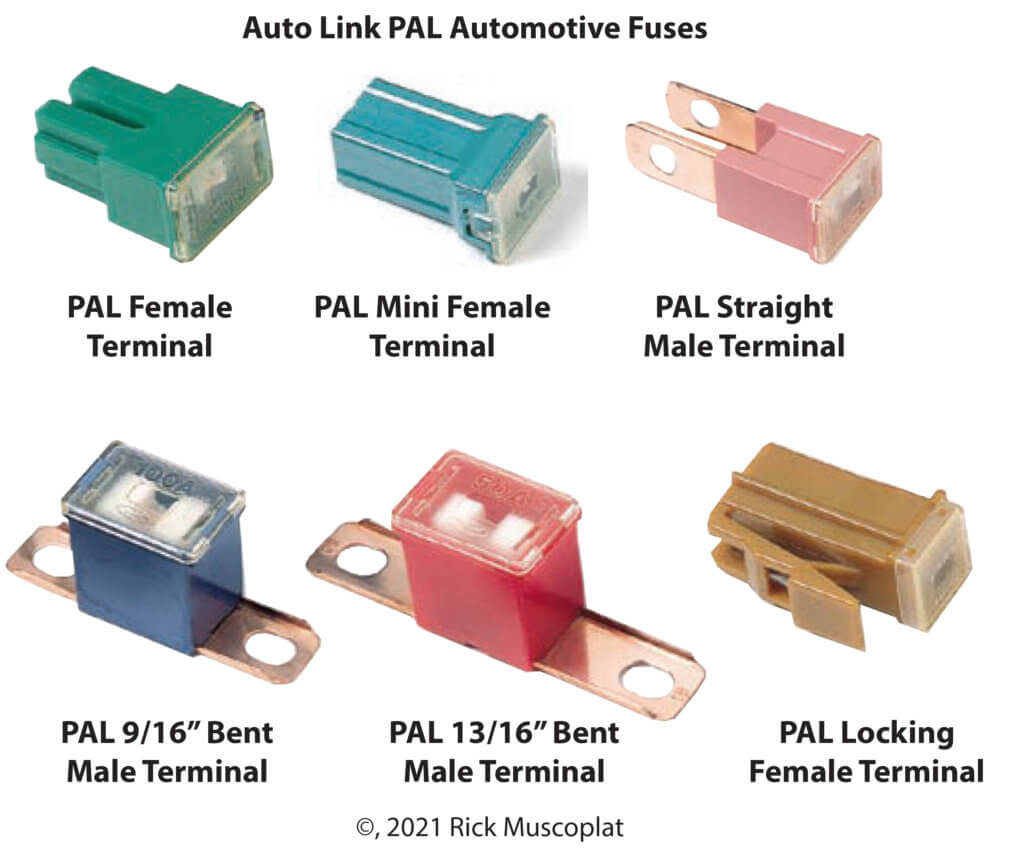
They come in multiple designs, including J-case and low-profile versions. There are about 10 variations of cartridge-style automotive fuses, which explains why misidentification is common.
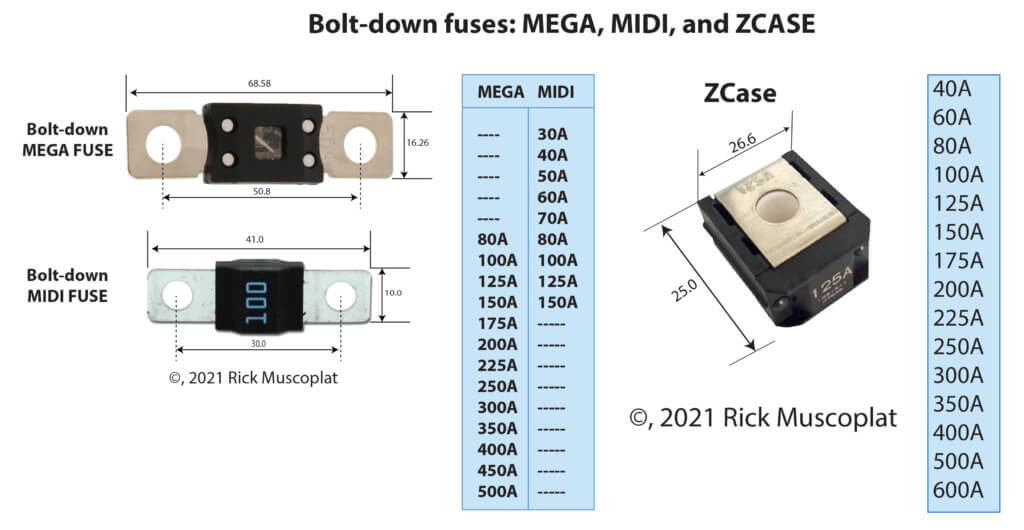
3. Bolt-Down Fuses (Mega and High-Amperage Circuits) — Bolt-down fuses are used for serious current—think 40 amps all the way up to 300+ amps.
These are typically mounted:
• Near the battery
• In power distribution blocks
• On alternator or starter circuits
They’re physically secured with bolts because push-in connections wouldn’t reliably handle that kind of load.
Identifying automotive fuses
Automotive fuses are available in several types: blade, cartridge, and bolt-down. Within those categories, carmakers may choose a mega, mini, standard, micro, or low-profile style fuse based on space requirements. Here are the three types of automotive fuses
There are six types of automotive blade fuses
Ten types of automotive cartridge fuses
Three types of automotive bolt-down fuses
What Causes a Fuse to Blow?
Here’s where most DIYers go wrong—they replace the fuse and call it fixed. Based on both real-world diagnostics these are the most common causes:
1) Too Much Load on the Circuit — When a device draws more current than the circuit was designed to handle, the fuse element melts, breaking the circuit and shutting off the power. An excessive load typically causes a fuse to blow slowly as the load generates heat that builds to the point where the fuse element melts. Excessive load can be due to:
• Component Failure — A failing motor can stall, causing it to draw too much current.
• Mechanical Wear — Worn motor bearings cause a motor to draw too much current
2) Short Circuit — Damaged wiring creates a direct path to ground—this is the fastest way to blow a fuse.
Fuse box locations
Carmakers usually install several fuse boxes in a vehicle. For example, the underhood fuse box normally contains fuses for the devices located under the hood. So you’ll find fuses for the electric radiator fans, windshield wipers, washer pump, AC compression, ABS brake module and pump, headlights, and brake lights.
The interior fuse box is often located under the dash on either the left or right side. Interior fuse boxes usually contain fuses for all the internal accessories, like the radio, blower motor, dash lights, power port, and computer modules.
For more information on fuse box diagrams, click here.
©, 2021 Rick Muscoplat
Posted on by Rick Muscoplat