
Bad Purge Valve Symptoms Explained by a Mechanic
Bad Purge Valve Symptoms: What to Look Out For and How to Fix It
Quick Summary
• Bad purge valve symptoms:
• Hard starting after refueling
• Rough idle
• Poor fuel economy
• Fuel smell under the hood
• Hissing sound from the engine
• Persistent check-engine light.
A stuck-open purge valve can even cause the gas pump to keep clicking off or result in excessive vacuum in the fuel tank. The good news is that the fix is usually straightforward. Once properly diagnosed, it’s often best to replace purge valve components rather than chase intermittent EVAP faults. Catching the problem early prevents drivability issues and avoids damage to other EVAP parts.
Article
Bad Purge Valve Symptoms: What I Look for and How I Fix Them
I’ve diagnosed hundreds of EVAP system problems over the years, and purge valve failures are among the most common—and most misunderstood. The purge valve plays a simple but critical role: it meters fuel vapors stored in the charcoal canister back into the engine so they can be burned instead of vented to the atmosphere. When it works, you never notice it. When it fails, the symptoms can feel random and confusing.
Understanding bad purge valve symptoms starts with understanding when the valve should be open—and when it absolutely should not.
How the Purge Valve Is Supposed to Work
Under normal conditions, fuel vapors collect in the charcoal canister as you fill the tank and as the fuel in the tank heats up. When engine operating conditions are right, usually right after a fill up, the engine computer opens the purge valve and vent valves and allows those vapors to be drawn out of the canister and into the intake manifold, where they are burned. The computer carefully monitors oxygen sensor feedback and trims fuel injector pulse width to compensate for the extra vaporized fuel.
When the purge valve sticks open or closed—or behaves erratically—the engine gets fuel vapor when it shouldn’t, or doesn’t get it when it should. That’s when bad purge valve symptoms begin to surface.
Hard Starting After Refueling: The Most Telling Clue
If there’s one symptom that immediately points me toward the purge valve, it’s a hard start right after filling the gas tank. The purge valve must stay closed during refueling. If it sticks open, raw fuel vapors bypass the charcoal canister and flood the intake. The engine cranks longer than normal because it’s flooded. Or it may start and then stumble or even stall.
This is one of the most classic bad purge valve symptoms, and when I see it, I don’t guess—I test. In many cases, the fix is simple: replace the purge valve and verify normal operation.
Why the Check Engine Light Comes On
A malfunctioning purge valve almost always triggers a check-engine light. The engine computer knows how much vapor flow to expect during a purge cycle and when to expect it. When the numbers don’t line up, it flags the problem.
Common EVAP-related codes associated with bad purge valve symptoms include circuit faults, incorrect purge flow, or EVAP leak codes that confuse many DIYers into unnecessarily replacing the gas cap. While gas caps do fail, a stuck-open purge valve can mimic a leak by preventing the system from holding vacuum during self-tests.
Here are the most common EVAP codes and their meaning:
P0443 – Evaporative Emission Control System Purge Control Valve Circuit
P0444 – Evaporative Emission Control System Purge Control Valve Circuit Open
P0445 – Evaporative Emission Control System Purge Control Valve Circuit Shorted
P0446 – Evaporative Emission Control System Vent Control Circuit
P0455 – Evaporative Emission Control System Leak Detected (Large Leak)
P0456 – Evaporative Emission Control System Leak Detected (Small Leak)
P0457 – Evaporative Emission System Leak Detected (Fuel Cap Loose/Off)
P1443 – Evaporative Emission Control System Control Valve
Rough Idle and Stalling at Stops
A purge valve that leaks when it shouldn’t acts like a vacuum leak—except it’s worse because it also introduces fuel vapors. At idle, even a small amount of unintended purge flow can cause unstable combustion. The engine may surge, stumble, or stall when coming to a stop.
When drivers describe a rough idle alongside other purge valve symptoms, I’m already thinking ahead to whether it’s time to replace purge valve components rather than continue testing marginal behavior.
Poor Fuel Economy That Doesn’t Make Sense
Fuel vapors are still fuel. When the purge valve allows uncontrolled vapor flow, the engine burns more fuel than necessary, even though the computer tries to compensate. Over time, this shows up as noticeably worse MPG.
Poor fuel economy alone doesn’t confirm bad purge valve symptoms, but when it appears alongside hard starts or idle issues, it becomes part of a very consistent pattern.
Want to diagnose your purge valve failure. See this post
Gas Pump Keeps Clicking Off While Filling
One of the more frustrating bad purge valve symptoms happens at the gas station. If the EVAP system can’t purge properly, the charcoal canister becomes saturated. When you try to refuel, fuel vapors have nowhere to go. Pressure builds up in the filler neck, and the pump nozzle keeps clicking off.
Many people replace gas caps or filler necks to chase this issue. In reality, a purge valve that won’t operate correctly is often the root cause, and the proper repair is to replace purge valve parts after verifying canister condition.
When a Bad Purge Valve Collapses a Fuel Tank
This one is rare, but I’ve seen it. If the purge valve sticks open while the EVAP vent valve remains closed, engine vacuum can be applied directly to the fuel tank. Over time, that vacuum can deform or partially collapse the tank.
When that happens, EVAP leak codes often follow, and the repair becomes far more expensive. Catching bad purge valve symptoms early prevents this kind of secondary damage.
Fuel Smell Under the Hood—Even When Parked
A purge valve that doesn’t seal can allow fuel vapors into the intake when the engine is off. That vapor has to go somewhere, and often you’ll smell raw fuel under the hood or around the vehicle after it’s been sitting.
This symptom alone won’t confirm a failure, but combined with other bad purge valve symptoms, it strongly suggests it’s time to replace purge valve components.
Why Purge Valves Fail in the First Place
In my experience, purge valves usually fail due to contamination or mechanical wear.
• A Failed Charcoal Canister: The canister contains a screen to prevent charcoal
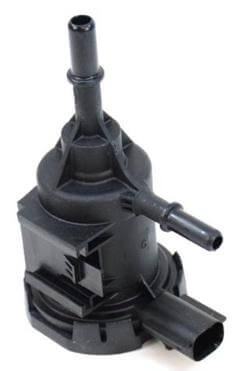
MOPAR 4891739AA purge valve
particles from entering the purge hose. If the screen fails, charcoal particles can get sucked into the purge valve, preventing it from operating properly. If you disconnect the vacuum line to the purge valve and discover charcoal particles, the root cause is the canister, not the valve. Replace the canister, flush the line and then replace the purge valve.
• Wear and Tear: Over time, the purge valve can wear out or become clogged with carbon deposits, which can prevent it from opening or closing properly.
• Electrical Issues: Since the purge valve is electronically controlled, problems with the wiring or connectors can lead to improper valve operation.
• Contaminants: Dirt, debris, or moisture entering the EVAP system can cause the purge valve to stick or fail to operate correctly.
• Vacuum Leaks: A vacuum leak in the EVAP system can disrupt the operation of the purge valve, leading to incorrect vapor flow.
How the ECM Tests the Purge Valve
During EVAP self-tests, the engine computer opens and closes the purge valve while monitoring oxygen sensors and, on many vehicles, a fuel tank pressure sensor. It watches how quickly the vacuum builds and whether it holds.
If the system fails to behave as expected, the computer flags a fault. When those tests fail repeatedly, and drivability issues line up, I don’t hesitate to replace purge valve components once power, ground, and control signals are confirmed.
The Bottom Line on Bad Purge Valve Symptoms
Bad purge valve symptoms are rarely subtle once you know what to look for. Hard starting after refueling, rough idle, fuel smells, poor mileage, and EVAP codes all point toward the same conclusion. Diagnosis is important, but once confirmed, the most reliable repair is to replace purge valve components rather than live with recurring issues.
Fix it once, fix it correctly, and the EVAP system will quietly go back to doing its job—just like it should.
©, 2020 Rick Muscoplat
Posted on by Rick Muscoplat