
Battery Maintainer: Keep Your Car Battery Fully Charged
Why You Should Use a Battery Maintainer For Your Grocery Getter Vehicle
The pandemic and remote work have changed car-driving habits. These days, remote employees only drive their cars once a week on short trips to the grocery store or to pick or drop off the kids. That kind of driving is really bad for your car battery. In those cases, connecting your battery to a battery maintainer can keep your battery fully charged, prevent battery sulfation, and extend its life.
Why You Need a Battery Maintainer
As someone who’s spent years maintaining vehicles, I’ve seen firsthand how neglecting your car battery can lead to frustration, downtime, and expensive replacements. If you’re like me and sometimes leave your vehicle parked for extended periods or only drive short distances, a battery maintainer is an absolute must-have. Let me explain why you need one and how to choose the best model for your needs.
The reality is that modern driving habits can wreak havoc on your car’s battery. Short trips or infrequent use don’t give your alternator enough time to fully recharge the battery. Add in the constant energy draw from your vehicle’s electronics, and you’ve got a recipe for a drained battery. This is where a battery maintainer comes into play. It’s not just a luxury; it’s a practical solution to keep your battery healthy and ready to go.
A battery maintainer works by monitoring the battery’s charge level, delivering power only when necessary to keep it fully charged. It automatically stops charging once the battery is full, then resumes as the battery naturally discharges. This ensures the battery is always in peak condition without overcharging or damage.
When to Use a Battery Maintainer
I always recommend using a battery maintainer if you’re not driving your vehicle for two weeks or more. Even if your car sits idle, the battery will still lose charge due to self-discharge and the constant draw from onboard systems. Over time, this can leave your battery severely depleted or even dead. A battery maintainer prevents this, saving you the hassle of jump-starting or replacing your battery.
How to buy a battery maintainer
Choosing the Right Battery Maintainer
Not all battery maintainers are created equal, and choosing the right one depends on your vehicle and battery type. I’ve tested several brands over the years, and here’s what I’ve learned:
The Clore Manufacturing Solar Pro-Logix PL2140
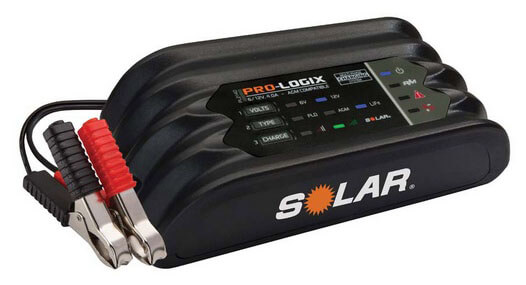
Clore/Solar ProLogix PL2140 battery maintainer
($40 on Amazon) is my top pick for its reliability and versatility. This 4-amp model works with virtually any type of battery, including SLI flooded, AGM, gel, deep cycle, and lithium. It features advanced modes like “soft start” to safely recover deeply discharged batteries and “recondition mode” to restore battery health. Plus, its temperature compensation ensures consistent performance in any climate. At about $46, it’s a solid investment.
Download the manual here:
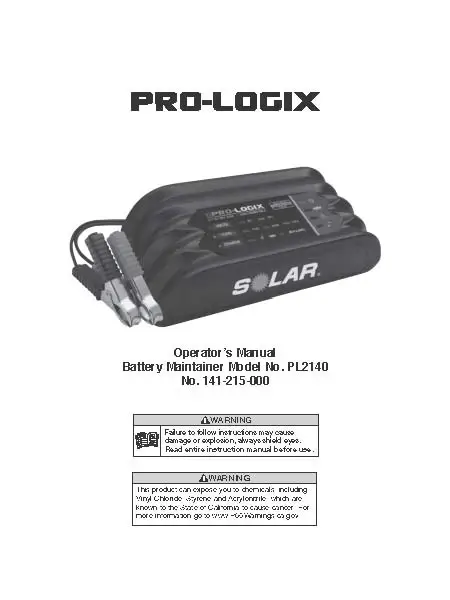
Click on the image to download the manual
Here are the specs for the PL2140 Battery Maintainer:
• Six- and 12-volt battery charging
• Four-amp charge rate
• Fully automatic operation
• Advanced multi-phase charging process
• Properly charges all battery types: SLI (Flooded), AGM, Gel, Lithium
• Soft Start Mode for severely depleted batteries
• Recondition Mode rejuvenates distressed batteries
• Enhanced maintenance mode for ideal long-term storage
• Temperature compensation for more effective charging in all temperatures
• Operator-controllable Recovery Mode allows the charger to overcome power outages
• Reverse polarity protection and battery fault detection
• Includes three output accessories: clamp set, ring terminal kit, and 12V plug
The charger uses a proprietary Multi-Stage charging process designed to optimally charge and maintain batteries.
1) ENERGIZING PHASE— The charging process includes an initial energizing mode in which the charger determines the best charging path for the connected battery. Voltage starts at 4.5 volts and rises to 7 volts while current remains constant at slightly above 2 amps. From there, the charger can enter the Fast Charge stage (in most cases), Soft Start Mode, Battery Recondition Mode, or stop the charging routine because unsafe battery conditions (short, etc.) are detected.
2) FAST CHARGE— Charges the battery with a 4-amp constant current and rising voltage from 7 volts to 14.2 volts.
3) ABSORPTION— Charges the battery with a constant voltage of 14.2 volts and drops the current from 4 amps to .75 amps.
4) COMPLETION— A slight drop in constant voltage to 13 volts and another current drop from .75 amps to 0 amps.
5) RESTING— Voltage stays steady at 13 volts, and current stays steady at 0 amps.
6) EXERCISING— Voltage drops from 13 volts to 12.2 volts, and a .5 amp current draw is pulled on the battery to exercise the battery.
7) RESTORING— Voltage rises from 12.2 volts to 14.2 and then drops to 13 volts, while current rises to 4 amps for a short period before a steady drop to 1 amp.
• SOFT START MODE— Soft Start Mode is activated when the charger is connected to a deeply discharged battery. This mode protects the battery during the initial charge period, as the battery’s voltage rises to a more normal level, and is beneficial for the long-term health of the battery.
• BATTERY RECONDITION MODE— During the Energizing Phase, if the charger detects the presence of battery sulfation, it will activate this mode. If this occurs, the CHARGING LED will flash. This indicates the charge time will be extended while the charger attempts to recondition the battery.
Battery Tender® 6V/12V, 4A: Although it’s more expensive than the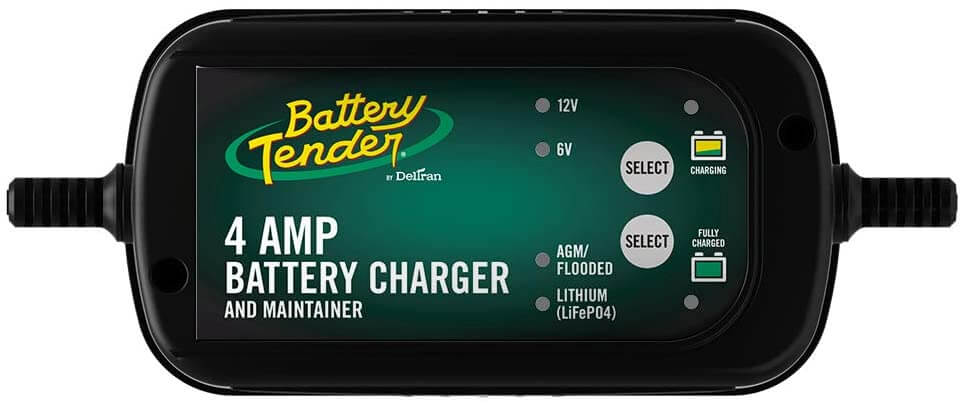 Clore Solar product, the Battery Tender Brand is another excellent option. It uses a fully automatic, microprocessor-controlled 4-step charging process and supports various battery types, including lithium. Expect to pay around $70 on Amazon.
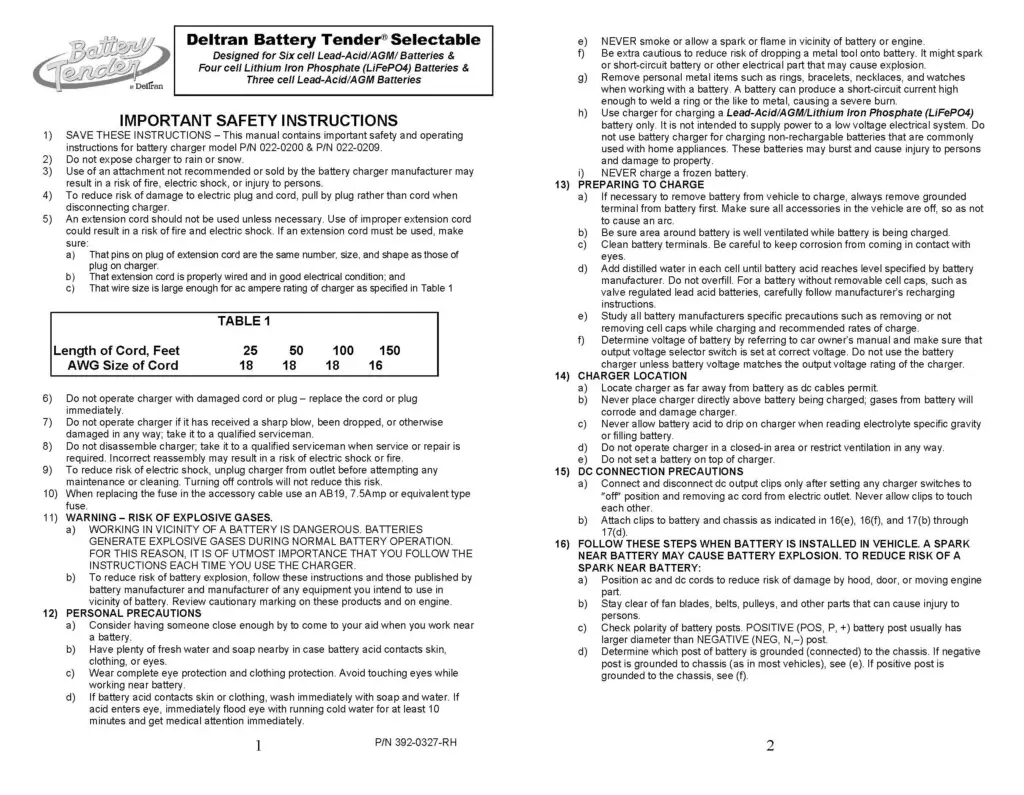
Click on this image to download the manual for the Battery Tender battery maintainer.
Here are the specs for the 4-Amp Battery Tender Battery Maintainer:
Charges & Maintains: Motorcycles, ATVs, Lawnmowers, Dirt Bikes, Personal Watercraft Classic Cars, Boats, SUV
Output: 4 Amp
Compatibility: AGM, GEL, Lead Acid, Lithium
Dimensions: 3.86″ x 1.87″ x 8.3″, 1.35 lbs
Included in the box: 4 AMP battery charger, ring terminal and alligator clip combo cable
Warranty: 5 Year
CTEK – 40-206 MXS 5.0 Fully Automatic 4.3 amp Battery Charger and Maintainer 12V: This 4.3-amp model offers features like temperature compensation, reconditionin
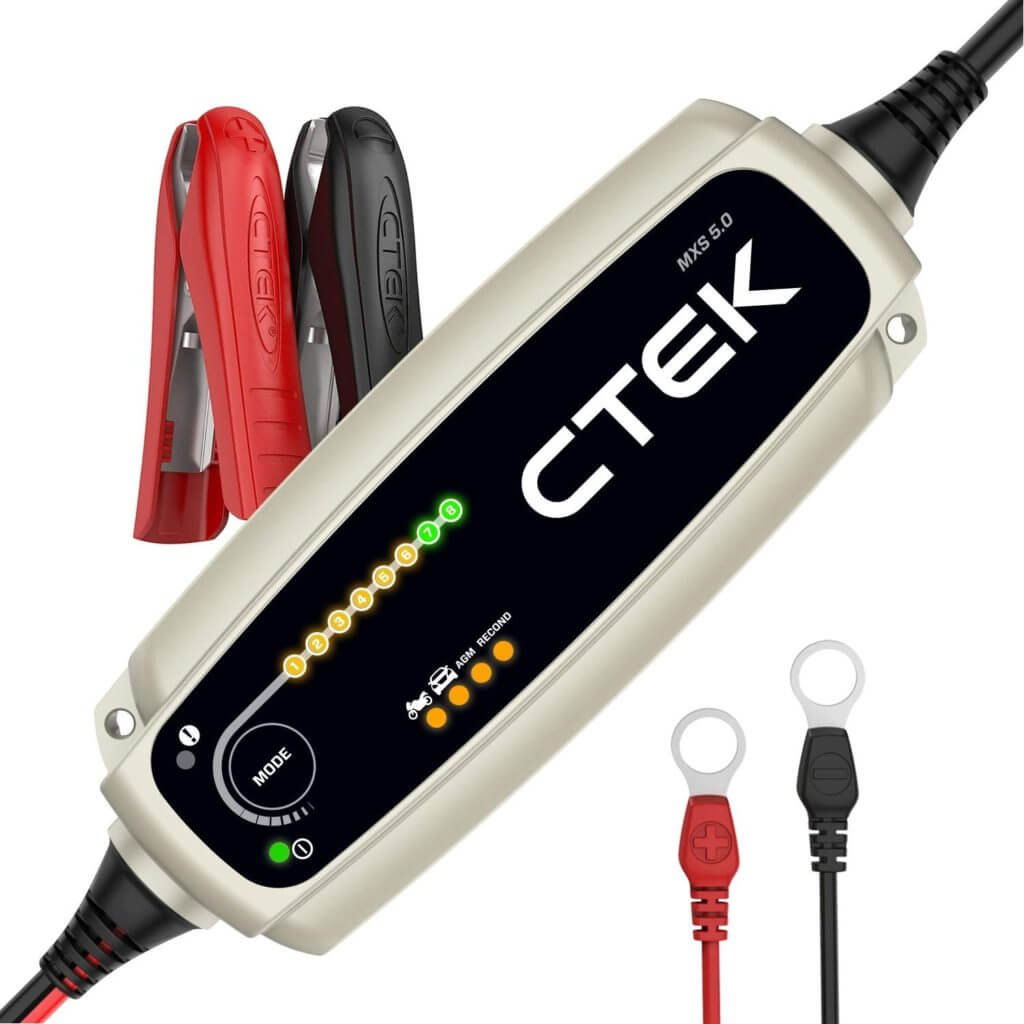
g phases, and protection against short circuits and reverse polarity. It’s perfect for those with modern vehicles equipped with Enhanced Flooded Batteries (EFB). At $95 (Amazon), it’s pricier than either the Clore or Battery Tender Brands.
STEP 1 DESULPHATION— Pulsing voltage removes sulfates from the lead plates of the battery, restoring the battery capacity
STEP 2 SOFT START— Tests if the battery can accept charge. Charging begins if the battery is OK.
3 STEP 3 BULK— Charging with maximum current until approximately 80 % battery capacity.
STEP 4 ABSORPTION, BATTERY READY TO USE— Charging with declining current to maximize up to 100 % battery capacity.
STEP 5 ANALYZE— Tests if the battery can hold charge. Batteries that cannot hold charge may need to be replaced.
STEP 6 RECOND— Reconditioning function for deeply discharged batteries.
STEP 7 FLOAT, BATTERY FULLY CHARGED— Maintaining the battery voltage at maximum level by providing a constant voltage charge.
STEP 8 PULSE, MAINTENANCE CHARGING— Maintaining the battery at 95–100 % capacity. The charger monitors the battery voltage and gives a pulse when necessary to keep the battery fully charged.
Must-have features for a maintainer
Not all car batteries are the standard lighting ignition (SLI) flooded lead-acid style. Many newer cars and trucks with start/stop technology use absorbent glass mat (AGM) batteries, which require a special charging routine. I don’t recommend charging an AGM or EFB battery with an older charger designed for SLI batteries. Plus, if you plan to use your battery maintainer on your gasoline-powered outdoor power equipment equipped with a gel-style lead-acid battery, you’ll need a charger equipped with a GEL recharging cycle.
How many amps do you need in a maintainer?
For more car and light truck applications, all you need is a two or 4-amp battery maintainer. For motorcycle and small engine gel batteries, I recommend a 1-amp battery maintainer.
It should have multiple charging cycles
Battery maintainers can be used to maintain a battery, but some can also be used to recharge a discharged battery. When a battery is discharged, a multi-phase charging routine is required to recondition the cells without causing damage.
Clore Manufacturing Solar brand Pro-Logix PL2140 is the brand I Use Exclusively.
I’ve been using Clore Manufacturing Solar products for years. The Clore Manufacturing Solar Pro-Logix PL2140 Battery maintainer is among the best on the market in my opinion. I use it to keep the battery fully charged on my weekend hauler minivan. Why? Because that van cansit unused for 6 weeks or more and I want it to fire right up when I need it.
Why I personally don’t like NOCO chargers and Jump Packs
People always ask my opinion of NOCO chargers and jumper packs. I don’t hide the fact that I’m not a fan of NOCO products. My opinion goes way back to when they first introduced jumper packs and rated their packs in STARTING AMPS, which is an industry-standard for lithium jumper packs. Back then, the CEO of NOCO made a huge deal about how they rated their packs in SA while others used PEAK AMPS, which is a meaningless term because there’s no industry standard. Later, as NOCO became the most popular model on Amazon, I noticed that NOCO stopped rating their jumper packs in SA and only posted peak amps, the very terms they derided when they first came out.
©, 2019 Rick Muscoplat
Posted on by Rick Muscoplat