
Should you upgrade to an AGM battery?
How to Safely Upgrade to an AGM Battery
If you’re thinking about an upgrade to an AGM battery, you need to know the facts. While the advantages of an AGM battery are clear, the upgrade doesn’t work well in all vehicles. In fact, making the switch without understanding your car’s charging system can lead to shorter battery life and wasted money.
On the flip side, if your car or truck was equipped with an AGM battery from the factory, you must replace it with an AGM battery. Installing a standard flooded lead-acid battery in a car or truck that requires an AGM battery can cause the flooded battery to fail within six months.
Why You Need to Be Cautious About Upgrading to an AGM Battery on Older Vehicles
Let me be clear: if your vehicle didn’t come with an AGM battery from the factory, you must be careful before making the switch. AGM batteries require a different charging profile than traditional flooded lead-acid batteries. If your vehicle isn’t equipped to handle it, you could end up damaging the new battery—or worse, overcharging it to the point of failure. However, if your car or truck was designed for an AGM battery or has a start/stop system, you must replace it with an AGM. Installing a standard lead-acid battery in a vehicle that requires an AGM battery can be dangerous—it could even lead to an explosion. That’s not an exaggeration.

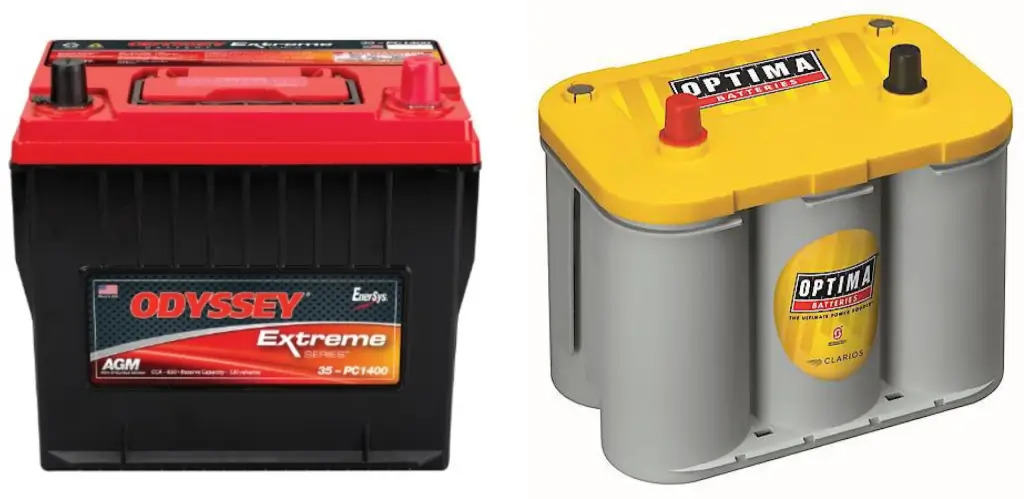
This image shows a standard AGM battery and an Optima spiral wound AGM battery. The majority of AGM batteries are NOT spiral wound.
Can your vehicle handle an upgrade to an AGM battery?
AGM batteries charge differently than traditional flooded lead-acid batteries. If your car has a modern power management system with a current draw sensor, you’re in luck—your vehicle can likely handle an upgrade to an AGM battery without any issues. These systems monitor battery health and adjust charging accordingly, ensuring the battery stays in peak condition.
However, not all vehicles are designed to support AGM technology. Newer vehicles rely on the PCM or ECM to regulate the charging rate based on the factory-installed battery type. If you upgrade to an AGM battery in an older vehicle without a power management system, your alternator might overcharge, leading to premature failure. AGM batteries require a lower charging voltage over a longer period. If your vehicle can’t provide that, the battery’s lifespan will be drastically reduced.
Differences between an SLI and AGM battery
Traditional starting/lighting/ignition (SLI) flooded lead acid batteries are designed to provide a quick burst of high amperage energy to crank the engine, even when it’s very cold. The lead plates sit in a liquid electrolyte bath, so they must be mounted upright, or the electrolyte will spill out.
On the other hand, absorbed glass mat (AGM) batteries still have lead plates, but they don’t sit in a liquid electrolyte bath. Instead, the plates are separated by a fiberglass mat that absorbs the electrolyte and wicks it to the plates. Because the electrolyte isn’t pooled, an AGM battery won’t spill if knocked over, and it can be mounted in different positions. It can also be transported without the hazardous material restrictions required by SLI batteries.
Why you might want to upgrade to an AGM battery— The Advantages of an AGM Battery
AGM batteries have a lower self-discharge rate. All lead-acid batteries lose charge over time, but AGM batteries hold their charge longer, meaning there is less worry if your car sits for extended periods.
AGM batteries have lower internal resistance— AGM batteries are designed for efficiency. Their internal structure allows them to deliver more power from a smaller unit than a traditional flooded battery.
They’re more resistant to sulfation— Sulfation is a leading cause of battery failure, but AGM batteries are far less susceptible to this issue than SLI batteries. Do you want to know more about sulfation? Click on this article: What causes battery sulfation?
They can survive a deep discharge better than an SLI battery— AGM batteries can be discharged up to 80% without damage.
The Disadvantages of an AGM Battery
Despite the many benefits, there are also some disadvantages of an AGM battery that need to be considered:
AGM batteries are more susceptible to freezing if discharged— All lead acid batteries can freeze if they’re discharged. Freezing destroys the battery. However, an AGM battery freezes more easily at a low state of charge than a standard flooded battery. Depending on battery size, an AGM battery can freeze when its charge rate falls below 50%.
AGM batteries fail early due to undercharging — One of the main reasons for early AGM failure is undercharging and long-term discharge, which results in hydration failure. This is a critical factor to consider if you drive your vehicle short distances or leave it unused for long periods. Short trips aren’t long enough to recharge the battery fully, and long periods of non-use cause battery drains.
AGM batteries can’t handle high voltage charging— Older vehicles without a power management system tend to recharge the battery at 15 or more volts. When AGM batteries are overcharged, the electrolyte is consumed. Overcharging causes the temperature to rise, which can easily affect the electrolyte saturation level and make the separator less efficient, permanently damaging the battery.
Higher cost— AGM batteries are more expensive than standard lead-acid options, sometimes significantly so.
Should You Upgrade to an AGM Battery?
Before you decide to upgrade to an AGM battery, check whether your vehicle’s charging system can handle it. If your car has a modern power management system, an AGM battery will offer better longevity, performance, and reliability. But if your vehicle lacks the necessary charging controls, you could ruin a brand-new battery.
For vehicles with start/stop technology, the answer is simple: you must replace an AGM battery with another AGM battery. Never install a flooded lead-acid battery in a start/stop vehicle, even if you disable the start/stop feature. The charging system is designed around AGM technology, and using the wrong battery can lead to serious safety issues.
©, 2019 Rick Muscoplat
Posted on by Rick Muscoplat