
Brake Rotor Quality: Understanding the Difference
Why Brake Rotor Quality Matters: Exploring the Differences
Not all brake rotors are created equal. Understanding the differences in quality can significantly impact braking performance, durability, and overall driving safety. This article explores the differences between economy brake rotors sold by chain/franchise repair shops and high quality brake rotors. There’s a huge difference in brake rotor quality and it affects your braking
Ask for a brake rotor and any auto parts store and you’ll be quoted a very low price. That brake rotor will be a store branded, economy rotor. Those cheap rotors are make from inferior materials that don’t last as long or brake as well as a higher quality rotor. They usually don’t follow the car makers specifications for cooling vane design and they’re often made with less metal.
How can they get away with that? Simple. Federal brake standards only apply to NEW CARS. There are NO federal standards for aftermarket brake rotors or brake pads. Brake parts manufacturers can make and sell anything they like without having to adhere to car makers specs. What’s the difference between brake rotors? Let’s take a look
Cheap brake rotors are made from substandard material and less of it
Disc brake rotors are made from grey cast iron. Grey cast iron has a graphitic microstructure due to the inclusion of 6 to 10% graphite. Carbon and silicone are also added to the iron. Silicone works as a graphite stabilizing element.
Just as important as the amount of graphite, carbon, and silicone is the solidification rate. Cast iron can take a long time to cool properly so the crystalline structure forms a peralitic matrix and relieves internal stresses. To cut corners, economy brake rotors are force cooled with air or liquid, which results in a ferritic matrix.
In the automotive industry, the SAE International (SAE) standard SAE J431 is used to designate grades of cast iron. The grades are a measure of the tensile strength-to-Brinell hardness ratio. OEM quality brake rotors are usually made from G3000 material with a Pearlitic matrix, although premium brake rotors are often made from an enhanced mixture with anti-rust coatings and properties.
Economy rotors weigh less because they contain less material
The image below shows two rotors, both for the same vehicle. The rotor on the left is a high quality rotor from a name brand manufacturer. It weighs 16.8 lbs. The rotor on the right is an economy rotor and weighs 14.2 lbs. It won’t brake as well or last as long as the rotor on the left.
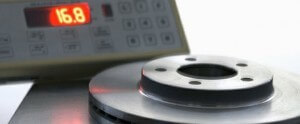
Premium quality brake rotor
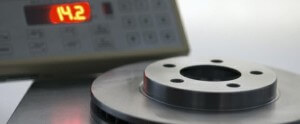
Notice how much lighter the economy version is than the image on the left
Brake Economy Rotors Use Straight Cooling Vanes
The heat generated by friction must be removed quickly during braking to avoid brake fade and rapid brake pad deterioration. The heat can be removed by convection, radiation, or conduction. Of the three, convection is the most efficient for automotive use, where the heat is carried away by airflow. To move air to cool the rotor, car makers use a variety of cooling vane designs to sweep air into the center of the brake rotor and fan it out to the edges. The vane designs are application-specific by vehicle model and vehicle weight. Here are some common vane designs:
Replacing your factory brake rotors with the EXACT vane design is CRITICAL to proper brake operation and longevity. If you purchase an economy brake rotor with fewer vanes or straight vanes where the factory used curved or staggered vanes, you’ll get less cooling and a much higher chance of early brake failure.
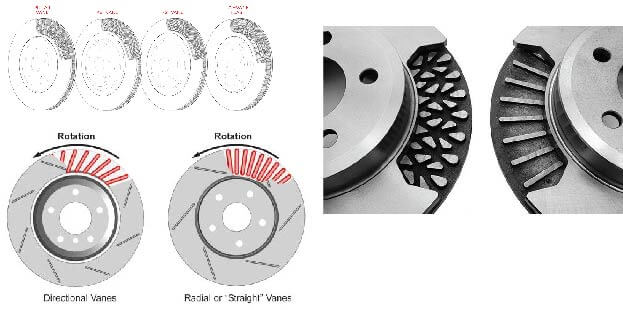
High quality discs duplicate the factory cooling vane design
The Swept plate thickness matters
To cut costs and reduce cooling times, economy brake rotors are designed with thinner swept plate thickness. The thinner plates reduce overall braking mass and result in higher temperatures. Although thinner plates allow for more vane air movement, if the aftermarket rotor uses straight vanes as opposed to curved or staggered vanes, the increased area still can’t make up for the lower air movement. So you get rotor overheating and brake pad failure.
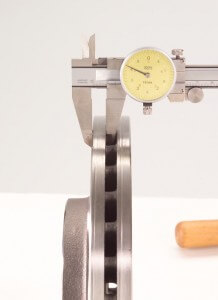
This is the OEM friction plate thickness. Compare it to the image on the right. The difference is noticeable.
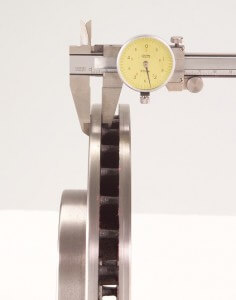
Notice the thinner friction plate on this economy version
Major brake parts manufacturers report that economy rotors can weigh almost 20% less than the OEM version of the same brake rotor.
Brake rotor cost
Now let’s take a look at the difference in brake rotor price. These prices are from rockauto.com
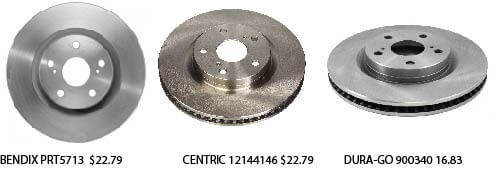
Name brand brake rotor prices versus no-name brake rotors
Conclusion
Economy brake rotors are cheaper because they’re made from cheaper raw materials, using less than optimal manufacturing techniques. They contain less material so they don’t last as long or perform as well and they don’t duplicate the OEM specs for vane design.
Economy rotors will cost more over their life than premium rotors.
©, 2017, Rick Muscoplat
Posted on by Rick Muscoplat