
Buy the Best Socket Set: A Consumers Buying Guide
How to Choose and Buy the Best Socket Set
Whether you’re assembling furniture, repairing your car, or working on household projects, a reliable socket set can make your tasks easier and more efficient. However, with so many options available, choosing the right socket set can be overwhelming. This guide will help you understand the key factors to consider when selecting and buying the best socket set for your needs.
You’ll see many brands and features, and it can be very confusing, so I’ll walk you through the terms and help you pick the best features.
Common Socket Set Components
A good socket set includes several key components that determine its versatility and usability:
• Ratchet Handle— The ratchet handle is the most frequently used tool in the set. Look for a ratchet with a comfortable grip, a high tooth count (at least 72 teeth for finer control), and a quick-release button for easy socket changes.
• Sockets— The number and variety of sockets in the set are crucial. Sockets come in various sizes, typically measured in millimeters (metric) or inches (SAE). A comprehensive set should include both shallow and deep sockets, as well as a mix of common sizes.
• Extensions and Adapters— These tools allow you to reach bolts in tight or awkward spaces. Make sure your set includes a few different lengths of extensions and any necessary adapters to convert between drive sizes.
• Drive Size— Socket sets are categorized by the drive size of the ratchet handle, which is the square fitting that the sockets attach to. Common drive sizes include 1/4 inch, 3/8 inch, and 1/2 inch. A 1/4-inch drive is suitable for light tasks, a 3/8-inch drive is versatile for most jobs, and a 1/2-inch drive is ideal for heavy-duty work.
What is socket drive size?
Socket sets are sold by drive size. That refers to the size of the square drive “tang” that the socket snaps onto. Most socket sets for home use are ¼-in., 3/8-in, and ½-in. drive.
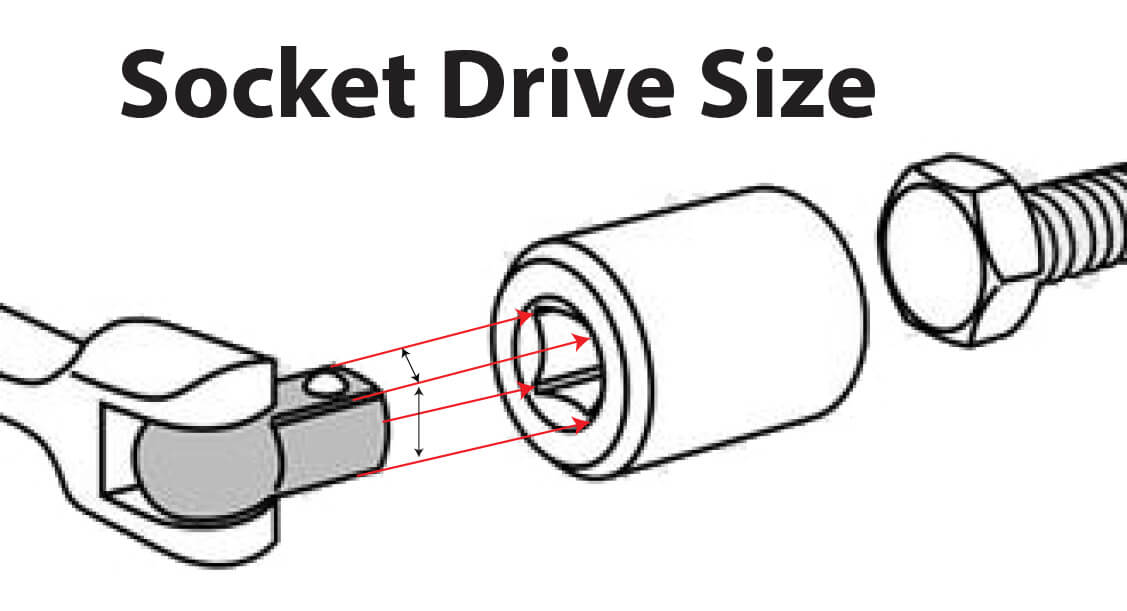 • 1/4″ — Use ¼-in drive sockets for small fasteners or when working in tight places.
• 3/8″ — Use 3/8″ drive sockets for most automotive and outdoor power equipment.
• 1/2″ — Use 1/2″ drive socket when removing or installing large nuts and bolts.
• 3/4″ — 3/4″ drive is used mostly in commercial applications.
The ratchet is one of the most important pieces when you buy a socket set
Aside from socket size marking and point count (more on that later), the ratchet handle is the most important piece of a socket set. Handle length, tooth count, and surface finish rule the day when choosing a ratchet.
The ratchet that comes with most sets is ok if you’re working on small appliances and fasteners that aren’t rusted. But if you plan to work on your car or truck or lawn equipment that short socket just isn’t going to provide enough leverage for the rusted bolts. You need a long-handled ratchet to get more leverage.
Ratchet handle length
Most socket sets come with a 7” ratchet. That doesn’t provide enough leverage for repairs on rusted fasteners. So, you’ll need to supplement the set with at least one long-handled ratchet.
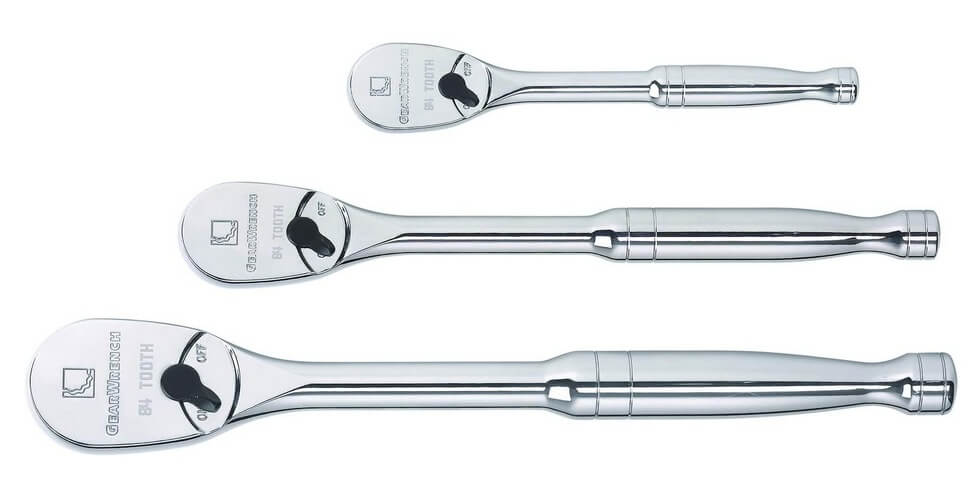
Longer ratchets come in 12”, 18” and 20” lengths. Longer handled ratchets give you more leverage, but also require more working space, so you will need an assortment of sizes.
In addition to the 7′ ratchet that comes with the set, I recommend buying a 12″ ratchet for extra leverage
Ratchet head styles
Ratchets come in two basic head styles: round and teardrop. Round-headed ratchets used to be the standard, but they’re going out of style because the teardrop design offers more advantages.
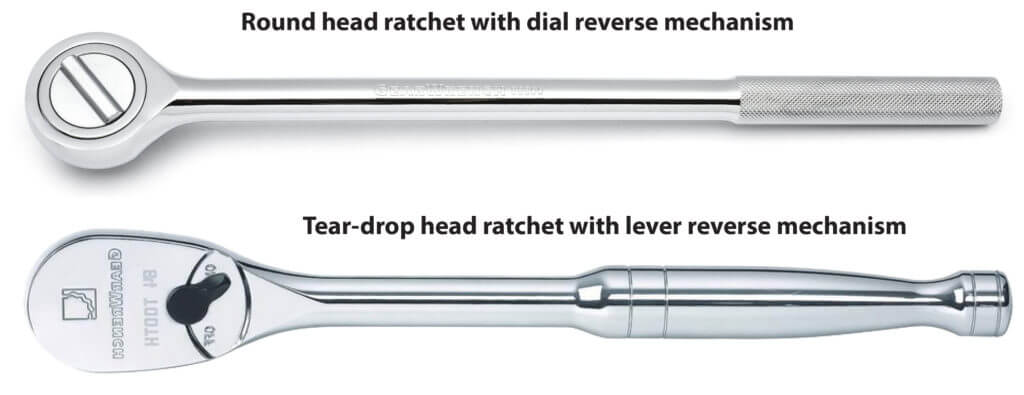
The reversing mechanisms on round-head ratchets are awkward, especially in tight places, because you often can’t reach the dial to change direction when the ratchet is in place. On the other hand, the tear-drop style utilizes a lever that you can operate with your thumb.
The tear-drop style is easy to reverse in tight spaces, which is why I recommend that style over a round-head
Flex head and gimble head ratchets
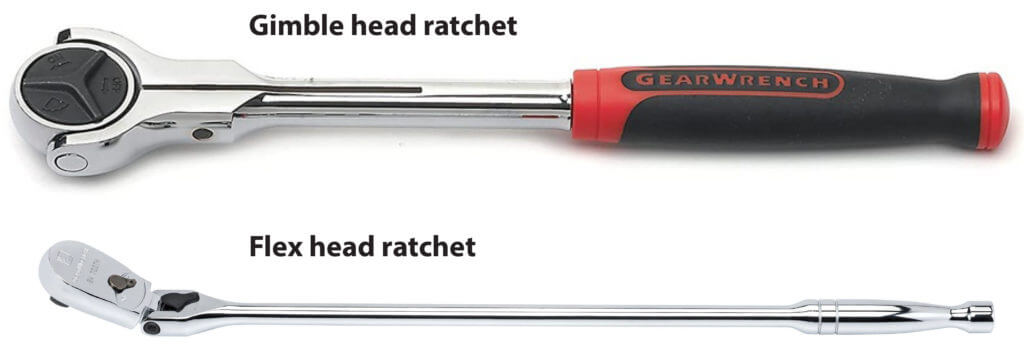
In addition to round versus tear-drop, ratchet heads can have a flex joint or a gimble. Both styles allow you to get into tight places and move the handle away from the fastener.
I recommend a flex head ratchet over a gimble head because it’s more stable, easier to find in stores, and is often cheaper than the gimble head style.
Ratchet head tooth count is critical
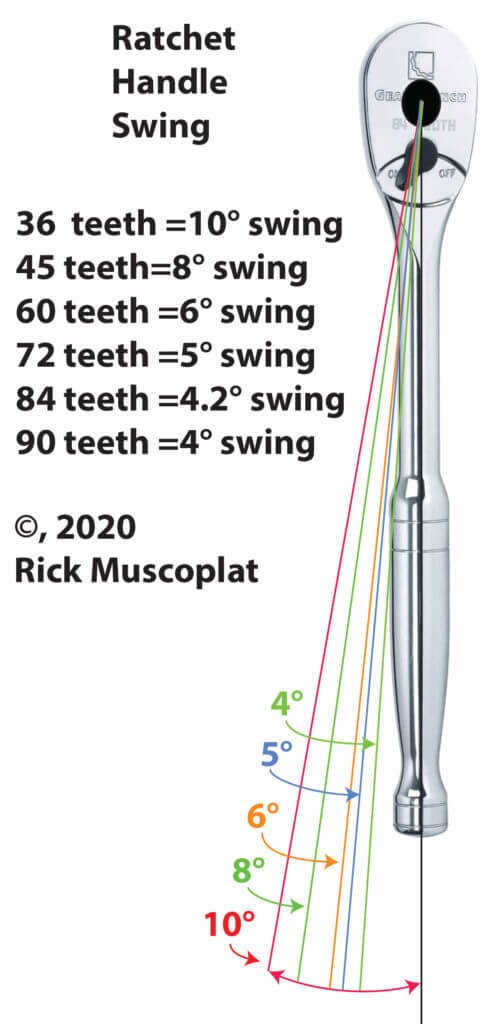
The gear inside the ratchet head has teeth around the circumference. 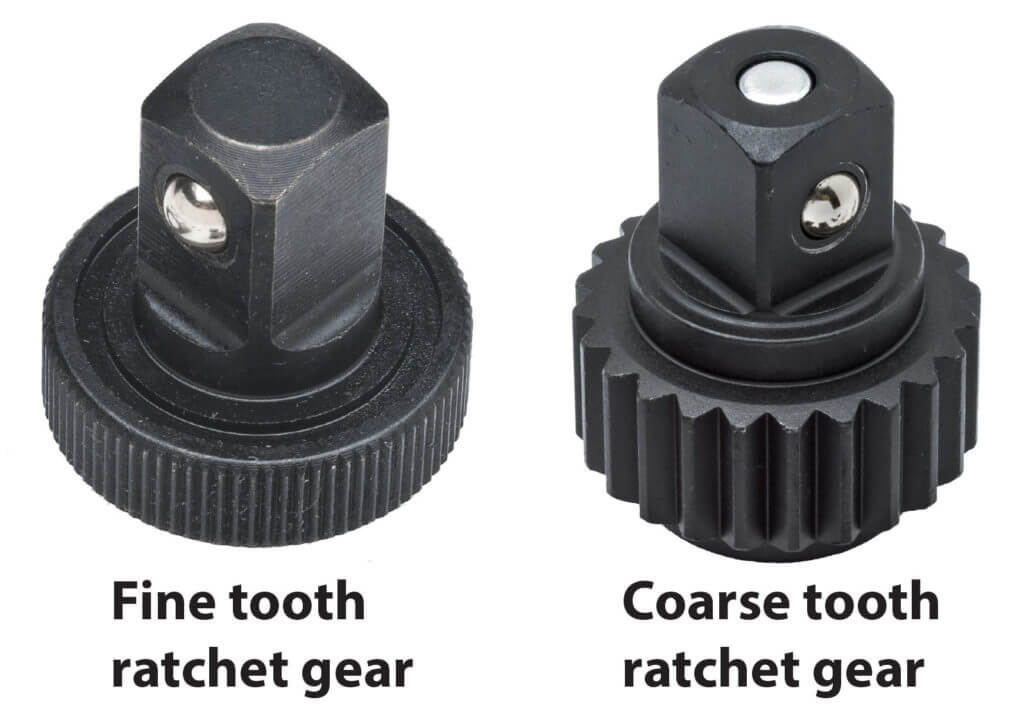 The number of teeth determines how far you can move the ratchet handle to engage the next tooth. Coarse ratchets often have just 24 or 36 teeth, so you must rotate the handle at least 10° to engage the next tooth.
That can be a real challenge in an engine compartment or deep inside your clothes dryer. On the other hand, fine tooth ratchets have many more teeth, which means you don’t have to swing the handle as far. See the image below to see what a difference the number of ratchet teeth makes
FINE TOOTH Ratchet MYTH Busting
Many DIYers and even some pros think that a fine-tooth ratchet can’t handle as much torque as the same size coarse ratchet. Not true. Even though the teeth on a fine-tooth ratchet gear are smaller than those on coarse-toothed gears, there are many more pawl engagement teeth that spread the torque to multiple teeth. A 3/8″ drive fine-tooth ratchet is tested to the same torque as a 3/8″ drive coarse drive ratchet. Myth busted!
Ratchet handle features
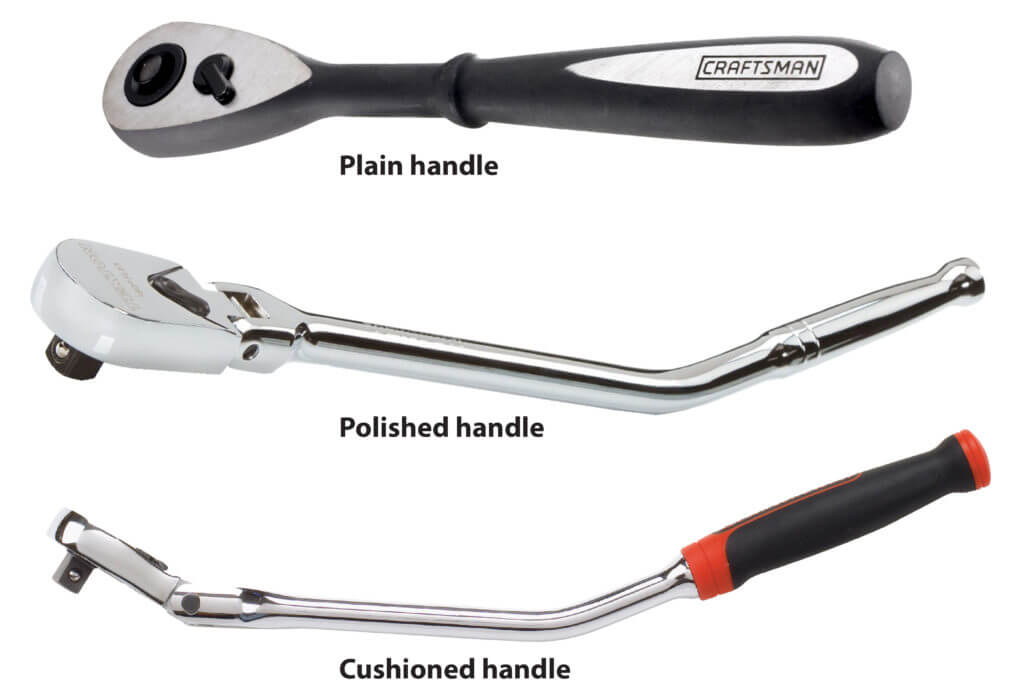
Choose from plain or polished finish, cushioned, or bent ratchets. A plain finish ratchet is harder to clean, requiring a squirt of degreaser to remove dirt and grease, while a polished finish just wipes off. A cushioned grip is a bit easier on your hands but also requires more cleaning. Lastly, a bent handle allows you to move the handle away from obstacles. That’s especially important when you’re working in tight spaces.
Ratchet Quick-release feature
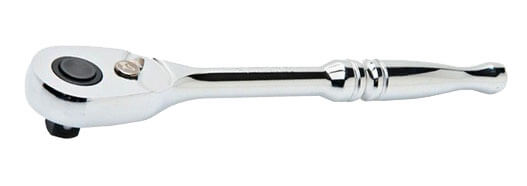
Some ratchet heads include a push-button socket release feature. This works well when you’re working in a greasy environment. Instead of trying to pry a greasy socket off the ratchet, push the button, and the socket falls off.
Quick release ratchet
Socket types
Chrome versus black impact sockets
Sockets come in chrome and impact types. Chrome sockets have thinner walls than impact sockets and can shatter if used with an impact wrench or impact driver.
Chrome sockets can’t be used with power impact tools, only hand ratchets. If you plan to use a battery-powered or air-powered impact driver, buy impact-rated sockets.
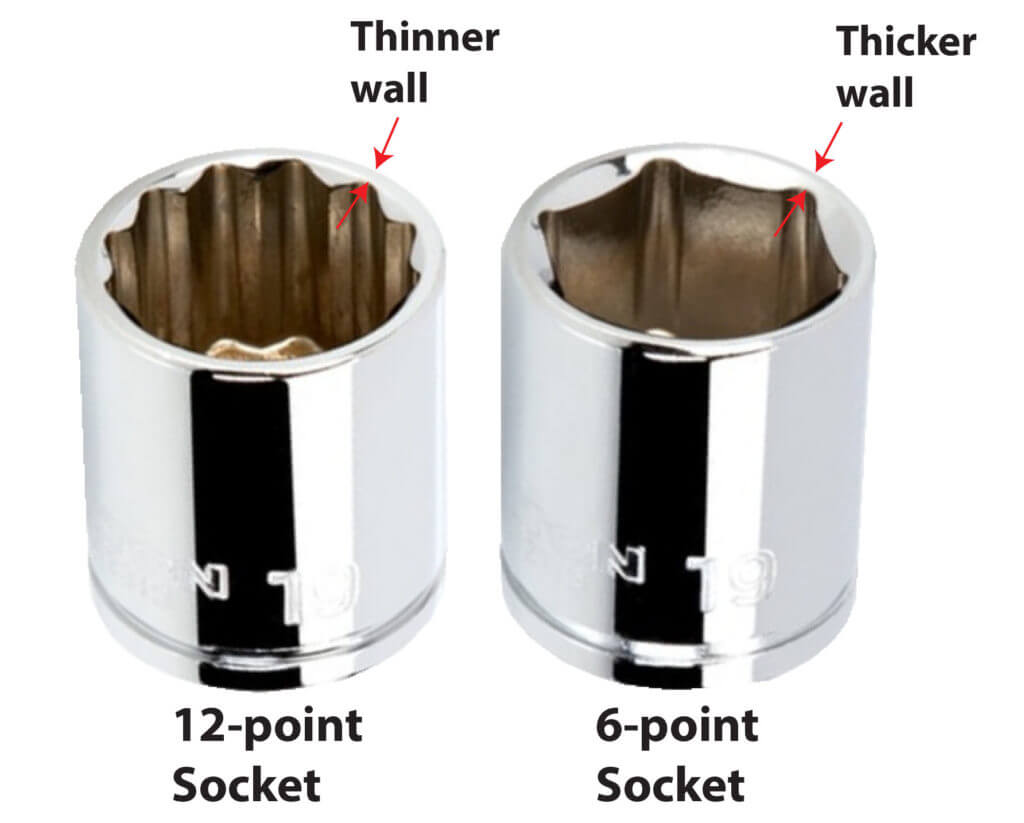
6-point versus 12-point sockets
In addition to chrome and black impact, sockets have 6, 8, or 12 “points of contact” inside the socket. 8-point sockets are used to install and remove square nuts and bolts. Since most modern fasteners are hexagonal, you’ll rarely, if ever, need 8-point sockets unless you’re working on very old homes.
Socket manufacturers often include 12-point sockets in their sets, but trust me, you don’t want them. The advantage of a 12-point socket is that you only have to rotate the socket 30° to fit it onto a hex fastener while moving a 6-point socket 60°. The downside to a 12-point socket is that they’re far more likely to strip the head of a worn or rusty hex bolt head or nut. Socket manufacturers deny this, but survey any auto tech, and you’ll find they all use 6-point sockets.
Deep versus shallow sockets
You’ll need the depth of a deep socket any time you’re 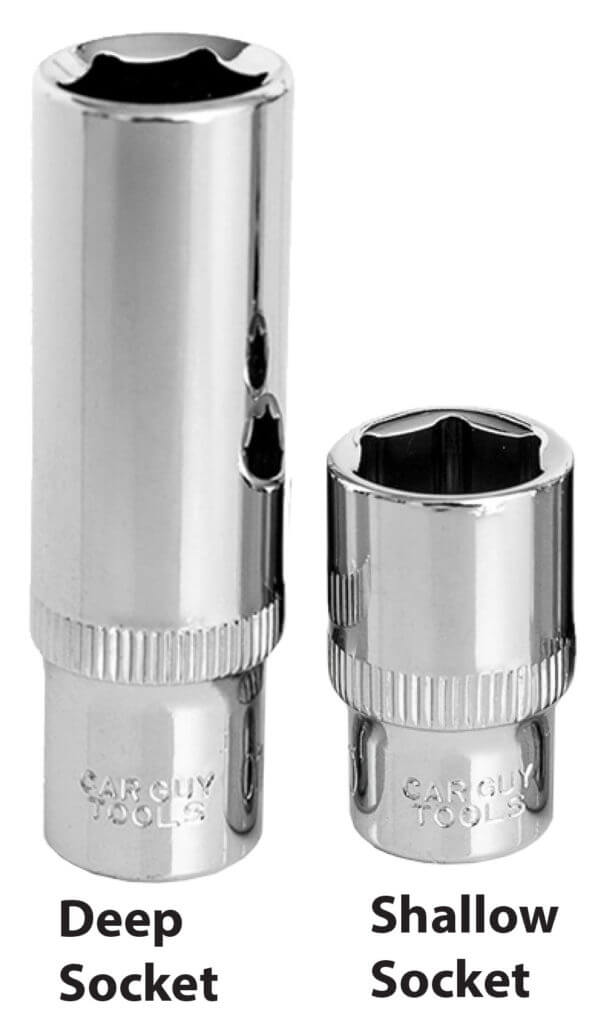 trying to remove a nut from a stud or a bolt with many exposed threads. However, you can also use a deep socket in applications where the extension bar in your socket set is too long. Aside from those two uses, you’ll mostly use shallow sockets.
How many pieces are in the socket set?
Sellers often confuse buyers by adding accessories pieces that you’ll rarely use to boost the perceived size of the socket set. They do that to create the illusion that the increased piece count is a better set. For example, they’ll add flat, Torx, hex, and Philips screwdriver bits. They’re nice to have, but chances are you already have them. Plus, when it comes to socket sets, having the widest range of socket sizes is what’s most important, NOT whether the set includes accessory bits. What good is an extra Philips bit if the set doesn’t have the socket of the right size for the job?
In other words, when it comes to socket set piece count, the number of sockets is the only number that counts. NOT the accessories.
What are the best socket set brands?
Most consumer-grade socket sets are made in Taiwan or China. But there are cheap sets and high-quality sets. What’s the difference? The quality of the finish, the size markings on the sockets, the degree of precision in the ratchet, and the warranty and how you obtain warranty service. Some brands offer an over-the-counter exchange for a broken socket, while others make you mail the defective socket back to the manufacturer.
Here are the socket set brands I like:
Gearwrench
Kobalt
DeWalt
Stanley
Husky (made by Stanley)
What about Harbor Freight Socket Sets?
I own Snap-On, Craftsman, S&K, Matco, and Harbor Freight sockets. The Harbor Freight sockets work just fine, even though they’re the cheapest. But I hate their HF series ratchets. I find their ratchet mechanisms to be rough and hard to reverse. They bind up. I hate them. If you buy Harbor Freight, buy just their sockets and buy ratchets from the companies listed above.
However, Harbor Freight has heard the complaints about their ratchets and now offers an upgraded ratchet under the ICON brand. If feels better and works better than their regular HF series ratchets, but they cost more.
Socket set Warranty
Many socket set manufacturers offer a lifetime warranty, but it usually only applies to the sockets, not the ratchet. To obtain warranty service on a socket, you’ll most likely have to mail it in, which will probably cost more than buying a new socket.
Replacement ratchet parts
Ratchets wear out with daily use and then can get damaged from rust. Many manufacturers offer ratchet rebuilt kits that can put your ratchet back into new condition.
The socket set case is an important consideration when you buy a socket set
This is a tough one because it’s hard to determine the quality of the case when you’re ordering online. Poorly designed cases make you fight to insert and remove the sockets, or they’re so loose that the sockets fall out as soon as you open the case. If possible, try removing and inserting the parts before you buy. If you’re buying online, read the reviews.
©, 2019 Rick Muscoplat
Posted on by Rick Muscoplat