
Car Ramps or Jack Stands: Which is Better?
Choosing Between Car Ramps or Jack Stands for Your Car Maintenance
When it comes to performing DIY maintenance on your vehicle, having the right equipment is essential for both safety and efficiency. Two of the most common tools used to elevate a car for underbody work are car ramps and jack stands. Each has its own set of advantages and drawbacks, making the choice between them important depending on the type of work you plan to do. In this article, we’ll explore the pros and cons of car ramps or jack stands, and help you determine which is better for your DIY maintenance needs.
Which Is Better for DIY Maintenance?
The choice between car ramps and jack stands ultimately depends on the type of maintenance you plan to perform and your personal preferences.
For fluid changes, ramps are the better choice
If you’re doing routine maintenance like oil changes or fluid checks, and don’t need to remove the wheels, car ramps are likely the better choice. They’re easy to use, provide stable support, and are ideal for tasks that don’t require extensive undercarriage access.
For brakes, suspension, steering, or axle repairs, jack stands work best
If you need to work on the wheels, brakes, suspension, or any part of the vehicle that requires it to be lifted higher or fully off the ground, jack stands are the way to go. Their versatility and height adjustability make them indispensable for more involved repairs.
Safety Considerations of car ramps and jack stands
Both ramps and jack stands can be safe if used correctly, but it’s essential to follow all manufacturer instructions and safety guidelines. Always ensure that your vehicle is on a flat, stable surface, and double-check that it’s securely supported before working underneath it.
The Advantages of Car Ramps
• Ease of Use— One of the biggest advantages of car ramps is their simplicity. To use them, you simply drive your car onto the ramps, and you’re ready to work. This eliminates the need for jacking up the car manually, making ramps a time-saver for quick maintenance tasks.
• Stability— Car ramps provide a solid and stable platform, reducing the risk of the vehicle slipping or shifting. Once the car is properly positioned on the ramps, there is little chance of movement, making it safer in some scenarios.
• Weight Capacity— High-quality car ramps are designed to support a significant amount of weight, often more than a standard floor jack or jack stand. This makes them suitable for larger vehicles like trucks and SUVs.
• Ideal for Fluid Changes— Ramps are particularly useful for tasks that don’t require the wheels to be removed, such as oil changes, transmission fluid changes, and exhaust work. The incline also naturally aids in draining fluids from the vehicle.
• Much easier and faster to set up. Just line up 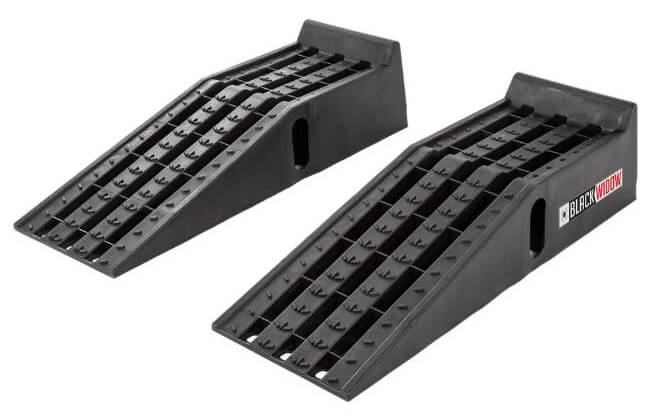 with your tires and drive onto the ramps. You’ll be ready to start working in just minutes.
• Less expensive than jack stands and a floor jack.
• Easier to store. Hand them on the wall so they don’t take up floor space.
Drawbacks of Car Ramps
• Limited Access— Car ramps lift only one end of the vehicle, which can limit your access to certain parts of the undercarriage. This makes them less ideal for jobs that require access to the wheels or suspension components.
• Surface Requirements— Using car ramps requires a flat, stable surface. If you have an uneven driveway or garage floor, ramps can be difficult or unsafe to use. Additionally, driving onto the ramps requires precision, which can be challenging for some vehicles.
• Height Limitation— Car ramps generally don’t provide as much clearance as jack stands. If you need significant undercarriage access, ramps might not lift the car high enough to comfortably work underneath.
• They slide as you’re driving up on them, especially if you’re working on concrete or gravel. You may have to cut blocking lumber to prevent them from moving as you climb the ramp.
• You can overshoot the ramp if you climb too quickly. Then, you’ll need a floor jack to get your vehicle down.
• They may not get your vehicle high enough off the ground to do some repairs, like removing a large component like bottom-removal radiators or transmissions.
• You can’t work on tires, brakes, drive axle, shocks/struts, wheel bearings or any other suspension components because the tires are supporting the vehicle.
• The vehicle must be drivable. In other words, If you have a bad starter that must be replaced from below, and you can’t start the vehicle to move it onto the ramps, you’re screwed.
• They limit access to the midsection of the vehicle. Once your vehicle is on the ramp, the ramp itself extends about halfway down each side of the vehicle, eliminating side access. You must crawl under the vehicle from the front. Also, once you’re under the vehicle, you have limited side-to-side access. Jack stands, on the other hand, to support the vehicle from behind the wheel. So you have more side-to-side clearance.
Jack stands and floor jack
A high-quality floor jack and jack stands offer you the 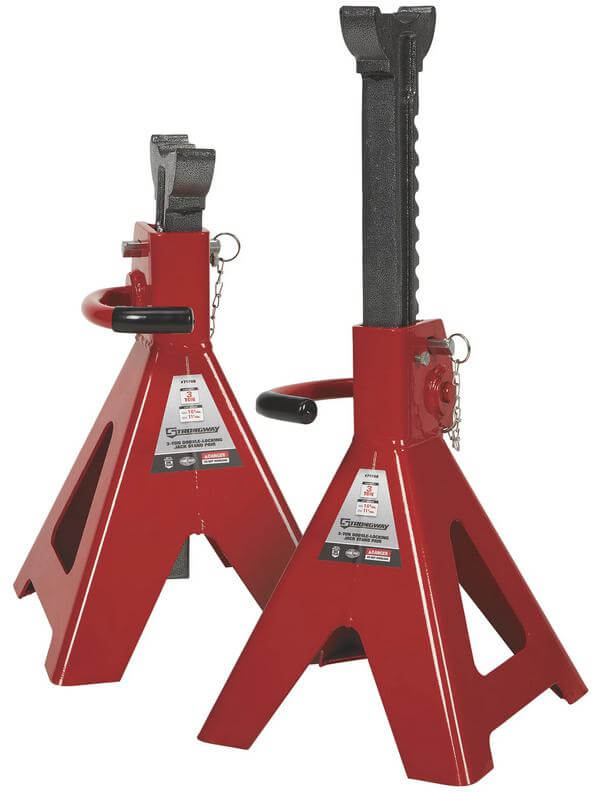 most flexibility to maintain and repair your car or truck. You’ll spend more on high-quality units and I advise you to stand away from the cheaper products. You won’t be happy with them.
Advantages of Jack Stands
• Versatility— Jack stands can be placed under various points of the vehicle, allowing you to lift one or both ends or even all four wheels off the ground. This makes them ideal for a wide range of maintenance tasks, including brake work, tire rotation, and suspension repairs.
• Height Adjustability— Unlike car ramps, jack stands offer adjustable heights, providing more flexibility for different types of undercarriage work. Whether you need a slight lift or significant clearance, jack stands can accommodate your needs.
• Access to Wheels— If your maintenance work requires removing wheels, such as brake or suspension repairs, jack stands are the better option. They allow you to elevate the vehicle while still having full access to the wheels and undercarriage.
• Compact Storage— Jack stands are generally smaller and more compact than car ramps, making them easier to store when not in use. They can be tucked away in a garage corner or on a shelf, freeing up valuable space.
• If you get the right jack, you can raise the vehicle higher than you can with ramps
• Allows you to work on wheels, brakes, and suspension components.
• Allows you to work on your vehicle without moving it.
Drawbacks of Jack Stands
• Setup Time— Using jack stands involves more steps than using ramps. You need to position a floor jack under the vehicle, lift it, and then carefully place the jack stands under the appropriate points before lowering the car onto them. This process can be time-consuming, especially for quick jobs.
• Stability Concerns— While jack stands are generally safe when used correctly, there’s a higher risk of improper setup compared to ramps. If the jack stands are not positioned securely or if the ground is uneven, there’s a risk of the vehicle slipping or falling.
• Weight Capacity— Depending on the model, jack stands may have lower weight capacities than ramps. It’s crucial to ensure that your jack stands are rated to support the weight of your vehicle, especially for heavier trucks and SUVs.
• Costs far more than a set of ramps
• Takes much longer to set up
• Takes up storage floor space in your garage
• Limits you to support the vehicle on factory lift points. If yours are rusted or damaged, that’s going to be a big problem.
• Must be used on a concrete surface or on asphalt with ¾” thick plywood pads under the jack stands and the jack to prevent sinking into the asphalt on hot days. Can’t be used on dirt or gravel
©, 2020 Rick Muscoplat
Posted on by Rick Muscoplat