
Choosing the Best Fuel Stabilizer: A Comprehensive Guide
Choosing the Best Fuel Stabilizer: What You Need to Know
Fuel stabilizers are essential for anyone who wants to ensure that their engine runs smoothly after prolonged periods of inactivity. Whether you’re storing a car for the winter, keeping a boat docked for months, or simply ensuring that your lawn equipment starts up without issue next season, choosing the right fuel stabilizer is crucial. With many options available, selecting the most effective one can be daunting. This guide will walk you through the key factors to consider when choosing a fuel stabilizer, helping you make an informed decision.
What is a Fuel Stabilizer?
A fuel stabilizer is a chemical additive that prevents gasoline from deteriorating over time. Gasoline, especially those containing ethanol, begins to degrade after just 30 days of storage. This degradation can lead to gum and varnish deposits forming in the fuel system, which can clog injectors, carburetors, and fuel lines. A fuel stabilizer works by preventing oxidation, moisture absorption, and the formation of harmful deposits, ensuring that the fuel remains fresh and usable for an extended period, often up to 12 months or more.
What to look for in a fuel stabilizer?
There are two ways to formulate a fuel stabilizer;
1) Formulate it to PREVENT oxidation and water infiltration, OR
2) Formulate it to REMEDIATE the effects of oxidation and moisture infiltration that’s going to happen regardless of how you try to prevent it from happening.
To understand more fully how fuel stabilizers work, see this post
How prevention fuel stabilizer products work (or don’t work)
Products like Sta-Bil, STP, Sea Foam, and Lucas Fuel Stabilizer work under the prevention principle. They contain light petroleum distillates similar to kerosene that float on top of the gasoline to form a seal against air and moisture. Seal the gasoline from contact with the air and moisture, and you keep the gasoline fresh, right? Ah, not so fast.
The floating seal approach works for a while, but since it’s a petroleum-based product, it, too, is subject to oxidation degradation from air in the tank or storage container.
Also, the floating seal only works as long as the fuel is sitting still in the storage container or the gas tank of your power equipment. As you jostle the storage container or gas tank (mowing, chain sawing, week whacking, etc.), the movement breaks the surface tension of the petroleum distillates, exposing the fuel to air and moisture. Air reacts with the fuel, causing gum and varnish deposits to form. Those sticky substances clog carburetor passages, causing no starts and poor performance.
However, even if the fuel sits still in the tank or container, moisture will always condense on the sides during temperature changes. Since the water is heavier than the fuel, it falls to the bottom of the tank, where it enters the carburetor, causing corrosion and clogged passages.
In addition to condensation issues, there’s the phase separation issue. Ethanol absorbs moisture until it reaches its limit, at which point the ethanol and water separate from the gasoline and fall to the bottom of the tank, where it mixes with the condensed water.
There is simply no way to prevent moisture condensation in a storage container or gas tank.
Remediation fuel stabilizer products
Products like K100 Fuel Stabilizer and Star Tron Fuel Stabilizer are remediation products. They assume that there’s really no practical way to prevent moisture condensation or fuel oxidation. Instead, they’re formulated to deal with gum varnish and moisture infiltration.
Remediation products contain emulsifying agents and surfactants to break the water into micron-sized droplets and disperse and suspend the water droplets throughout the fuel. Plus, they contain solvents to dissolve the gums and varnish that form as the result of oxidation.
K100 Fuel stabilizer and Star Tron both break the water into micro-sized droplets and disperse it throughout the fuel. But the K100 product takes the process a step further by bonding a flammable component to the droplets. The bonding creates a flammable outer “shell” that enhances combustibility so the fuel actually works as it should, even though it contains water. The Star Tron product doesn’t coat the water droplets, so the fuel’s combustibility is actually degraded because its filled with water droplets. (Star Tron, feel free to correct me if I’m wrong)
Rick recommends K100 fuel treatment
I take a logical approach to fuel stabilizers. Here are the facts:
• No fuel stabilizer product can prevent moisture 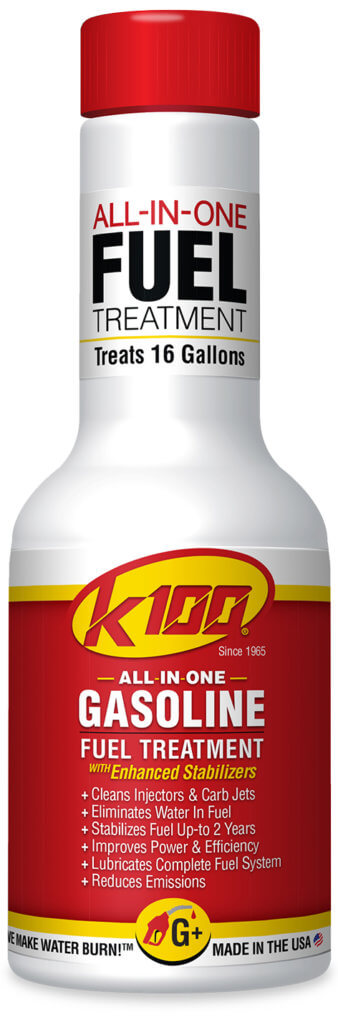 from condensing on the sides of the storage container or gas tank. So there will always be water in the container or gas tank and that water will always fall to the bottom.
• It’s simply unrealistic to think that the gasoline is going to remain still in the gas tank, so any time there’s movement, the fuel is going to mix with air and oxidize and form gum and varnish deposits.
• Prevention products ignore water at the bottom of the tank and gum and varnish formation.
That’s why I prefer the K100 Fuel Stabilizer product; because it’s formulated to remediate water and oxidization issues in gasoline
• K100 Prevents Phase Separation in Ethanol Blended Gasoline by breaking water into micron-sized droplets and encapsulating them with a flammable outer shell that makes the fuel burn better even though it contains water.
• Reverses phase separation in old gas
• Increases Octane/Cetane ratings by 1 ½ to 2 points
• Stabilizes fuel for up to two years
• Replaces lost lubricity in LSD, ULSD and K-1 winter blends
• The cleaning solvents in K100 keep fuel systems clean for better mileage, easier starts, smoother idle, more power, and better acceleration
©, 2022 Rick Muscoplat