
Choosing the Best Serpentine Belt Brand: What You Need to Know
The Ultimate Guide to Finding the Best Serpentine Belt Brand
A good serpentine belt ensures the belt drive system functions efficiently and lasts the longest, while a poor-quality belt can lead to breakdowns and costly repairs. Here’s a guide to help you select the best serpentine belt brand for your needs.
Don’t assume all serpentine belt brands sare the same
They’re not. Many companies sell serpentine belts. But what’s the best serpentine belt brand? Well, some companies manufacture the brands they sell, while others simply private label and resell belts made by other companies.
Why is serpentine belt quality so important?
If you stare at the pulleys on a running internal combustion engine, you’ll swear that the engine is rotating smoothly. It’s not. An internal combustion engine runs in power pulses, each pulse resulting from a combustion event. Every time there’s a power pulse, the power transmits to the belt, and the belt transmits the power to every driven component. Between power pulses, the driven components tend to slow down, placing a drag on the belt. The alternator rotor, for example, weighs about 10 lbs and causes significant drag on the serpentine belt between each power pulse. The AC compressor causes a different kind of stress as the AC compressor clutch cycles on and off. So, there’s always a pull/drag movement in the belt.
Each power pulse and drag event stresses the tensile cords in the belt, like snapping a rope and then releasing it. That pull/drag event causes the belt to vibrate. In addition, the pulses wear the micro “V” sections in the belt. A low-quality serpentine belt wears out faster, produces more noise, transmits more power pulse vibration to the driven components, and prematurely wears out the automatic belt tensioner.
To understand how a belt tensioner dampens power pulses, click here.
How are serpentine belts manufactured?
Early serpentine belts were made with neoprene rubber with polyester tensile cords molded in the middle like a peanut
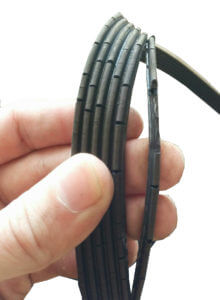
Torn/worn water pump belt
butter sandwich. Neoprene rubber tends to age when heated. The heat causes the rubber to crack. For decades, DIYers and shop technicians judged the condition of serpentine belts based on how many cracks they found in the belt ribs. Neoprene serpentine belts last about 30,000 miles.
Starting around the 2000 model year, car makers switched to serpentine belts made with ethylene propylene diene monomer (EPDM) rubber. EPDM belts don’t crack, are quieter, and reduce noise and vibration transmission. They last almost 100,000 miles. But they do wear, and you can’t judge the condition of an EPDM belt visually. You must use a wear gauge. See this post
What are the major serpentine belt brands
Gates, Dayco, Continental and Bando
Are there different quality levels?
Yes. Neoprene belts are the lowest quality. EPDM belts are a step up. EPDM belts with Aramid tensile cords are at the top of the line. Armid tensile cords further reduce pulse stretch, noise and vibration transmission.
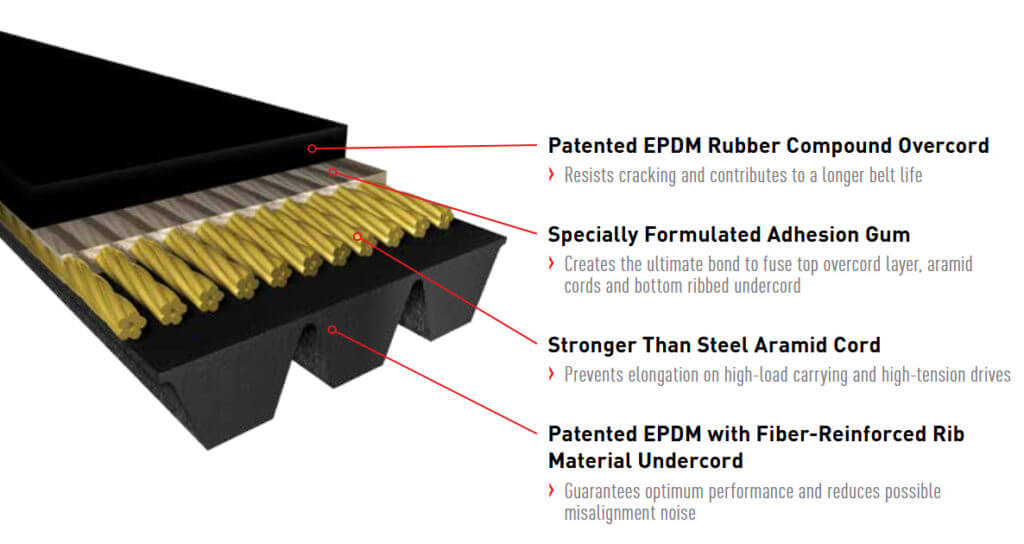
Gates aramid serpentine belt
Rick’s picks for best serpentine belt brand
I think Gates aramid and Dayco aramid belts are the highest quality belts. Gates and Dayco aramid belts cost about $6 more than a comparable EPDM belt with polyester tensile cords. I think they’re worth it.
If Gates and Dayco aren’t available, choose Bando or Continental. My advice is to avoid all private label store brands. Who knows who makes them? Who knows what they’re made of?
©, 2018 Rick Muscoplat
Posted on by Rick Muscoplat